
Yes, scoliosis can sometimes contribute to a pinched nerve, especially in adults or in more severe curves. This can happen when changes in spinal alignment reduce space around a nerve root, leading to symptoms such as radiating pain, tingling, numbness, or weakness. Symptoms of a pinched nerve can be felt far from the affected nerve. Nerve-related pain can be an important symptom in some adults with scoliosis, particularly when nerve roots are irritated or compressed.
A pinched nerve occurs when there is not enough space around the nerve, causing nearby tissues or bones to place pressure on it. Pinched nerves are caused by tissue, muscles, tendons, and/or bones pressing on a nerve. Scoliosis can cause a pinched nerve if the spine’s unnatural curve and rotation is impinging on a nerve root where it exits the spine and/or compressing the spinal cord.
Scoliosis can become more compressive after growth stops, which is one reason nerve-related pain is more commonly reported in adults than in children.
Scoliosis and Pinched Nerves
The term pinched nerve is often used interchangeably with compressed nerve, but they differ slightly. A pinched nerve is a localized issue with symptoms more isolated to the affected nerve and its immediate surroundings; a compressed nerve involves spinal cord compression and is more of a whole-body problem (1).
Scoliosis can contribute to pinched nerves in a few ways. The spine’s unnatural curve and twist can cause the openings the nerve roots pass through to narrow, applying direct pressure to the nerve root where it exits the spine (2).
Uneven pressure on the spinal discs can also contribute to nerve pain. When the spine curves unnaturally, the discs that sit between vertebrae (bones of the spine) are exposed to uneven weight and pressure. This can cause disc degeneration and disc material to press on a nearby nerve root and irritate it (2).
As a structural spinal condition, the spine’s unnatural curve can also stretch nerves on the outside of the curve, exposing them to adverse tension that can impact blood flow and nerve function (2).
Scoliosis can also cause nerve irritation by uneven wear and tear on the facet joints (3). The facet joints are small hinge-line connections between vertebrae that stabilize the spine and shape its movement. The spine’s disrupted mechanics can cause uneven wear and tear on the facet joints, contributing to facet joint arthritis, inflammation, and in some cases, bone spurs that take up more space in and around the spine and can press on nearby nerves (2, 3).
There are 31 pairs of spinal nerves that exit the spine and travel to different areas of the body, and in order for the nerves to function optimally, they need space; a pinched nerve can cause irritation, inflammation, and damage (1). Nerve compression usually happens when a nerve has to pass through a tight space, such as the spinal cord passing through the spinal canal (1).

If the spinal cord is being compressed, nerve compression can be severe, but where the spinal nerves exit the spine is the most common site for pinched nerves (4).
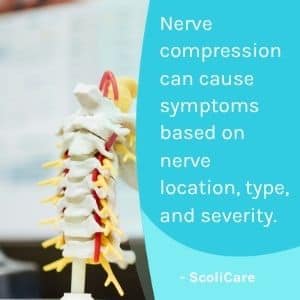
If nerve compression is occurring inside the spinal cord, or where nerve roots exit the spine, the excess pressure can cause a number of symptoms, shaped largely by the nerve’s location, role, and severity (3).
Scoliosis can cause compression of nerve roots and/or the spinal cord because it causes an abnormal spinal curvature with rotation to develop, but root compression is more common, and patient age and severity is an important factor when it comes to scoliosis and nerve health.
Patient Age and Compression
It’s important to understand that while nerve compression isn’t a common part of childhood scoliosis, because scoliosis is progressive, it can change over time (5). If scoliosis is progressing, the spine’s unnatural lateral curve and rotation is becoming more severe, and this can cause increasing symptoms that become more noticeable and disruptive over time.
And because growth is the main trigger for progression in children, scoliosis, and its related symptoms, can change quickly during growth spurts (5).
Young patients who haven’t reached skeletal maturity are constantly growing, and the spine’s lengthening motion during growth can counteract some of the compressive force of the spine’s unnatural curve and rotation, and this is one cause of nerve pain being more common in adults than children (6).
While severe pain isn’t considered a main symptom of childhood scoliosis, in severe cases and/or typical cases caused by neuromuscular disorders (neuromuscular scoliosis), children can also experience nerve compression and pain (7).
Adult Scoliosis
It’s a common scenario that adolescent idiopathic scoliosis, the most common type of scoliosis, goes undiagnosed and untreated until growth stops and symptoms increase, leading to assessment and diagnosis; this is why adults are most affected by preexisting cases of idiopathic scoliosis from adolescence (5, 6).
As mentioned, nerve pain is more common in adults, and if the scoliosis continues progressing, the spine becomes more rigid, causing stiffness, localized back pain, and nerve-related back and body pain caused by a pinched nerve(s) (6).
Degenerative scoliosis develops later in life as adult onset scoliosis, and because it’s caused by degenerative instability, most cases of degenerative scoliosis are progressive, involve severe back pain, and can involve pinched nerve symptoms (2, 6).
Degenerative disc disease is a common cause of nerve pain because it causes changes to disc health, function, and shape, and disrupts the spine’s structural support; if a disc is degenerating, it can cause too much pressure on a nerve and chronic pain (2).
Back/nerve pain is the main symptom of adult scoliosis, and it’s important to understand that increasing pain should be assessed, as it may be related to curve progression, nerve irritation, degenerative changes, or another spinal issue.
Symptoms of a Pinched Nerve
Pinched nerve symptoms involve changes to how the nerve functions and can include pain, tingling sensations, numbness, weakness, and is commonly felt in the neck, arms, hands, legs, and feet (1).
Scoliosis can develop in any of the spine’s main sections (the cervical, thoracic, and lumbar spine), disrupting its healthy curve and balance, and depending on the type of nerve and its location, pinched nerve symptoms can vary.
If the spine has lost its natural curves, it can cause widespread effects, but the direct effects are largely felt in and around the spinal section with the unhealthy curve and surrounding nerves.
Nerve Compression and Lumbar Scoliosis
If scoliosis develops in the lumbar spine, sciatic nerve pain is a common complication. If the sciatic nerve is pinched where it exits the lumbar spine, sciatic nerve pain can develop anywhere along the sciatic nerve’s extensive pathway: lower back, hip, buttock, leg, and foot (8).
Because the sciatic nerve is a mixed nerve containing both sensory and motor fibers, if it’s pinched, it can affect sensation and movement (8). A pinched sciatic nerve, because it’s located in the lower back, will largely affect the lower body (8).
Scoliosis sciatica symptoms can include sharp burning sensations down one side of the lower body, shooting sensations, numbness, tingling, lower back pain, leg pain, and muscle weakness in the affected leg and/or foot (8).
Prolonged sitting can increase sciatic nerve pain because it means more pressure on the nerve, and movements that involve flexing the spine can further irritate the sciatic nerve (8).
Nerve Compression and Thoracic Scoliosis
If scoliosis develops in the thoracic spine, it’s disrupting the largest spinal section’s alignment in the middle/upper back.
Thoracic scoliosis is the most common location, and because the middle/upper back directly connects to the rib cage, it can cause more rotation in the vertebrae, and thoracic curves are also the most likely to progress quickly (5).
Nerve roots that are pinched where they exit the thoracic spine can cause localized radiating pain that extends around the rib cage and into the chest.
Nerve Compression and Cervical Scoliosis
A healthy cervical spine is needed to properly support the weight of the head and the neck’s range of motion (9).
If scoliosis develops in the cervical spine, cervical radiculopathy can occur, and pinched nerve symptoms can include muscle weakness, numbness, tingling, and sharp burning pain that radiates from the neck into the shoulder, arm, and hand (9).
Because scoliosis becomes more compressive when growth stops, in adults, scoliosis may sometimes contribute to nerve root irritation or compression. Spinal cord compression is less common but requires prompt medical assessment, whereas postural changes (uneven shoulders and hips) are considered the primary childhood scoliosis symptoms (9).
If you have radiating pain, numbness, tingling, weakness, changes in walking, or symptoms that are worsening, a medical assessment can help identify whether a nerve is involved and what care may be appropriate.
Conclusion
Can scoliosis cause nerve pain? Yes, it can, but scoliosis nerve pain is more closely associated with severe scoliosis and/or adult degenerative scoliosis.
While not all cases of adult scoliosis involve severe nerve pain and radiculopathy, because scoliosis is progressive, its severity and effects can change over time.
The goal of a proactive nonsurgical treatment plan is to avoid increasing severity and symptoms which can include radiating pain due to pinched nerves.
There are no treatment guarantees, but when scoliosis is diagnosed early and treated proactively, it can be highly treatable, and knowing the early signs of nerve compression can help with diagnosing and treating nerve damage proactively, before permanent damage occurs.
At ScoliCare, assessment and care planning consider the spinal curve, posture, muscle function, symptoms, and any signs of nerve involvement so treatment can be tailored to the individual.
Find Your Nearest Clinic
ScoliCare Clinics, affiliates and product providers are in over 200 locations around the world. Find your nearest ScoliCare location here.


References:
- National Research Council (US) Steering Committee for the Workshop on Work-Related Musculoskeletal Injuries: The Research Base. Work-Related Musculoskeletal Disorders: Report, Workshop Summary, and Workshop Papers. Washington (DC): National Academies Press (US); 1999. Biological Response of Peripheral Nerves to Loading: Pathophysiology of Nerve Compression Syndromes and Vibration Induced Neuropathy. Available from: https://www.ncbi.nlm.nih.gov/books/NBK230871/
- Kotwal S, Pumberger M, Hughes A, Girardi F. Degenerative scoliosis: a review. HSS J. 2011 Oct;7(3):257-64. doi: 10.1007/s11420-011-9204-5. Epub 2011 Jun 11. PMID: 23024623; PMCID: PMC3192887
- G Bisson D, Lama P, Abduljabbar F, Rosenzweig DH, Saran N, Ouellet JA, Haglund L. Facet joint degeneration in adolescent idiopathic scoliosis. JOR Spine. 2018 May 24;1(2):e1016. doi: 10.1002/jsp2.1016. PMID: 31463443; PMCID: PMC6686828
- Khan YS, Lui F. Neuroanatomy, Spinal Cord. [Updated 2023 Jul 24]. In: StatPearls [Internet]. Treasure Island (FL): StatPearls Publishing; 2026 Jan-. Available from: https://www.ncbi.nlm.nih.gov/books/NBK559056/
- Menger RP, Sin AH. Adolescent Idiopathic Scoliosis. [Updated 2023 Apr 3]. In: StatPearls [Internet]. Treasure Island (FL): StatPearls Publishing; 2026 Jan-. Available from: https://www.ncbi.nlm.nih.gov/books/NBK499908/
- Trobisch P, Suess O, Schwab F. Idiopathic scoliosis. Dtsch Arztebl Int. 2010 Dec;107(49):875-83; quiz 884. doi: 10.3238/arztebl.2010.0875. Epub 2010 Dec 10. PMID: 21191550; PMCID: PMC3011182
- Zaina F, Marchese R, Donzelli S, Cordani C, Pulici C, McAviney J, Negrini S. Current Knowledge on the Different Characteristics of Back Pain in Adults with and without Scoliosis: A Systematic Review. J Clin Med. 2023 Aug 9;12(16):5182. doi: 10.3390/jcm12165182. PMID: 37629224; PMCID: PMC10455254
- Koes BW, van Tulder MW, Peul WC. Diagnosis and treatment of sciatica. BMJ. 2007 Jun 23;334(7607):1313-7. doi: 10.1136/bmj.39223.428495.BE. PMID: 17585160; PMCID: PMC1895638
- Margetis K, Magnus W, Mesfin FB. Cervical Radiculopathy. [Updated 2025 Aug 6]. In: StatPearls [Internet]. Treasure Island (FL): StatPearls Publishing; 2026 Jan-. Available from: https://www.ncbi.nlm.nih.gov/books/NBK441828/
More news
-
 27 January 2026
Scoliosis can cause back and leg pain from spinal misalignment, muscle imbalance, or nerve compression—severity and symptoms vary by case.
-
 25 October 2023
Back pain in patients with scoliosis is quite prevalent. It is also possible that patients with scoliosis present with specific features of low back or leg pain. ScoliCare Head of…
-
 21 September 2022
By Ella Bourne - Chiropractor Background Idiopathic Scoliosis is the most common spinal deformity in adolescents, with established prevalence 2-3% in adolescents (1). The estimated prevalence of lower back pain…