Scoliosis can be complex to treat; there are no two cases the same, so a generic treatment plan can’t correct scoliosis for long-term sustainable treatment results. And as a progressive condition, the nature of scoliosis treatment is ongoing.
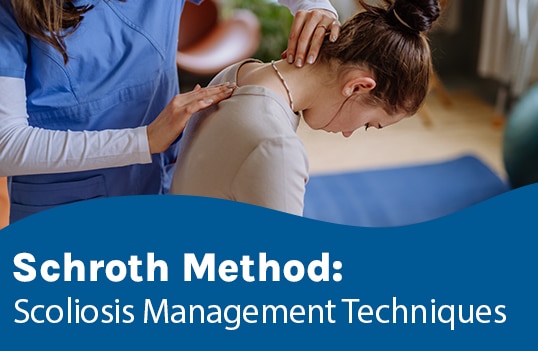
Scoliosis causes the spine to bend and rotate unnaturally, and the Schroth method originated as a nonsurgical scoliosis-specific exercise program that’s designed around a patient’s specific curve type, pattern, severity, posture, rotation, experienced symptoms, and ability.
Before exploring the place of scoliosis-specific exercise in non surgical treatment, let’s talk generally about scoliosis.
Scoliosis
Scoliosis causes the spine to bend unnaturally to the side, and as the spine also twists, the rotation makes scoliosis 3-dimensional, and treatment needs to address it as such for any type of corrective potential.
As a progressive condition, the nature of scoliosis is to increase in severity, and it’s growth that triggers the scoliosis to advance (1).
There are a number of factors that shape a patient’s rate and level of progression: condition type, severity, curve type, location, and patient age.
Growth spurts trigger progression, so children are the most at risk for rapid advancement due to the rapid and unpredictable nature of growth spurts, particularly during puberty; adolescent idiopathic scoliosis is the most common form of scoliosis and is diagnosed between the ages of 10 and 18, most often at the onset of puberty (1, 2).
Scoliosis can be mild, moderate, severe, or very severe, and while progressive, it can be highly responsive and treatable, particularly with early diagnosis and intervention.
And when a diagnosis of scoliosis is given, the most important decision a patient has to make is the type of treatment to commit to; as a progressive condition, scoliosis treatment has to be ongoing, but scoliosis can be highly treatable.
When it comes to scoliosis treatment options, the two main choices are surgical treatment or nonsurgical treatment, and here at ScoliCare, the focus is on restoring the spine and body’s balance and alignment through the integration of nonsurgical scoliosis-specific treatment options.
The Schroth Method
So how can a scoliosis-specific exercise program address scoliosis?
The amount of variability within scoliosis cases in terms of condition severity, types, symptoms, curve pattern, and more necessitate the customization of treatment plans.
While no corrective movements on their o
wn will be enough to impact scoliosis on every level, nonsurgical treatment values integration, and the Schroth method is combined with additional treatment disciplines as part of the ScoliBalance® program (3).
Evidence shows us that therapists trained in the Schroth method don’t tend to stick to just the Schroth method; they combine multiple methods (4). The ScoliBalance program is designed to ensure the therapists harness the benefits of corrective breathing based on Schroth principles for the patients that are likely to benefit from this the most.
Corrective Scoliosis-Specific Exercises
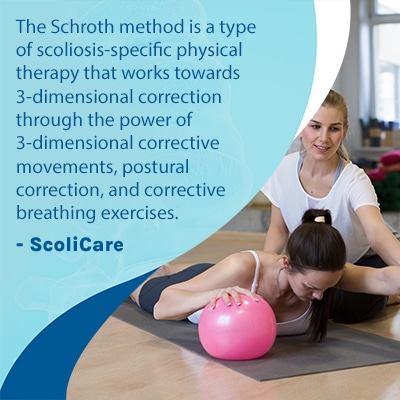
The Schroth method is a type of scoliosis-specific physical therapy that works towards 3-dimensional correction through the power of 3-dimensional corrective movements, postural correction, and corrective breathing exercises (3).
The method involves a comprehensive initial evaluation so the specifics of each patient’s scoliosis, severity, type, posture, curve type, angle of rotation, and location are addressed.
Once a treatment plan is fully customized, patients are taught a series of scoliosis-specific exercises tailored to improve the spine’s rotation and asymmetry.
The ScoliBalance program incorporates a variety of methods, including Mirror Image® exercises (3) and the Schroth based methods of corrective breathing (4), which are adapted to suit each specific patient. No two programs are the same. The program is designed for each patient to teach postural awareness for postural correction. The exercises
are initially taught in-Clinic, and as patients become more confident and capable, they can also be performed from home to sustain treatment results and further stabilize the spine (3, 4).
Scoliosis patients need to be mindful of how they hold their spines and bodies during movement and rest as body positioning and posture can help counteract the spine’s unnatural curve and rotation.
Postural Correction
A spine that doesn’t have its natural curves in place is one that’s off-balance, and this can cause the entire body to become misaligned.
Schroth exercises have the potential to improve the body’s posture and alignment, and when patients understand the benefit and can perform them as prescribed, they can apply these corrections to daily life to help correct the scoliosis (5).
Chronic poor posture can expose the spine to adverse spinal tension and cause uneven wear and tear, and it can also affect the spine’s surrounding muscle endurance, strength, and balance.
Restoring a healthy upright posture means the spine is being held in a neutral and aligned position, and this helps ensure the spine isn’t being exposed to uneven forces, and the spine’s surrounding muscles are strong and balanced
for more spinal support and stability.
Corrective Breathing Techniques
In addition to the power of scoliosis-specific exercises and postural restoration, Schroth therapy also teaches corrective breathing techniques to further influence curve progression and size (4).
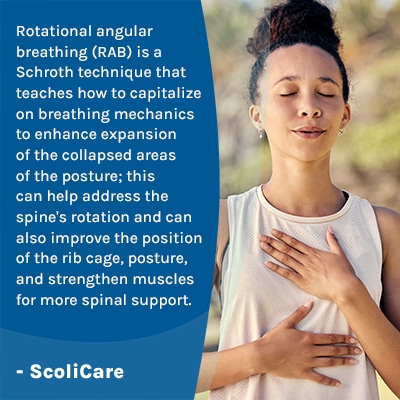 “Rotational angular breathing (RAB) is a Schroth technique that teaches how to capitalize on breathing mechanics to enhance expansion of the collapsed postural spaces; this can help address the spine’s rotation and can also improve the position of the rib cage, posture, and strengthen muscles for more spinal support.” (3).
So as you can see, Schroth therapy is a three dimensional treatment plan that aims to impact scoliosis in different ways: through scoliosis-specific exercise to postural awareness, correction, and corrective breathi
ng techniques (6).
And when the Schroth method is combined with the potential of other facets of scoliosis treatment, results can be further specified and corrective, and this is where ScoliBalance® has emerged as a leading scoliosis-specific exercise program (3).
ScoliBalance®
There are over 200 ScoliCare Clinics around the world, and patients benefit from a proactive nonsurgical scoliosis treatment plan that’s customized and corrective.
ScoliBalance® was designed by Dr. Jeb McAviney and Rose Mirenzi. Dr. Jeb McAviney is, a scoliosis specific chiropractor trained and experienced in Chiropractic BioPhysics® (CBP), Schroth therapy, and the Sc
ientific Exercises Approach to Scoliosis (SEAS) (3, 4, 5, 6, 7). Rose Mirenzi is a physical therapist who is trained in the Schroth method, SEAS method and Lyon method.
Dr. McAviney saw the potential benefit of integrating these different types of treatment for more customized and specific results, and when combined with the power of 3-dimensional corrective bracing, the potential scope of nonsurgical scoliosis treatment increases further. He worked with Ms. Mirenzi to develop a comprehensive rehabilitation and certification program; together, they have trained health professionals worldwide.
The ScoliBalance® program was designed within the guidelines of the International Scientific Society on Scoliosis Orthopaedic and Rehabilitation Treatment (SOSORT) (2) and is applied by a team of highly-trained and experienced Clinicians who are certified in the ScoliBalance® program.
While no treatment results can ever be guaranteed, the ScoliBalance® program, incorporati
ng the best components of the Schroth method, is evidence-based with the potential to slow/stop scoliosis progression, prevent falls in older adults, help reduce curve size, improve the spine and body’s balance, core muscle balance and strength, posture, and pain.
Conclusion
Scoliosis is not new, but we are still learning about how it develops, affects patients, and how to manage it effectively, which is why ScoliCare is at the center of scoliosis research and education.
Although we don’t know what causes most cases of scoliosis to develop initially, we know growth triggers progression, and we know progression makes scoliosis more challenging to treat.
A treatment approach that’s proactive and works towards preventing progression through corrective results has a lot to offer, and ScoliCare Clinicians want to treat patients proactively for a better quality of life.
The Schroth method is a highly-specified scoliosis-specific physical therapy program used to address scoliosis in patients of all ages; it works towards improving body mechanics, posture, breathing patterns, spinal alignment, and balance, while counteracting the spine’s unnatural bend, twist, and slowing/stopping progression.
When ScoliCare Clinicians combine the Schroth method with the power of scoliosis-specific exercise rehabilitation care and corrective bracing, there are fewer limitations to nonsurgical treatment.
Find Your Nearest Clinic
ScoliCare Clinics, affiliates and product providers are in over 200 locations around the world. Find your nearest ScoliCare location here.

References:
- Weinstein, S. L., Dolan, L. A., Cheng, J. C., Danielsson, A., & Morcuende, J. A. (2008). Adolescent idiopathic scoliosis. The lancet, 371(9623), 1527-1537
- Negrini, S., Donzelli, S., Aulisa, A. G., Czaprowski, D., Schreiber, S., de Mauroy, J. C., … & Zaina, F. (2018). 2016 SOSORT guidelines: orthopaedic and rehabilitation treatment of idiopathic scoliosis during growth. Scoliosis and spinal disorders, 13(1), 3
- Marchese R, Du Plessis J, Pooke T, McAviney J. The Improvement of Trunk Muscle Endurance in Adolescents with Idiopathic Scoliosis Treated with ScoliBrace and the ScoliBalance Exercise Approach. J Clin Med. 2024 Jan 23;13(3):653. doi: 10.3390/jcm13030653. PMID: 38337346; PMCID: PMC10856658
- Marchese, R., Ilhan, E., & Pacey, V. (2023). How Schroth therapists vary the implementation of Schroth worldwide for adolescents with idiopathic scoliosis: a mixed methods study. Journal of Clinical Medicine, 12(18), 6063.
- Berdishevsky, H., Lebel, V.A., Bettany-Saltikov, J. et al. Physiotherapy scoliosis-specific exercises – a comprehensive review of seven major schools. Scoliosis 11, 20 (2016). https://doi.org/10.1186/s13013-016-0076-9
- Schreiber, S., Parent, E. C., Moez, E. K., Hedden, D. M., Hill, D., Moreau, M. J., … & Southon, S. C. (2015). The effect of Schroth exercises added to the standard of care on the quality of life and muscle endurance in adolescents with idiopathic scoliosis—an assessor and statistician blinded randomized controlled trial:“SOSORT 2015 Award Winner”. Scoliosis, 10(1), 24
- Harrison, D. E., & Oakley, P. A. (2017). Scoliosis deformity reduction in adults: a CBP® Mirror Image® case series incorporating the ‘non-commutative property of finite rotation angles under addition’in five patients with lumbar and thoraco-lumbar scoliosis. Journal of Physical Therapy Science, 29(11), 2044-2050
More news
-
 31 October 2023
Schroth is a type of physiotherapeutic scoliosis specific exercise (PSSE) prescribed to adolescents with idiopathic scoliosis (AIS). Until recently, no research had been done to explore the actual implementation of…
-
 24 October 2025
Adolescents face rapid scoliosis progression during growth. Early, customized, nonsurgical treatment can help realign the spine and prevent worsening.
-
 15 July 2024
In recent years, patient-centred care has revolutionised the approach to scoliosis treatment by focusing on the unique needs, preferences and values of each patient. This approach places patients at the…