
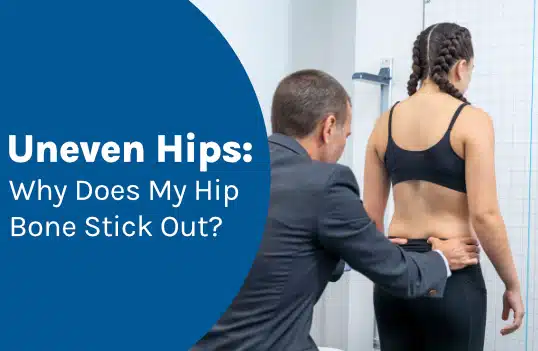
Kyphosis and scoliosis are both spinal curve conditions, but they affect the spine in different ways. Kyphosis usually describes an excessive forward rounding of the upper back, while scoliosis is a sideways spinal curve that also involves rotation. Understanding the difference can help you recognise possible signs and know when an assessment may be appropriate.
Kyphosis and scoliosis are spinal conditions that share some similarities, but also have key differences. Kyphosis is an exaggerated front-to-back spinal curve, and scoliosis is an unnatural sideways spinal curve with rotation.
For patients and families, the key difference is often what the change looks like: kyphosis may appear as a rounded upper back, while scoliosis may show as uneven shoulders, ribs, waist, or hips.
Understanding Kyphosis
Kyphosis can be healthy or unhealthy and refers to the spine’s natural backward spinal curve found in the thoracic spine.
Kyphotic curves can vary in size from person to person without being problematic, but if a person’s kyphosis becomes excessive and doesn’t fall within a typical range, it can disrupt the spine’s balance and stability (1).
Excessive kyphosis is known as hyperkyphosis and causes the thoracic spine to develop an over-pronounced front-to-back spinal curve (1).
Because hyperkyphosis can get worse with growth and/or age-related changes to spinal health, being aware of the early signs to watch for can mean starting treatment before the kyphosis increases and becomes more complex to treat.
Types of Kyphosis
There are also different types of kyphosis to consider, and treatment plans are shaped around a condition’s underlying cause.
Types of hyperkyphosis include postural hyperkyphosis, Scheuermann’s hyperkyphosis, and age-related hyperkyphosis (1).
Postural Kyphosis
Postural kyphosis is usually more flexible than structural kyphosis, so treatment often focuses on posture, strength, mobility, and daily habits. It’s caused by chronic poor posture that, over time, causes the spine’s surrounding muscles, ligaments, and supportive structures to become weak (1).

A lack of structural support can cause hyperkyphosis, particularly in adolescents spending too much time slouching forward looking down at screens.
Physical therapy and lifestyle guidance that works towards improving posture and muscle strengthening are common effective treatment options for postural kyphosis (1).
Scheuermann’s Kyphosis
Cases of Scheuermann’s kyphosis are more complex to treat because the excessive kyphotic curvature of the spine is structural, rigid, and harder to improve.
Scheuermann’s kyphosis is caused by structural abnormalities and can include vertebral bodies not growing uniformly, being misshapen, and/or failing to separate and becoming fused together (1).
When the front portion of several vertebrae are wedged compared with the back, the spine can develop a sharper forward curve (1).
Scheuermann’s kyphosis may require a more comprehensive plan, which can include kyphosis-specific exercise, bracing when appropriate, and other clinician-guided care.
Kyphosis most often occurs during adolescence and can progress during periods of rapid growth. The main symptoms of hyperkyphosis include a rounded-forward posture, middle back pain and stiffness, muscle pain and stiffness, reduced flexibility, fatigue, and difficulty standing upright for extended periods of time (1).
Age-Related Hyperkyphosis
Age-related hyperkyphosis affects older adults and is caused by a lack of muscular support and vertebral compression fractures that can cause the spine to wedge forward (2).
As we age, it becomes more difficult to resist gravity’s downward pull, and this can weaken muscles, ligaments, and supportive structures the spine relies on for stability (2).


Particularly common in menopausal women experiencing bone-density loss, the spine can become less stable and vertebrae are more vulnerable to fractures and shifts in position (2).
Treatment for age-related hyperkyphosis can include kyphosis-specific exercise to increase core strength and improve posture and kyphosis-specific bracing to further support a healthy upright posture and increase spinal stability (2).

Recognising the signs of hyperkyphosis early in older adults is key because postural changes left unaddressed will cause uneven wear and degeneration, making the spine increasingly unstable, and patients vulnerable to injury from a fall (2).
Understanding Scoliosis
Scoliosis is diagnosed if an unnatural lateral curvature of the spine has developed, and a key difference between kyphosis and scoliosis is that scoliosis doesn’t just make the spine curve unnaturally, but also rotates, so scoliosis is a 3-dimensional spinal condition (3).
Scoliosis ranges from mild to very severe. Some curves remain stable, while others can progress, especially during periods of growth or with age-related spinal changes.
Some forms, including adolescent idiopathic scoliosis and Scheuermann’s kyphosis, are often identified around puberty, while degenerative scoliosis and age-related hyperkyphosis are more common in older adults.
Like kyphosis, the uneven forces of scoliosis can disrupt the spine’s balance and stability, and if the spine is not aligned, the effects can be felt throughout the body (3).
The first step to treating scoliosis successfully is a comprehensive initial assessment, followed by a scoliosis X-ray that determines the type of scoliosis and its underlying cause.
The main types of scoliosis include idiopathic, neuromuscular, and degenerative de novo scoliosis (3).
Common signs of scoliosis can include uneven shoulders, one shoulder blade sitting more prominently, uneven hips, rib prominence, or a change in waist shape.
Idiopathic Scoliosis
The majority of scoliosis cases are idiopathic: no single-known cause.
The most prevalent type of scoliosis overall is adolescent idiopathic scoliosis diagnosed around the onset of puberty in females and a little later in males (4).
While the cause of idiopathic scoliosis is unknown, its progressive nature is understood; it’s growth that triggers progression, so how childhood scoliosis is managed during periods of rapid growth is crucial (4, 5).
Childhood scoliosis, in particular, needs a proactive treatment plan to counteract the constant progressive trigger of growth occurring (5).
Treatment for typical cases of adolescent idiopathic scoliosis combine the potential of scoliosis-specific rehabilitative exercise with corrective 3D bracing, and specialized chiropractic treatment (CBP) as an adjunctive treatment (5, 6).
Idiopathic scoliosis is thought to be multifactorial, and the remaining types of scoliosis have known causes.
Neuromuscular Scoliosis
Neuromuscular or muscular conditions such as spina bifida, muscular dystrophy, cerebral palsy, or spinal muscular atrophy can cause the development of neuromuscular scoliosis (7).
Not all neuromuscular conditions cause scoliosis, but it is a common complication, and these cases can be severe because there is a larger condition disrupting communication between the brain and the spine’s surrounding muscles, ligaments, and supportive structures (7).
Some patients with neuromuscular scoliosis become wheelchair-dependent, and treatment has to focus on the underlying neuromuscular condition: complicating treatment needs.
Age-Related de novo Degenerative Scoliosis
Age-related de novo degenerative scoliosis develops in older adults due to a loss of healthy posture, weakened muscles and ligaments, and spinal degeneration (8).
Most often, adults over the age of 45 are affected, and females are more often diagnosed with degenerative scoliosis due to changes in bone density related to menopause.(8).
The onset of age-related spinal degeneration often starts with the intervertebral discs (9).
As we age, the discs that sit between adjacent vertebrae providing structure, flexibility, and shock absorption lose fluid, and if one or more discs become desiccated, they change shape as a result and become less functional (9).
If a disc loses height due to degeneration, it also affects the adjacent vertebrae attached and can contribute to increasing instability that contributes to the development of an unnatural spinal curve (9).
Degenerative scoliosis can progress and is often associated with back pain, changes in posture, or symptoms related to nerve irritation (9).
Because adult spines are no longer growing, they are less flexible, and there is less potential for significant curve reductions than there is in cases of childhood scoliosis.
The altered balance of the spine is the cause of pain and disability, and a scoliosis-specific exercise plan can work towards increasing spinal support and stability by building core strength, and when degenerative progression is occurring, a custom 3D brace can help further stabilize the spine, relieve pain, and slow progression (9, 10).
Conclusion
So what are the key differences between kyphosis and scoliosis? While both are spinal conditions that cause the development of an unhealthy spinal curve, kyphosis causes an exaggerated forward curve, while scoliosis causes the spine to curve to the side and rotate.
The rotational component is a key difference, and kyphosis also mainly affects the thoracic spine as thoracic kyphosis, and scoliosis can develop in any of the spine’s sections.
The primary symptoms of kyphosis and scoliosis also differ; primary effects of kyphosis include a round back posture, upper back pain and rigidity, and the primary symptoms of scoliosis include uneven shoulders and hips. In adults, scoliosis may also contribute to nerve-related symptoms, such as pain, tingling, or numbness that travels into the legs.
While kyphosis can occur at any age, it’s most common in older adults due to postural collapse and spinal degeneration, and scoliosis is most prevalent in adolescents as adolescent idiopathic scoliosis.
The most important shared factor between kyphosis and scoliosis is the benefit of early detection and intervention. If you notice changes such as a rounded upper back, uneven shoulders or hips, increasing stiffness, or back pain, a spine-specific assessment can help clarify what is happening and whether monitoring, imaging, or treatment may be appropriate.
Find Your Nearest Clinic
ScoliCare Clinics, affiliates and product providers are in over 200 locations around the world. Find your nearest ScoliCare location here.


References:
- Lam JC, Mukhdomi T. Kyphosis. [Updated 2023 Aug 8]. In: StatPearls [Internet]. Treasure Island (FL): StatPearls Publishing; 2026 Jan-. Available from: https://www.ncbi.nlm.nih.gov/books/NBK558945/
- Katzman WB, Vittinghoff E, Kado DM. Age-related hyperkyphosis, independent of spinal osteoporosis, is associated with impaired mobility in older community-dwelling women. Osteoporos Int. 2011 Jan;22(1):85-90. doi: 10.1007/s00198-010-1265-7. Epub 2010 May 18. PMID: 20480146; PMCID: PMC2958231
- Janicki JA, Alman B. Scoliosis: Review of diagnosis and treatment. Paediatr Child Health. 2007 Nov;12(9):771-6. doi: 10.1093/pch/12.9.771. PMID: 19030463; PMCID: PMC2532872
- Weinstein SL. The Natural History of Adolescent Idiopathic Scoliosis. J Pediatr Orthop. 2019 Jul;39(Issue 6, Supplement 1 Suppl 1):S44-S46. doi: 10.1097/BPO.0000000000001350. PMID: 31169647
- Negrini, S., Donzelli, S., Aulisa, A. G., Czaprowski, D., Schreiber, S., de Mauroy, J. C., … & Zaina, F. (2018). 2016 SOSORT guidelines: orthopaedic and rehabilitation treatment of idiopathic scoliosis during growth. Scoliosis and spinal disorders, 13(1), 3
- Marchese R, Du Plessis J, Pooke T, McAviney J. The Improvement of Trunk Muscle Endurance in Adolescents with Idiopathic Scoliosis Treated with ScoliBrace® and the ScoliBalance® Exercise Approach. J Clin Med. 2024 Jan 23;13(3):653. doi: 10.3390/jcm13030653. PMID: 38337346; PMCID: PMC10856658
- Vialle R, Thévenin-Lemoine C, Mary P. Neuromuscular scoliosis. Orthop Traumatol Surg Res. 2013 Feb;99(1 Suppl):S124-39. doi: 10.1016/j.otsr.2012.11.002. Epub 2013 Jan 19. PMID: 23337438
- Kotwal S, Pumberger M, Hughes A, Girardi F. Degenerative scoliosis: a review. HSS J. 2011 Oct;7(3):257-64. doi: 10.1007/s11420-011-9204-5. Epub 2011 Jun 11. PMID: 23024623; PMCID: PMC3192887
- Scarcia L, Pileggi M, Camilli A, Romi A, Bartolo A, Giubbolini F, Valente I, Garignano G, D’Argento F, Pedicelli A, Alexandre AM. Degenerative Disc Disease of the Spine: From Anatomy to Pathophysiology and Radiological Appearance, with Morphological and Functional Considerations. J Pers Med. 2022 Nov 1;12(11):1810. doi: 10.3390/jpm12111810. PMID: 36579533; PMCID: PMC9698646
- Palazzo, C., Montigny, J. P., Barbot, F., Bussel, B., Vaugier, I., Fort, D., … & Marty-Poumarat, C. (2017). Effects of bracing in adults with scoliosis: a retrospective study. Archives of Physical Medicine and Rehabilitation, 98(1), 187-190.Oakley PA, Harrison DD, Harrison DE, Haas JW. Evidence-based protocol for structural rehabilitation of the spine and posture: review of clinical biomechanics of posture (CBP) publications. J Can Chiropr Assoc. 2005 Dec;49(4):270-96. PMID: 17549209; PMCID: PMC1840024
More news
-
 24 February 2023
The short answer is yes, people with scoliosis can live normally. However, it is important to understand the condition and its impact on the individual's life. Scoliosis is a complex…
-
 1 November 2022
It is hard to believe that the fastest man on earth has scoliosis! Olympian Usain Bolt was born with scoliosis. His right leg is half an inch shorter than his…
-
 9 July 2024
Scoliosis is a condition that is often surrounded by misconceptions and myths. This can lead to unnecessary worries and confusion about its treatment and, in some cases, potential mismanagement. In…

