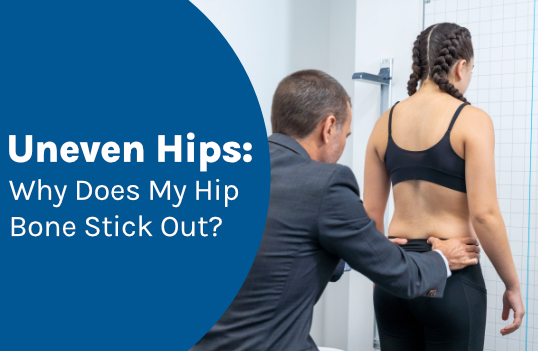
Scoliosis mainly affects the spine and its immediate surroundings, but because the spine attaches directly to the pelvis, it can also affect the hips. If uneven hips are noticed in a child, being assessed by a trained scoliosis clinician can help determine if other signs of scoliosis are present, and if increasing hip changes are occurring in patients already diagnosed with scoliosis, the changes may indicate curve progression and need to be monitored.
Uneven hips may be an early sign of scoliosis in children and can be caused by the spine’s unnatural curve and rotation disrupting overall body symmetry. A misaligned spine can pull on the pelvis, disrupting its healthy position and causing one hip to sit higher than the other.
Particularly for young patients who want to look like their peers, body-appearance changes can be stressful, but a complete care approach focuses on the spine’s irregularities and related postural changes.
Uneven Hips and Scoliosis
Scoliosis causes the spine to curve unnaturally to the side and rotate, but what does it have to do with the hips?
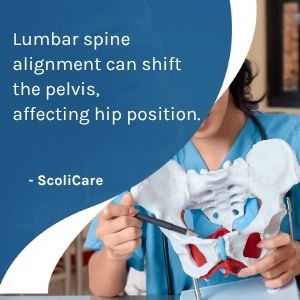
The pelvis is the spine’s foundation, and the hips refer to the broad areas on each side of the bony pelvis. The lumbar spine attaches directly to the pelvis, so changes to the spine’s alignment can alter the position of the pelvis, and changes to the position of the pelvis can alter where the hips sit (1).
If one hip is sitting higher, or more forward than the other, this may be a sign of scoliosis. Uneven hips are most common in cases of lumbar scoliosis and thoracolumbar scoliosis because of the close proximity of the lumbar spine and the lower thoracic spine to the pelvis and hips (2).
Because one hip bone sticking out may be an early sign of childhood scoliosis, it’s important for parents and caregivers to understand scoliosis prevalence, risk factors, and the role of early detection in treatment (2, 3).
What To Do If Uneven Hips Are Noticed In A Child
Scoliosis is one of the main spinal conditions affecting school-aged children, and when routine screening isn’t available, parents, caregivers, teachers, and health professionals all play a role in noticing possible signs and encouraging assessment (2).
If uneven hips are noticed in a child, asymmetries elsewhere in the body should be looked for such as uneven shoulders, one shoulder blade protruding excessively, and one side of the rib cage sticking out more.
Additional changes to watch for include clothes that don’t seem to hang evenly, changes to gait, balance, and coordination (2). In some cases, these changes can seem very sudden when a significant growth spurt occurs. Parents often describe the changes as happening overnight.

While uneven hips don’t guarantee a diagnosis of scoliosis, it may be an early sign of childhood scoliosis and shouldn’t be ignored, particularly as adolescence approaches.
Childhood scoliosis affects children of all ages, but adolescent idiopathic scoliosis is the most common type. The value of regular scoliosis screening examinations cannot be underestimated, particularly when risk factors such as family history are present (2).
Early detection doesn’t guarantee treatment success, but it does give patients and families more time to understand the condition, monitor changes, and consider appropriate treatment options (2).
Now that we’ve discussed the need for evaluation if uneven hips are noticed in a child and scoliosis is a concern, let’s take a detailed look at the different ways a scoliotic curve can contribute to one hip sitting higher.
Scoliosis can contribute to the development of uneven hips through structural changes, the spine’s unnatural twist, muscular imbalance, and how the body tries to compensate.


Structural Changes
Scoliosis causes changes to the spine’s structure. As scoliosis develops, the position of the spine is changing as certain vertebrae are becoming more unnaturally tilted.
Because the spine attaches to the pelvis, if the lumbar spine curves and rotates unnaturally, it can cause the pelvis to tilt forward and to the side: lateral pelvic tilt, also known as pelvic obliquity (4).
Pelvic obliquity can further disrupt healthy posture, contribute to functional leg length discrepancy (4), and cause hip pain, but pain is more common in adults (5).
If a snapping sensation or pop is heard and/or felt in and around the hip during motion, snapping hip syndrome may have developed due to the mechanical changes caused by the tilted pelvis forcing its surrounding muscles and tendons to work under uneven angles, causing them to snap during hip motion (extension and flexion) (4).
Pelvic obliquity can also cause upper body weight to be unevenly distributed over the pelvis, hips, and lower body: disrupting healthy movement patterns and causing uneven wear and tear on the hip joint and lower body (4).
If the pelvis is unnaturally tilted, one hip can stick out more than the other.
Rotational component
As mentioned, scoliosis also causes the spine to rotate, and the rotational component makes scoliosis a 3-dimensional issue that, if left untreated, may become severe.
When the vertebrae are unnaturally twisted, rotation can twist the pelvis, making one hip more prominent and/or appear more rounded (6).
While thoracic scoliosis is more linked to severe rotation because the thoracic spine attaches directly to the rib cage, because the lumbar spine sits directly atop the pelvis, lumbar scoliosis and/or thoracolumbar scoliosis are the most likely to disrupt pelvic and hip balance (6).
Muscular Imbalance
In addition to postural and mobility changes, a common effect of scoliosis is muscular imbalance (7).
The uneven forces of scoliosis also affect the spine’s surrounding muscles and support structures. A muscular imbalance develops as tight muscles on one side of the spine are strained and overworked from trying to counteract the spine’s unnatural curve, and muscles on the opposite side become stretched and weak from lack of use (7).
A muscular imbalance may contribute to curve progression, increasing postural changes, unhealthy movement patterns, wear and tear on the spine and body, and pain.
Uneven hips can also be caused by a lack of uniform support from its surrounding muscles, pulling excessively on one side of the pelvis, causing it to shift upward in position, and one hip to sit higher than the other.
Body Compensations
As the body’s central support structure, if the spine isn’t balanced, the body tries to compensate in a number of ways to restore balance and stability (8).
If scoliosis causes a prominent lean to one side, the body can naturally shift its weight to the opposite side in an attempt to counteract the excessive lean, and this can also contribute to the appearance of one hip bone sticking out excessively (8).
If one hip bone sticks out more than the other, it can be caused by the structural nature of scoliosis causing structural changes to the position of the pelvis, the spine’s rotation, muscular imbalance, and body compensations (4, 6, 7, 8).
For individuals first noticing changes in the position of one hip in relation to the other, assessment is needed to determine if there are asymmetries elsewhere in the body that further suggest scoliosis and warrant further resting.
Not all scoliosis patients feel pain, but many adults experience hip pain, groin pain, knee pain, lower back pain and a decreased range of motion (5).. Symptoms need to be assessed and discussed so treatment plans can be personalized around important details such as long-term symptom relief.
Are Uneven Hips Caused by Scoliosis Painful?
For parents of children recently diagnosed with scoliosis, a common concern is how painful the scoliosis is, or may become.
There are a number of factors that shape a patient’s scoliosis symptoms including patient age, severity, cause, curve location and pattern, and when it comes to scoliosis pain, patient age is important.
Scoliosis-related pain can involve the back muscles, spinal structures, and nerves, leading to radiating pain, and can range from mild to severe (5). For children who are still growing, the spine’s lengthening motion during growth may be enough to counteract compression, so uneven hips aren’t always painful in children, but adults experience scoliosis differently, and postural changes such as uneven hips can involve nerve compression in the lower body (2, 5).
Because scoliosis compression increases once skeletal maturity is reached, back, radiating pain, and hip pain is more common in adults (5).
If one hip is sitting higher than the other, the hips aren’t bearing weight evenly, and may contribute to degeneration and pain.
Uneven hips caused by scoliosis need to be addressed with a whole-body treatment plan that prioritizes structural improvements to the spine’s position, then focuses on building uniform core and back muscle strength for more upper-body support for the spine, pelvis, and hips, and increasing lower body strength so the pelvis and hips are receiving uniform support and stability from above and below the pelvis (9).
Conclusion
The primary symptom of scoliosis is uneven posture, and the earliest signs of scoliosis in children include uneven shoulders and uneven hips.
When the spine’s unnatural curve and rotation pull on the pelvis and cause it to tilt unnaturally, uneven hips may develop as one hip is pushed forward excessively.
Additional postural changes to watch for include uneven shoulder blades, rib cage asymmetry, arm and leg-length discrepancy, and the more progression occurs, the more noticeable postural changes can become.
It’s best to start treatment while scoliosis is mild because the spine is flexible and most likely to be responsive.
Improving the spine’s alignment and support from its surrounding muscles means reducing uneven forces on the pelvis and hips and providing the pelvis and hips with more support and stability.
Working towards improving the spine’s healthy range of motion may relieve back and hip pain by improving pelvis and hip mobility.
Understanding how scoliosis affects the body can help parents and caregivers recognize the need for assessment. If a child’s hips aren’t aligned, it may be an early sign that assessment is needed to determine if additional signs of scoliosis are present, if further testing is warranted, and to determine if scoliosis is the cause of uneven hips.
Find Your Nearest Clinic
ScoliCare Clinics, affiliates and product providers are in over 200 locations around the world. Find your nearest ScoliCare location here.

References:
- Chaudhry SR, Nahian A, Chaudhry K. Anatomy, Abdomen and Pelvis, Pelvis. [Updated 2023 Jul 25]. In: StatPearls [Internet]. Treasure Island (FL): StatPearls Publishing; 2026 Jan-. Available from: https://www.ncbi.nlm.nih.gov/books/NBK482258/
- Weinstein SL. The Natural History of Adolescent Idiopathic Scoliosis. J Pediatr Orthop. 2019 Jul;39(Issue 6, Supplement 1 Suppl 1):S44-S46. doi: 10.1097/BPO.0000000000001350. PMID: 31169647
- Negrini, S., Donzelli, S., Aulisa, A. G., Czaprowski, D., Schreiber, S., de Mauroy, J. C., … & Zaina, F. (2018). 2016 SOSORT guidelines: orthopaedic and rehabilitation treatment of idiopathic scoliosis during growth. Scoliosis and spinal disorders, 13(1), 3
- Winter RB, Pinto WC. Pelvic obliquity. Its causes and its treatment. Spine (Phila Pa 1976). 1986 Apr;11(3):225-34. PMID: 3715623
- Zaina F, Marchese R, Donzelli S, Cordani C, Pulici C, McAviney J, Negrini S. Current Knowledge on the Different Characteristics of Back Pain in Adults with and without Scoliosis: A Systematic Review. J Clin Med. 2023 Aug 9;12(16):5182. doi: 10.3390/jcm12165182. PMID: 37629224; PMCID: PMC10455254
- Gum JL, Asher MA, Burton DC, Lai SM, Lambart LM. Transverse plane pelvic rotation in adolescent idiopathic scoliosis: primary or compensatory? Eur Spine J. 2007 Oct;16(10):1579-86. doi: 10.1007/s00586-007-0400-4. Epub 2007 Aug 1. PMID: 17668251; PMCID: PMC2078296
- Fidler MW, Jowett RL. Muscle imbalance in the aetiology of scoliosis. J Bone Joint Surg Br. 1976 May;58(2):200-1. doi: 10.1302/0301-620X.58B2.932082. PMID: 932082
- Nowotny-Czupryna O, Czupryna K, Nowotny J, Brzęk A. Some possibilities of correction and compensation in body posture regulation among children and adolescents with low degree scoliosis. Ortop Traumatol Rehabil. 2012 Nov-Dec;14(6):525-35. doi: 10.5604/15093492.1011636. PMID: 23382280
- Marchese R, Du Plessis J, Pooke T, McAviney J. The Improvement of Trunk Muscle Endurance in Adolescents with Idiopathic Scoliosis Treated with ScoliBrace® and the ScoliBalance® Exercise Approach. J Clin Med. 2024 Jan 23;13(3):653. doi: 10.3390/jcm13030653. PMID: 38337346; PMCID: PMC10856658
More news
-
 29 July 2026
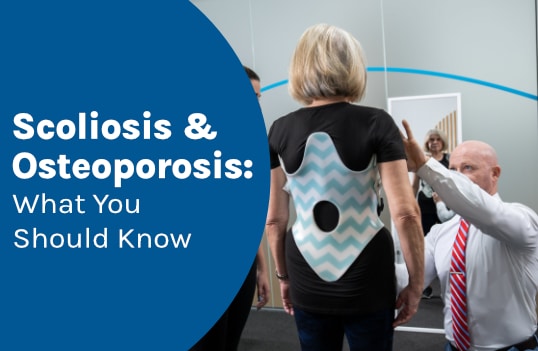
Scoliosis and osteoporosis can occur together, weakening the spine and increasing progression risk. Early diagnosis helps protect long-term spinal health.
-
 14 March 2021
Kurt Cobain and his Scoliosis Part of our series of famous people who have/had a Scoliosis. Next up is Kurt Cobain! Kurt Cobain is best known as the lead…
-
 1 November 2022
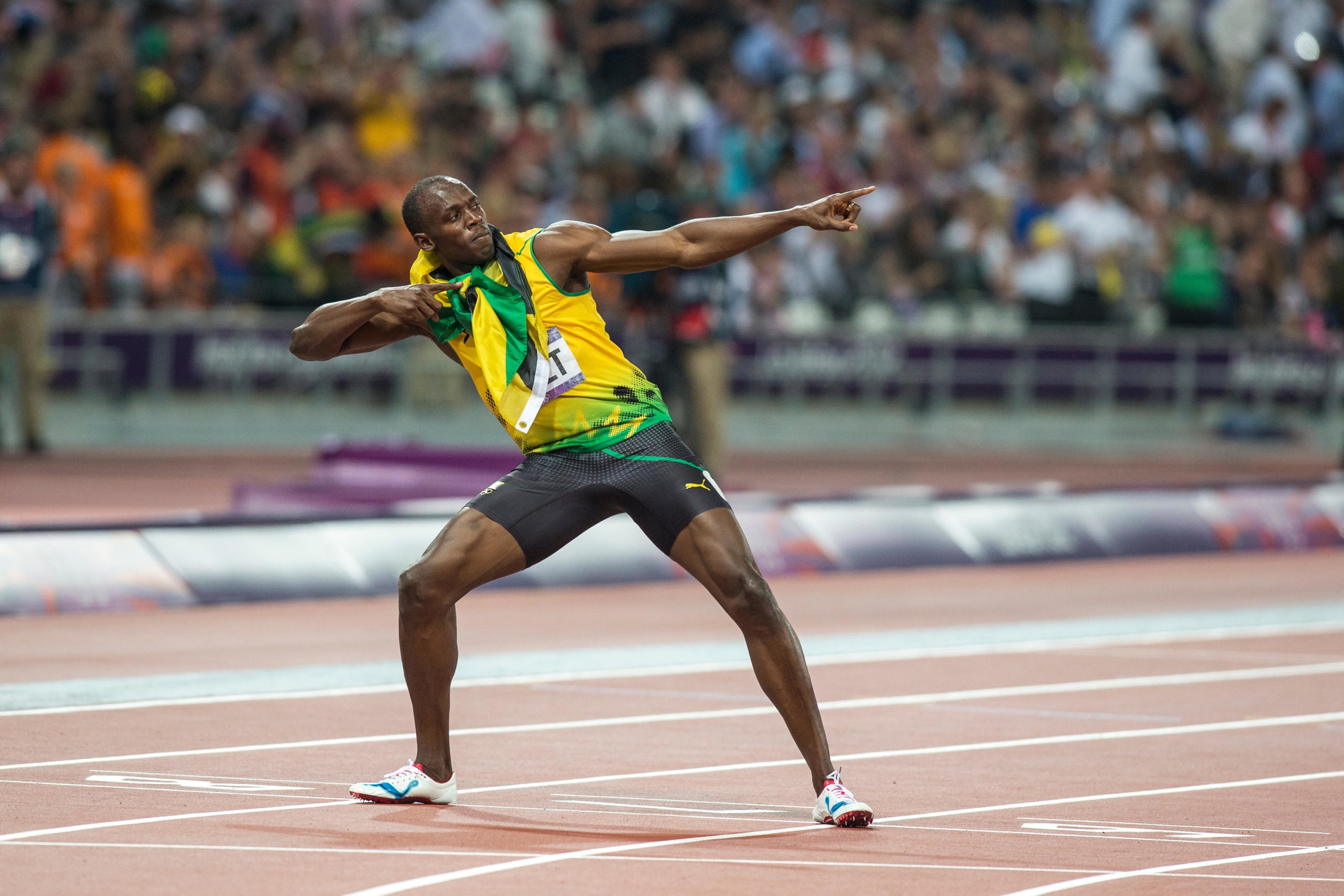
It is hard to believe that the fastest man on earth has scoliosis! Olympian Usain Bolt was born with scoliosis. His right leg is half an inch shorter than his…