
Scoliosis ranges widely in severity, and there are also different types with a variety of curve patterns. A comprehensive initial assessment classifies scoliosis based on patient age, type, severity, and curve location, and these factors shape the customization of treatment plans.
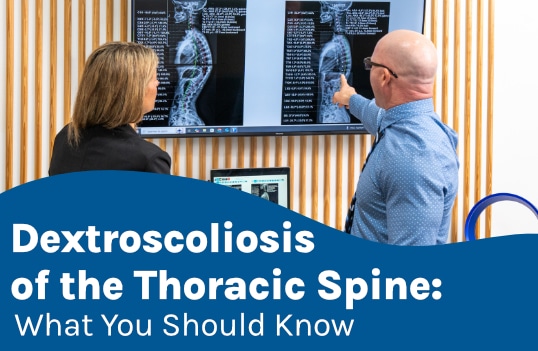
Dextroscoliosis of the thoracic spine means the middle/upper back has developed an unnatural spinal curve that bends to the right and rotates. The thoracic spine is the main spinal section affected by scoliosis and is associated with high degrees of rotation.
The thoracic spine is the largest spinal section and the most commonly affected by scoliosis.
The Roles of the Thoracic Spine
Symptoms of scoliosis are shaped by a number of factors, including curvature location (1).
The spine’s three main sections include the cervical spine, the lumbar spine, and the thoracic spine.
Each spinal section has unique roles to play in maintaining spinal health and function. Curvature location doesn’t just indicate where treatment efforts need to be concentrated, but also the area of the body that’s most likely to feel the direct effects of scoliosis (1).
The health of each individual spinal section affects the others; the sections work together to maintain the spine’s strength, flexibility, and ability to handle mechanical stress (2).
In cases of cervical scoliosis, the neck’s ability to support the weight of the head can be disrupted, and lumbar scoliosis can disrupt healthy movement patterns and interfere with the lower back’s ability to support the weight of the spinal sections above.
If the thoracic spine’s health is disrupted, it can have a number of effects, so let’s explore the many functions of the spine’s largest section.
Structural Support
The thoracic spine contains 12 vertebral bodies and acts as a stable anchor for the torso, rib cage, and the upper body (3).
The middle/upper back connects the cervical spine to the lumbar spine while protecting the spinal cord for a healthy central nervous system and clear brain-body communication (3).
Protecting Important Organs
The thoracic spine is the only section that attaches to the rib cage, forming the thoracic cage that protects the heart and lungs within (4, 5).
Because the thoracic spine is attached to the rib cage, the health and function of the rib cage can be disrupted by thoracic scoliosis as it pulls on the rib cage and changes its position (3).
Respiratory mechanics are affected by the position of the rib cage so an unnatural spinal curve in the thoracic spine can disrupt the chest’s ability to expand/contract during the breathing process (4).
Healthy Movement
The thoracic spine also facilitates upper body rotation and maintains the middle/upper back’s healthy kyphosis (spinal curve that bends outwards) that helps the spine evenly absorb and distribute stress and body weight (3, 6).
Although the thoracic spine isn’t as flexible as the cervical and lumbar sections, its primary movement is rotation, and to a lesser extent, it also helps with flexion and extension (3).
Muscles important for breathing and upper body movement also attach to the thoracic spine, so if there is a change in the position and health of the thoracic spine, any of the aforementioned functions can be disrupted (3, 5).
Thoracic Dextroscoliosis and Vertebral Rotation
What you should know about thoracic scoliosis is because the thoracic spine attaches to the rib cage, it’s associated with a higher degree of rotation (1, 3).
Rotation makes scoliosis 3-dimensional, and treatment needs to address the unnatural tilt and twist of the vertebrae for corrective treatment results (1).
To be considered a true scoliosis, the unnatural spinal curve has to be of a minimum size and also rotate; rotoscoliosis is associated with severe thoracic scoliosis and involves significant rotation, meaning the spine twists excessively (1).
A high degree of rotation increases the complexity of treatment and is associated with the development of a noticeable arch in the rib cage; the spine’s unnatural curve and twist causes one side of the rib cage to protrude excessively, and when severe, this can impact the heart and lungs (3, 4, 5).
Thoracic Dextroscoliosis and Curve Pattern
Dextroscoliosis is the most typical curve pattern. In most cases of idiopathic scoliosis, curves bend to the right, away from the heart (dextroscoliosis), but in atypical forms of scoliosis, curves can bend towards the heart (levoscoliosis) (7).
When a curve bends towards the heart, there is usually an underlying pathology such as cases of neuromuscular scoliosis that are caused by the presence of a neurological or muscular condition like spina bifida, muscular dystrophy, cerebral palsy, or spinal muscular atrophy (8).
Dextroscoliosis means the curve is a typical pattern that bends to the right and is associated with typical cases of idiopathic scoliosis (7).
Thoracic Dextroscoliosis and Curve Progression
Scoliosis is progressive, so its nature is to increase in severity over time.
Although we don’t know what triggers the initial onset of idiopathic scoliosis, we understand what makes it progress: growth.
Scoliosis affects all ages, but the most prevalent type overall is adolescent idiopathic scoliosis commonly diagnosed at the onset of puberty in females and a little later in males (9).
Due to the rapid and unpredictable growth spurts of puberty, adolescents are the most at risk for rapid advancement, and thoracic scoliosis is also associated with faster rates of progression (9).
Thoracic scoliosis progresses faster due to the thoracic spine’s rigidity and its higher degree of rotation, and during growth, the spine is naturally less stable, so cases of adolescent idiopathic scoliosis that develop in the thoracic spine are the most prone to rapid advancement and need to be treated proactively (3, 9).
Conclusion
What you should know about dextroscoliosis of the thoracic spine is that it can include higher degrees of rotation and faster rates of progression, particularly for adolescents.
How scoliosis is managed during periods of rapid growth is crucial. The more severe scoliosis becomes, the more complex it is to treat, but scoliosis can be highly treatable.
Treatment outcomes can never be guaranteed, but with early detection and intervention, the scope of nonsurgical treatment widens, and there is more potential for correction.
An abnormal sideways spinal curvature that curves to the right in the thoracic spine can range from mild to very severe and requires a scoliosis treatment plan that’s customized and proactive.
Proactive nonsurgical scoliosis treatment works towards preventing progression, increasing effects, and the need for invasive surgical correction.
Nonsurgical treatment options for dextroscoliosis include scoliosis-specific rehabilitative exercise plans and corrective 3-dimensional bracing that are customized and evidence-based.
Find Your Nearest Clinic
ScoliCare Clinics, affiliates and product providers are in over 200 locations around the world. Find your nearest ScoliCare location here.


References:
- Janicki JA, Alman B. Scoliosis: Review of diagnosis and treatment. Paediatr Child Health. 2007 Nov;12(9):771-6. doi: 10.1093/pch/12.9.771. PMID: 19030463; PMCID: PMC2532872
- InformedHealth.org [Internet]. Cologne, Germany: Institute for Quality and Efficiency in Health Care (IQWiG); 2006-. In brief: How does the spine work? [Updated 2025 Aug 28]. Available from: https://www.ncbi.nlm.nih.gov/books/NBK279468/
- Waxenbaum JA, Reddy V, Futterman B. Anatomy, Back, Thoracic Vertebrae. [Updated 2023 Aug 1]. In: StatPearls [Internet]. Treasure Island (FL): StatPearls Publishing; 2025 Jan-. Available from: https://www.ncbi.nlm.nih.gov/books/NBK459153/
- Xiao J, Li T, Wang Y, Zhao Z, Xie J, Zhou J. Effects of severe scoliosis on cardiac structure and function in resting patients: a retrospective study. J Orthop Surg Res. 2025 Jul 19;20(1):681. doi: 10.1186/s13018-025-06113-3. PMID: 40684229; PMCID: PMC12276671
- Koumbourlis AC. Scoliosis and the respiratory system. Paediatr Respir Rev. 2006 Jun;7(2):152-60. doi: 10.1016/j.prrv.2006.04.009. Epub 2006 Jun 2. PMID: 16765303
- Lam JC, Mukhdomi T. Kyphosis. 2023 Aug 8. In: StatPearls [Internet]. Treasure Island (FL): StatPearls Publishing; 2025 Jan–. PMID: 32644371
- Soucacos PN, Zacharis K, Gelalis J, Soultanis K, Kalos N, Beris A, Xenakis T, Johnson EO. Assessment of curve progression in idiopathic scoliosis. Eur Spine J. 1998;7(4):270-7. doi: 10.1007/s005860050074. PMID: 9765033; PMCID: PMC3611270
- Vialle R, Thévenin-Lemoine C, Mary P. Neuromuscular scoliosis. Orthop Traumatol Surg Res. 2013 Feb;99(1 Suppl):S124-39. doi: 10.1016/j.otsr.2012.11.002. Epub 2013 Jan 19. PMID: 23337438
- Menger RP, Sin AH. Adolescent Idiopathic Scoliosis. [Updated 2023 Apr 3]. In: StatPearls [Internet]. Treasure Island (FL): StatPearls Publishing; 2025 Jan-. Available from: https://www.ncbi.nlm.nih.gov/books/NBK499908/
More news
-
 14 March 2021
Kurt Cobain and his Scoliosis Part of our series of famous people who have/had a Scoliosis. Next up is Kurt Cobain! Kurt Cobain is best known as the lead…
-
 3 February 2026
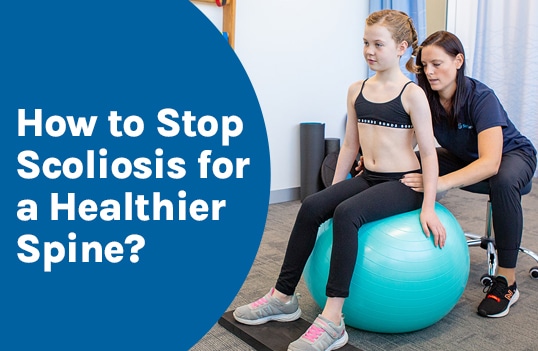
Early detection and customized nonsurgical care—like 3D bracing and scoliosis-specific rehab—can help stop progression and improve spinal health.
-
 12 June 2026
Scoliosis is a condition that affects the spine: an unnatural sideways-bending spinal curvature that rotates develops. As a progressive lateral curvature of the spine, the nature of scoliosis is to…