
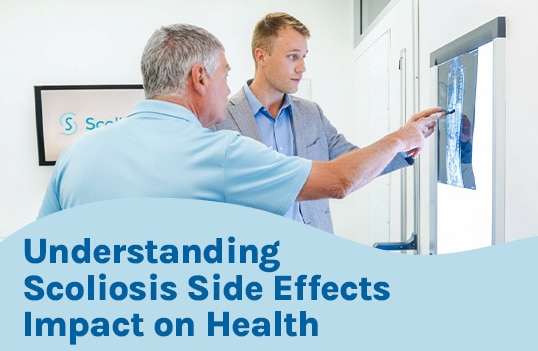
The effects of scoliosis aren’t just limited to the back. Although scoliosis causes the development of an unnatural lateral curvature of the spine with rotation, because the spine is so integral to overall health and mobility, changes to its health can be felt throughout the body.
An important scoliosis-characteristic to understand is its progressive nature; this is key because scoliosis effects can increase over time. Common side effects of scoliosis include back/nerve pain, postural changes, and muscular imbalance, but particularly with early detection and intervention, scoliosis can be highly treatable.
Although treatment outcomes can never be guaranteed, because scoliosis is progressive, the sooner treatment is started, the better.
The Progressive Nature of Scoliosis
A key characteristic of scoliosis is its progressive nature; this is important to understand because even cases diagnosed as mild can progress and become moderate or severe.
The nature of scoliosis is to increase over time, so the size of the spine’s unnatural lateral curve, and its rotation, are likely to get worse without treatment.
In most cases of scoliosis, we don’t know what triggers the initial onset, but we know it’s growth that makes it progress, which is why childhood scoliosis needs to be managed proactively during growth (1).
Scoliosis does affect all ages, but it is most commonly diagnosed in children, and adolescent idiopathic scoliosis, commonly diagnosed at the onset of puberty, is the most prevalent type of scoliosis overall (2).
Adolescents are also the most at risk for rapid advancement due to the rapid and unpredictable growth spurts of puberty (2), so for children recently diagnosed, in particular, delaying treatment in favor of watching and waiting can have consequences (1).
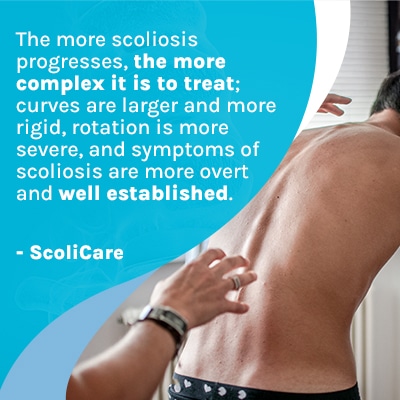
T more scoliosis progresses, the more complex it is to treat; curves are larger and more rigid, rotation is more severe, and symptoms of scoliosis are more overt and well established (1).
So particularly with children recently diagnosed, it’s important to understand that a diagnosis of mild scoliosis and experiencing mild effects doesn’t mean that’s where the scoliosis will stay: not without the help of a proactive customized treatment plan.
As scoliosis affects children and adults differently, let’s explore how some effects of scoliosis are shaped by patient age.
Patient Age and Progression
There are a number of factors that shape the symptoms of scoliosis, one of which is patient age, and when it comes to progression, this is a key factor.
Growth triggers progression, so the more potential growth a patient has remaining prior to reaching skeletal maturity, the more potential progression they may face over time (1).
There are other factors that shape a patient’s rate of progression, such as curvature location and spinal flexibility; scoliosis that develops in the thoracic spine is the most prone to rapid advancement and because the thoracic spine is the only section that attaches to the rib cage, it can also involve more rotation (3).
Adolescents are the most at risk for rapid advancement due to puberty, and while it was once thought that progression stopped once skeletal maturity was reached, we have since learned that the actual rate of scoliosis increases among the aging population; this is due to age-related spinal degeneration and the development of degenerative scoliosis (2, 4).
The most common type of scoliosis in adults, however, is idiopathic scoliosis, and most of these cases are pre-existing from adolescence; it’s a common scenario that scoliosis isn’t diagnosed until after skeletal maturity has been reached, and this is because symptoms of scoliosis can get more overt during adulthood, particularly when it comes to pain (5).
Patient Age and Pain
Patient age and scoliosis pain are closely connected, and this is due largely to compression.
While there are other factors that shape a patient’s pain level, such as spinal flexibility, curvature location, and the angle of trunk rotation (ATR), because scoliosis becomes compressive when growth stops, patient age is a key factor (3, 6).
Compression is excessive pressure, and if the spine is no longer growing, there is no lengthening motion to counteract the compressive force of the scoliosis, and in some cases, this is when a patient’s scoliosis starts to cause pain (6).
Scoliosis-related pain can involve the back muscles, spinal structures, and nerves, leading to radiating pain; nerve-related back pain is the main symptom of adult scoliosis that leads to assessment and diagnosis (6).
If the spinal nerves are exposed to uneven and/or excessive pressure in the spinal cord, or where they exit the spine and branch off throughout the body, nerve pain can be felt anywhere along an affected nerve’s pathway.
So nerve compression caused by scoliosis most commonly causes pain in the arms and hands, legs and feet.
Back pain is most likely to be concentrated around the main spinal section affected, while nerve pain can be more widespread.
Postural Changes
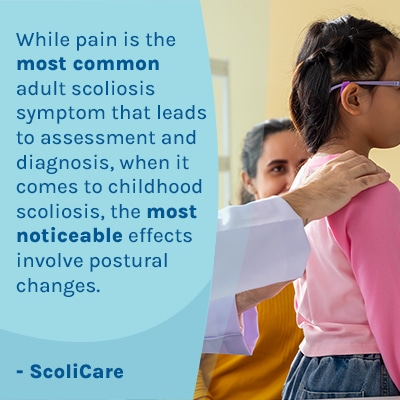
While pain is the most common adult scoliosis symptom that leads to assessment and diagnosis, when it comes to childhood scoliosis, the most noticeable effects involve postural changes (7).
Asscoliosis develops and progresses, its uneven forces can disrupt the body’s overall symmetry through a number of postural changes (7).
Adults will also experience postural changes and a prominent lean to one side, but in children, asymmetrical posture is the main symptom leading to assessment and diagnosis (7).
Long-term spinal health can be shaped by a person’s posture, and a person’s posture can also be affected by the spine’s health and function, which is why a focus of nonsurgical treatment methods is on postural awareness and restoration.
In many cases of childhood scoliosis, the earliest warning signs include uneven shoulders and uneven hips, and additional postural changes to watch for can include:
- The head appearing uncentered over the torso
- An uneven eye line
- Shoulder blades becoming uneven
- Rib flaring
- An uneven waistline
- Arm- and leg-length discrepancies causing ill-fitting clothing
If progression from mild to moderate and severe is occurring, postural changes become more overt, and the longer scoliosis is left untreated, the more established these changes can become, and the more difficult they may be to improve and/or reverse (1, 2).
Postural changes can also be accompanied by movement changes as body posture is so key to healthy movement patterns; changes to gait, balance, and coordination are common (2, 8).
The more movement is disrupted, the more likely activity restrictions will be, and this can include a number of sports and activities, and the more the spine’s surrounding muscles are impacted, the harder it is to maintain the spine’s alignment, healthy movement patterns, and upright posture.
Muscular Imbalance
Muscle pain can also develop as a muscular imbalance is a common effect of scoliosis, and the more progression there is, the more likely it is to cause a related muscular imbalance (9).
Scoliosis doesn’t just introduce uneven forces to the spine, but also its surrounding nerves and muscles; a muscular imbalance can develop as the spine curves unnaturally and pulls its surrounding muscles in different directions. This can cause muscles on one side of the spine to work harder, becoming strained and sore, while muscles on the opposite side lose strength from lack of use (9).
Part of nonsurgical treatment focuses on improving trunk muscle endurance and balance, and this can be done by an effective scoliosis-specific, non-surgical rehabilitation plan incorporating ScoliBalance® and ScoliBrace® (10).
So the effects of scoliosis can be visual (postural) (7), functional (disrupting how the spine functions, nerve health, and healthy movement patterns)(2), include a muscular imbalance (9), and varying levels of pain (more common in adult scoliosis) (6), and there also the psychological effects to consider (11).
Psychological Effects of Scoliosis
While it would be stressful for anyone to be diagnosed with a progressive spinal condition, for young children and adolescents, it can be particularly challenging.
We can’t undervalue the effects of scoliosis on mental health as typical adolescents are already known to struggle with self-esteem issues, and scoliosis patients have additional challenges that make them more likely to experience negative body-image issues and poor mental health (11).
Most adolescents don’t want to look or walk differently; they don’t want to wear a scoliosis brace to school, and they don’t want to be told they can no longer participate in once-loved sports and activities (11).
This is another reason to be proactive with treatment: it’s the best chance of preventing progression and increasing symptoms that, over time, can also affect a patient’s mental health.
Ultimately, when it comes to the potential side effects of scoliosis, it’s important to understand that they can change and increase over time, and starting treatment early increases the potential for a successful nonsurgical treatment outcome (1, 2).
Conclusion
While no two cases of scoliosis are the same, there are some common effects including pain and postural changes, and because scoliosis can range so widely in severity, treatment plans need to be fully customized.
Here at ScoliCare, the customization of treatment plans starts with a patient’s initial assessment which includes a physical examination of the spine and trunk while in a forward-bend position, checking for a family history of scoliosis, and assessing posture and gait.
If an assessment finds indicators of scoliosis, X-ray imaging is performed to confirm the presence of scoliosis with rotation and its severity.
The value of regular scoliosis screening examinations cannot be underestimated, particularly when risk factors, such as family history are present.
The goal of regular scoliosis screening is early detection and intervention, which is why a focus of ScoliCare Clinics around the world is education and awareness; knowing the early signs of scoliosis to watch for, and the value of regular screening, can put patients on a path with the most potential for treatment success.
Find Your Nearest Clinic
ScoliCare Clinics, affiliates and product providers are in over 200 locations around the world. Find your nearest ScoliCare location here.


References:
- Negrini, S., Donzelli, S., Aulisa, A. G., Czaprowski, D., Schreiber, S., de Mauroy, J. C., … & Zaina, F. (2018). 2016 SOSORT guidelines: orthopaedic and rehabilitation treatment of idiopathic scoliosis during growth. Scoliosis and spinal disorders, 13(1), 3
- Weinstein SL. The Natural History of Adolescent Idiopathic Scoliosis. J Pediatr Orthop. 2019 Jul;39(Issue 6, Supplement 1 Suppl 1):S44-S46. doi: 10.1097/BPO.0000000000001350. PMID: 31169647
- Wong LPK, Cheung PWH, Cheung JPY. Curve type, flexibility, correction, and rotation are predictors of curve progression in patients with adolescent idiopathic scoliosis undergoing conservative treatment : a systematic review. Bone Joint J. 2022 Apr;104-B(4):424-432. doi: 10.1302/0301-620X.104B4.BJJ-2021-1677.R1. PMID: 35360948; PMCID: PMC9020521
- Marty-Poumarat, Catherine MD*; Scattin, Luciana MD†; Marpeau, Michèle MD*; Garreau de Loubresse, Christian MD‡; Aegerter, Philippe MD, PhD§. Natural History of Progressive Adult Scoliosis. Spine 32(11):p 1227-1234, May 15, 2007. | DOI: 10.1097/01.brs.0000263328.89135.a6
- Ansari K, Singh M, McDermott JR, Gregorczyk JA, Balmaceno-Criss M, Daher M, McDonald CL, Diebo BG, Daniels AH. Adolescent idiopathic scoliosis in adulthood. EFORT Open Rev. 2024 Jul 1;9(7):676-684. doi: 10.1530/EOR-23-0162. PMID: 38949156; PMCID: PMC11297403
- Zaina, F., Marchese, R., Donzelli, S., Cordani, C., Pulici, C., McAviney, J., & Negrini, S. (2023). Current Knowledge on the Different Characteristics of Back Pain in Adults with and without Scoliosis: A Systematic Review. Journal of Clinical Medicine, 12(16), 5182. https://doi.org/10.3390/jcm12165182
- Hong KS, Van Minh P, Nguyen HT, Phan MH, Nguyen HN, Pham TP. Re-evaluation of Incorrect Posture as a Diagnostic Criterion for Scoliosis in School Screenings: A Cross-Sectional Study in Vietnam. Cureus. 2025 Mar 31;17(3):e81535. doi: 10.7759/cureus.81535. PMID: 40314041; PMCID: PMC12043434
- Xu J, Chen M, Wang X, Luo X. Biomechanical changes in adolescent idiopathic scoliosis during walking: A protocol for systematic review and meta-analysis. Medicine (Baltimore). 2023 Dec 8;102(49):e36528. doi: 10.1097/MD.0000000000036528. PMID: 38065886; PMCID: PMC10713143
- Ford DM, Bagnall KM, McFadden KD, Greenhill BJ, Raso VJ. Paraspinal muscle imbalance in adolescent idiopathic scoliosis. Spine (Phila Pa 1976). 1984 May-Jun;9(4):373-6. doi: 10.1097/00007632-198405000-00008. PMID: 6474252
- Marchese, R., Du Plessis, J., Pooke, T., & McAviney, J. (2024). The Improvement of Trunk Muscle Endurance in Adolescents with Idiopathic Scoliosis Treated with ScoliBrace® and the ScoliBalance® Exercise Approach. Journal of Clinical Medicine, 13(3), 653. https://doi.org/10.3390/jcm13030653
- Payne WK 3rd, Ogilvie JW, Resnick MD, Kane RL, Transfeldt EE, Blum RW. Does scoliosis have a psychological impact and does gender make a difference? Spine (Phila Pa 1976). 1997 Jun 15;22(12):1380-4. doi: 10.1097/00007632-199706150-00017. PMID: 9201842
More news
-
 9 February 2022
Did you know that there is a considerable knowledge gap amongst health professionals in regards to scoliosis? A study that explored the knowledge of health professionals in regards to adolescent…
-
 8 August 2024
Receiving a scoliosis diagnosis often brings a flood of questions and concerns about the future. How did this happen? What are the scoliosis treatment options? Is scoliosis surgery necessary? Navigating…
-
 17 July 2024
Receiving a scoliosis diagnosis as an adult can be daunting. Many people wonder how it happened, what the future holds, and whether it can be treated. Understanding scoliosis in adults…