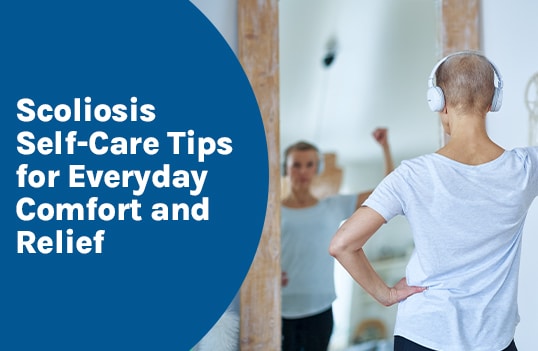
Scoliosis is progressive, so its effects can change and increase over time. While daily self-care strategies are important, the most powerful step a patient can take, in terms of long-term comfort, is to treat the scoliosis proactively.
No two cases of scoliosis are the same, so each patient’s experience, symptoms, and everyday needs will vary. When it comes to self-care tips for everyday comfort and relief, maintaining a healthy weight and activity level, good posture, regular stretching, getting enough rest, and treating scoliosis proactively is important.
Not all scoliosis patients will experience pain and discomfort, but as a progressive condition, even mild symptoms can increase over time, hence the benefit of proactive treatment.
Being Diagnosed with Scoliosis
Being diagnosed with scoliosis can be overwhelming. It’s normal to have questions about daily life and treatment requirements.
The most important thing to understand about a scoliosis diagnosis is because it’s progressive, how it feels to live with scoliosis can change alongside its severity.
Even patients diagnosed with mild scoliosis can experience the effects of severe scoliosis, if left untreated and allowed to progress unimpeded (1).
Being diagnosed with scoliosis means an unnatural lateral spinal curvature that rotates has developed, and as an asymmetrical condition, its main visual effect is postural deviation.
There was a time when being diagnosed with scoliosis was thought to mean a life of pain and mobility issues, but over time, we have learned just how responsive and treatable scoliosis can be, particularly with early detection and intervention (1).
So being diagnosed with scoliosis means treatment is needed, and also necessitates the cultivation of a spine-friendly lifestyle with positive self-care strategies.
Tips for a Spine-Friendly Lifestyle
When it comes to living with scoliosis, cultivating a spine- and scoliosis-friendly lifestyle is important.
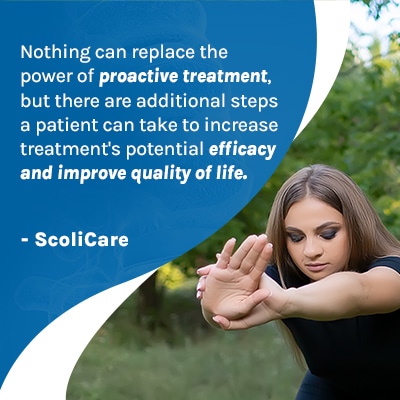
Nothing can replace the power of proactive treatment, but there are additional steps a patient can take to increase treatment’s potential efficacy and improve quality of life.
When it comes to a spine-friendly lifestyle, maintaining a healthy weight is key. Carrying excess weight puts strain on the spine’s supportive structures, increases mechanical stress, compresses discs, can trigger degenerative changes, alter the spine’s alignment, and make the spine more vulnerable to injury and a number of spinal conditions (2).
Carrying excess weight can also disrupt healthy posture.
Staying active can help with weight management, and it can also help with maintaining core strength, spinal flexibility, and mobility (3).
Cultivating a healthy activity level should include a focus on core strength as keeping the spine’s surrounding muscles healthy and strong means more support and stability for the spine, and as the spine’s natural design is based on movement, leading a sedentary lifestyle doesn’t support spinal health and function (4, 3).
As postural restoration is a focus of nonsurgical scoliosis treatment, maintaining good posture is also important for everyday comfort.
Practice Good Posture
Most of us have been told, at one point in our lives, to stand up straighter, hold the shoulders back, and to stop slouching.
While this advice may have been driven by the aesthetics of good posture, there is a lot more behind the importance of proper posture (5).
One of the roles of the spine is to provide structural support for the body and to facilitate our ability to maintain straight and upright posture.
Posture refers to how we position our bodies, and there are a number of factors involved in the process from muscle health and support to spinal health and brain-body communication (5).
Poor posture increases pressure on the spine and its individual parts, particularly the spinal discs, and over time, it can lead to weakened and unbalanced supportive muscles, lower back pain, and disruptions to the spine’s alignment, balance, and stability (5).
In addition, unhealthy posture doesn’t support healthy movement patterns which can further contribute to degenerative changes, discomfort, and pain (5).
Regular Stretching
When it comes to daily self-care strategies for pain relief, regular stretching is important for everyone, but for people with scoliosis, it can offer additional benefits (6).
It is important to note, however, that any exercise and/or stretching routine needs to be approved by a patient’s treatment provider to ensure its safety and specificity to scoliosis; for example, it’s helpful to know in which direction to stretch as a portion of the spine may already be overstretched due to its unnatural curve/rotation.
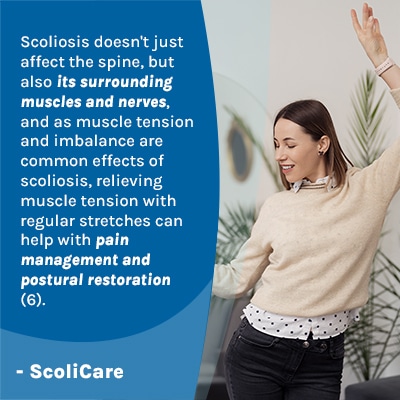
Scoliosis doesn’t just affect the spine, but also its surrounding muscles and nerves, and as muscle tension and imbalance are common effects of scoliosis, relieving muscle tension with regular stretches can help with pain management and postural restoration (6).
Regular stretching can also increase circulation (important for healthy spinal discs) and maintain general and spinal flexibility, which can make the body and spine more responsive to treatment (6).
Getting Enough Rest
For people with scoliosis, the body may at times need some extra rest, not only to handle the extra challenges of life and treatment, but also to create an internal environment that’s conducive to managing the condition.
Not everyone with scoliosis will experience pain and sleep issues, but some find it difficult to get comfortable at night. This may be particularly important for adults with scoliosis.
Knowing the best sleep positions can help maintain optimal spinal alignment so the spine isn’t being exposed to more uneven forces during sleep.
Sleeping flat on the back is the best position for spinal health because the spine is held in a neutral and aligned position and pressure from body weight is evenly distributed.
After back sleeping, side sleeping is the best for spinal health, and placing a pillow between the knees can further align the spine, hips, and pelvis for pain relief and comfort.
Sleeping flat on the stomach should be avoided by people with scoliosis because it flattens out the spine’s natural curves, puts extra pressure on the lower back, and places the neck in an unnatural position, potentially causing pain and discomfort.
A scoliotic spine is facing adverse spinal tension, spinal misalignment, and compression; reducing the uneven forces and pressure it’s exposed to as much as possible during daily activity and sleep can help with general spinal health, pain management, and responsiveness to treatment.
Treating Scoliosis Proactively
The single best way to ensure long-term symptom relief and management is to treat scoliosis proactively.
For people diagnosed with mild scoliosis, it can be a mistake to assume treatment isn’t as necessary or can be delayed; the truth is that while no treatment results can be guaranteed, people diagnosed with mild scoliosis have achieved early detection, but the potential benefits of early detection are only available if a diagnosis is responded to with early intervention (7).
Because scoliosis is progressive, the timing of when treatment is started can make a difference, and proactive treatment is started immediately following a diagnosis because as its nature is to increase in severity over time, diagnosing and treating scoliosis while mild can mean preventing progression and increasing effects (7).
In cases of childhood scoliosis, as progression is triggered by growth, how scoliosis is managed during periods of rapid growth is key; adolescents are the most at risk for rapid advancement due to the stage of growth they’re in (7).
Here at ScoliCare, there are many goals of Care: education, early detection, intervention, and above all, securing the best possible treatment outcome for each patient.
Treatment plans are shaped around a patient’s comprehensive initial assessment, the specifics of the scoliosis, and treatment goals.
While daily self-care tips and healthy routines can help manage scoliosis, the true power for long-term improvement lies in its correction through proactive treatment plans that restore the spine and body’s balance and stability.
Nonsurgical Treatment Modalities
ScoliCare clinics offer patients a proactive nonsurgical treatment response that combines the potential of multiple treatment disciplines, including scoliosis-specific chiropractic treatment, but while chiropractic treatment for scoliosis may be effective as an adjunctive treatment, it needs to be a part of an entire scoliosis-specific rehabilitation program.
Designed by chiropractor, Dr. Jeb McAviney, and physical therapist Rose Mirenzi, ScoliBalance® combines the best of what scoliosis-specific chiropractic care and established scoliosis-specific exercise-based treatment programs such as the Schroth Method and the Scientific Exercise Approach to Scoliosis (SEAS) has to offer (8).
ScoliBalance® also has the goal of educating patients so they can continue their customized scoliosis-specific exercise rehabilitation program from home to support long-term sustainable treatment results.
Corrective bracing is an additional facet of nonsurgical scoliosis treatment that complements ScoliBalance®; ScoliBrace® is a custom 3-dimensional scoliosis brace that’s evidence-based and customized to address the specifics of a patient’s posture, scoliosis type, and severity (8).
The ScoliBrace® individualizes potential corrective results through the use of an overcorrective approach to improve spinal alignment and balance through spinal coupling, and as the spine is held in an overcorrective position in the brace, the brain and body are being retrained together to maintain this position out of the brace (8).
When scoliosis-specific chiropractic treatment is combined with the power of a customized scoliosis-specific exercise rehabilitation program and corrective bracing, the potential for long-term improvement increases.
Conclusion
Part of a comprehensive scoliosis care plan includes lifestyle guidance throughout treatment and beyond.
ScoliCare patients are empowered through education; they’re taught about scoliosis, how to lead a spine- and scoliosis-friendly lifestyle, including recommendations for certain lifestyle modifications when necessary, and how to sustain healthy posture and corrective treatment results through an established and customized home-rehabilitation program.
Maintaining healthy weight and activity levels, good posture, healthy sleep habits, and regular stretching can help improve daily quality of life, but when it comes to long-term sustainable symptom relief, this is best achieved through proactive treatment that works towards preventing progression and increasing severity.
The best way to improve quality of life with scoliosis is to proactively work towards minimizing its effects through customized treatment plans with the potential to prevent progression.
Find Your Nearest Clinic
ScoliCare Clinics, affiliates and product providers are in over 200 locations around the world. Find your nearest ScoliCare location here.

References:
- De Groot C, Heemskerk JL, Willigenburg NW, Altena MC, Kempen DHR. Educating Parents Improves Their Ability to Recognize Adolescent Idiopathic Scoliosis: A Diagnostic Accuracy Study. Children (Basel). 2022 Apr 15;9(4):563. doi: 10.3390/children9040563. PMID: 35455607; PMCID: PMC9025014
- Sheng B, Feng C, Zhang D, Spitler H, Shi L. Associations between Obesity and Spinal Diseases: A Medical Expenditure Panel Study Analysis. Int J Environ Res Public Health. 2017 Feb 13;14(2):183. doi: 10.3390/ijerph14020183. PMID: 28208824; PMCID: PMC5334737
- Chu L, Yang D, Zhang F, Qi W, Huang Y, Yang Y, Qu S, Huang S, Zheng K, Luo C. Association of physical activity and sedentary time with scoliosis screening positive in Chinese primary and secondary school students: a cohort study in Shanghai. Front Public Health. 2025 May 7;13:1483007. doi: 10.3389/fpubh.2025.1483007. PMID: 40401075; PMCID: PMC12092463
- Li X, Shen J, Liang J, Zhou X, Yang Y, Wang D, Wang S, Wang L, Wang H, Du Q. Effect of core-based exercise in people with scoliosis: A systematic review and meta-analysis. Clin Rehabil. 2021 May;35(5):669-680. doi: 10.1177/0269215520975105. Epub 2020 Dec 27. PMID: 33356498; PMCID: PMC8076838
- Du SH, Zhang YH, Yang QH, Wang YC, Fang Y, Wang XQ. Spinal posture assessment and low back pain. EFORT Open Rev. 2023 Sep 1;8(9):708-718. doi: 10.1530/EOR-23-0025. PMID: 37655847; PMCID: PMC10548303
- Levi D, Springer S, Parmet Y, Ovadia D, Ben-Sira D. Acute muscle stretching and the ability to maintain posture in females with adolescent idiopathic scoliosis. J Back Musculoskelet Rehabil. 2019;32(4):655-662. doi: 10.3233/BMR-181175. PMID: 30636726
- Negrini, S., Donzelli, S., Aulisa, A. G., Czaprowski, D., Schreiber, S., de Mauroy, J. C., … & Zaina, F. (2018). 2016 SOSORT guidelines: orthopaedic and rehabilitation treatment of idiopathic scoliosis during growth. Scoliosis and spinal disorders, 13(1), 3
- Marchese, R., Du Plessis, J., Pooke, T., & McAviney, J. (2024). The Improvement of Trunk Muscle Endurance in Adolescents with Idiopathic Scoliosis Treated with ScoliBrace® and the ScoliBalance® Exercise Approach. Journal of Clinical Medicine, 13(3), 653. https://doi.org/10.3390/jcm13030653
More news
-
 1 June 2022
Long trips can be a little difficult for brace wearers, especially if sitting for hours at a time. Here are some tips for scoliosis brace wearers that may help make…
-
 28 June 2023
By Rebecca Phillips - Exercise Physiologist Team Leader Scoliosis can cause pain of varying intensity and frequency for each person. It is often thought that pain is more common in…
-
 29 May 2024
Wearing a scoliosis brace, especially when it comes to sleeping comfortably, can be an adjustment. Whether you’re a preteen, teenager, or adult, getting a good night's rest while adhering to…