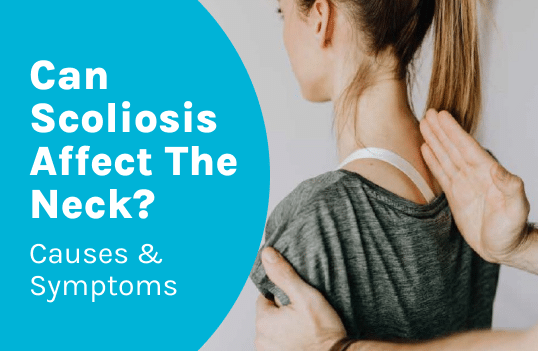
Scoliosis is more common in the thoracic and lumbar spinal sections, but it can also develop in the neck (cervical spine). Scoliosis is progressive and can get worse over time. Regardless of where the scoliosis develops, the entire spine may be affected.
Scoliosis can develop in any of the spine’s main sections, including the cervical spine as cervical scoliosis. Cervical scoliosis causes can be idiopathic, muscular, congenital, neuromuscular, degenerative, or injury-related. Common symptoms of cervical scoliosis include forward head posture, neck pain, and a reduced range of motion.
Cervical scoliosis can range from mild to severe and have a number of effects.
The Cervical Spine
In order to diagnose scoliosis, an X-ray is needed to confirm the presence of an unnatural lateral spinal curve, with rotation, and a minimum Cobb angle measurement of 10 degrees.
An X-ray will show where the scoliosis occurs in the spine, and curvature location helps determine the types of symptoms a patient may experience..
Symptoms of scoliosis can be widespread, particularly when severe, and while scoliosis affects the entire spine, the main spinal section affected, and its immediate surroundings, feel the most direct effects (1).
As each spinal section has unique roles to play in maintaining the spine’s function, curvature location is a factor that shapes scoliosis symptoms.
The cervical spine is the first spinal section; it starts at the base of the skull and contains the first seven vertebrae (bones of the spine). The cervical spine is the bridge between the brain, the spine, and body (2).
The cervical spine has some key functions; it has to support the weight of the head, maintain the neck’s range of motion, and protect the spinal cord and vertebral arteries (2).
The cervical spine has a natural lordosis (inward bending spinal curve) (2). There can be a number of causes for the neck losing its healthy curve and alignment.
Cervical Scoliosis Causes
While many cases of scoliosis are idiopathic (no known cause), cervical scoliosis most commonly develops as a compensatory curve due to muscular imbalance, degeneration, congenital abnormalities, injury, or neurological reasons (3).
Scoliosis most often develops in the largest spinal section, the thoracic spine, but a common effect of lumbar scoliosis that develops in the lower back is a compensatory curve in the cervical spine.
Compensatory Curve
The body makes adjustments to compensate for a loss of balance and stability, and if the lumbar spine develops scoliosis, a compensatory scoliotic curve can develop in the upper spine to counteract the uneven forces occurring in the lower spine and restore balance.
Muscular Issues
Cervical scoliosis can also be caused by muscular issues; weak and/or unbalanced muscles and ligaments in the neck can cause a lack of spinal support and stability (4).
Forward head posture can occur alongside scoliosis, and this involves the head shifting forward to compensate for the neck’s misalignment, increasing the weight of the head on the cervical vertebrae and the spine’s surrounding muscles (4).
Degenerative Disc Disease
If degenerative disc disease is affecting one or more discs in the cervical spine, changes to disc health and height can affect the position of adjacent vertebrae attached causing the cervical spine to develop an unnatural spinal curve (5).
Disc degeneration can contribute to increasing degenerative instability, and too much movement within the spine makes it vulnerable to injury (5).
Congenital Scoliosis
Congenital abnormalities can include misshapen cervical vertebrae and/or the failure of certain vertebral bodies to separate into their own distinct bones, instead forming fused together as one solid bone; babies are born with congenital scoliosis due to a malformed spine that develops in utero (6).


Neuromuscular scoliosis
Neuromuscular conditions that affect the connection between the brain, the spine, and its supportive muscles and structures, such as cerebral palsy, muscular dystrophy, spina bifida, or spinal muscular atrophy, can also trigger the onset of cervical scoliosis as a related complication (7).
Injury
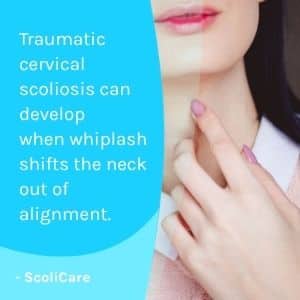
A traumatic injury can also cause the development of cervical scoliosis if a sudden impact jolts the cervical spine out of alignment (whiplash) (8).
Cervical Scoliosis Symptoms
If the cervical spine is misaligned due to scoliosis, symptoms are shaped largely by its severity and underlying cause.
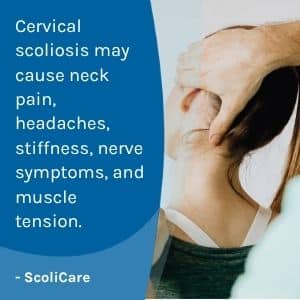
Common symptoms of cervical scoliosis include neck pain, headaches, stiffness, reduced range of motion in the neck, tingling sensations in the arms and hands due to compressed nerves, forward head posture, and muscle tension and pain (3).
Neck Pain
Chronic neck pain that worsens with movement may develop in the neck and shoulders due to the strain from the cervical spine’s misalignment and instability (3).
Headaches
Muscle tension headaches are also common due to strained muscles trying to support the neck’s unnatural curve and rotation (3).
Muscle pain and Imbalance
A muscular imbalance is a common effect of scoliosis, causing muscle tension, muscle spasms, and tight, sore muscles (3).
Muscles on one side of the neck are overworked, tight, and sore, while muscles on the opposite side can weaken due to lack of use.
Reduced Range of Motion
A stiff neck is common, with a reduced range of motion, making it difficult to turn the head from left to right and up and down and causing pain (3).
Radiating Pain
Nerve compression is a common effect of adult scoliosis and can cause tingling, pain, and/or numbness in the arms and hands (3).
If the spinal cord is compressed or a nerve root where it exits the spine, the uneven pressure on the nerve can cause it to become inflamed and irritated, and nerve pain can be felt throughout the body.
Forward Head Posture
Forward head posture is a common body compensation that occurs with cervical scoliosis.
As the cervical spine structure changes due to its unnatural curve and rotation, the head tilts forward to compensate, shifting it out of alignment with the shoulders, contributing to further muscular imbalance and shoulder pain (4).
The best way to minimize the potential effects and complications of cervical scoliosis is to treat it proactively.
Cervical Scoliosis Treatment
Cervical scoliosis treatment plans are customized around important variables such as patient age, symptoms, severity, and cause (3).
Mild scoliosis cases are the simplest to treat because the curvature of the spine is small, flexible, and more responsive to treatment. The goal of nonsurgical treatment is to prevent curve progression so mild cases stay mild and don’t become moderate or severe.
Nonsurgical treatment prioritizes the spine’s natural strength, flexibility, and function through improving the spine’s alignment and balance.
If progression isn’t preventable and the surgical threshold is crossed, surgical treatment may be recommended, and spinal fusion surgery can permanently alter the strength and flexibility of the spine, so the goal of a proactive nonsurgical treatment plan is to prevent the need for future surgical treatment (9).
ScoliBalance®
Through a scoliosis-specific rehabilitative exercise plan, neck muscles and shoulder muscles are targeted as overworked muscles are relaxed and stretched and underused muscles are engaged, strengthened, and tightened; improving the cervical spine’s surrounding muscle strength and balance improves the spine’s support and stability (10).
More support and stability from strong musculature surrounding the cervical spine takes pressure off the cervical discs, facet joints, and nerves (10).
Postural restoration is also a focus of treatment; a person’s posture shapes spinal health, and spinal health shapes a person’s posture (10).
The use of Mirror Image® exercise educates patients on the dangers of poor posture and how to recognize its effects (10). Optimal posture is necessary for sustaining long-term treatment results; a straight upright posture promotes the spine’s neutral and straight alignment from the cervical spine to the lumbar spine (10).
ScoliBrace®
In some cases of mild scoliosis, scoliosis-specific exercise plans may be enough to improve the spine’s alignment and stability, but in many cases, a combination of scoliosis-specific exercise, corrective bracing, and Chiropractic BioPhysics®, as an adjusting treatment, is necessary (10).
Corrective bracing supports the torso and spine’s straight alignment and helps retrain the brain-body connection to maintain the body’s straighter position and 3D alignment when out of the brace, and while the ScoliBrace® is most commonly used to address thoracic, thoracolumbar, and lumbar scoliosis, the ScoliBrace also has a high thoracic option to address alignment issues in the neck (10).
The 3D ScoliBrace® complements scoliosis-specific exercise by working towards realigning and untwisting the spine.
Chiropractic BioPhysics®
Chiropractic BioPhysics® combines the best of what scoliosis-specific chiropractic has to offer with the potential of scoliosis-specific exercise and 3D bracing (11).
As an adjunctive treatment, CBP may help restore the cervical spine’s healthy lordosis by complementing the primary nonsurgical treatment options: scoliosis-specific physical therapy and corrective bracing (11).
Conclusion
The neck’s healthy curve is important for stabilizing the head, promoting healthy posture, nerve, and muscle health.
The cervical spine contains the first seven vertebrae of the spine and form a natural lordosis. Scoliosis causes the cervical spine to curve unnaturally to the side and rotate, disrupting the balance and stability of the spine.
Primary causes for cervical scoliosis are idiopathic, muscular, injury-related, congenital, or neuromuscular, and symptoms include neck and shoulder pain, tension headaches, forward head posture, and tingling, numbness, and/or discomfort in the arms and hands due to nerve compression.
Improving posture can help all spinal sections, and restoring the head’s central position over the neck and torso takes pressure off compressed nerves and strained muscles in the neck and shoulders.
Through the combined potential of scoliosis-specific rehabilitative exercise, corrective bracing, and CBP, neck and shoulder muscles are targeted to improve strength and balance for more support and stability for the neck.
Scoliosis-specific exercise for postural correction can also work towards improving the cervical spine’s flexibility for a better range of motion, pain relief, and increasing treatment responsiveness.
Corrective bracing complements scoliosis-specific exercise with its movement-based design and impacts both the spine’s unnatural curve and rotation for 3-dimensional improvement to the spine and upper body posture.
Chiropractic manual adjustments may be applied to improve the position of the curve’s most tilted vertebrae to restore alignment in the neck, along with its natural lordosis.
Find Your Nearest Clinic
ScoliCare Clinics, affiliates and product providers are in over 200 locations around the world. Find your nearest ScoliCare location here.

References:
- Janicki JA, Alman B. Scoliosis: Review of diagnosis and treatment. Paediatr Child Health. 2007 Nov;12(9):771-6. doi: 10.1093/pch/12.9.771. PMID: 19030463; PMCID: PMC2532872
- Rahman S, Das JM. Anatomy, Head and Neck: Cervical Spine. [Updated 2023 Aug 28]. In: StatPearls [Internet]. Treasure Island (FL): StatPearls Publishing; 2026 Jan-. Available from: https://www.ncbi.nlm.nih.gov/books/NBK557516/
- Mesfin A, Bakhsh WR, Chuntarapas T, Riew KD. Cervical Scoliosis: Clinical and Radiographic Outcomes. Global Spine J. 2016 Feb;6(1):7-13. doi: 10.1055/s-0035-1554776. Epub 2015 Jun 5. PMID: 26835196; PMCID: PMC4733367
- Lotfian S, Fesharaki MJ, Shahabbaspour Z, Akbarzadeh H, Moezy A. The impact of forward head posture on neck muscle endurance and thickness in women with chronic neck pain: a cross-sectional study. BMC Musculoskelet Disord. 2025 May 13;26(1):468. doi: 10.1186/s12891-025-08705-w. PMID: 40361072; PMCID: PMC12070504
- Scarcia L, Pileggi M, Camilli A, Romi A, Bartolo A, Giubbolini F, Valente I, Garignano G, D’Argento F, Pedicelli A, Alexandre AM. Degenerative Disc Disease of the Spine: From Anatomy to Pathophysiology and Radiological Appearance, with Morphological and Functional Considerations. J Pers Med. 2022 Nov 1;12(11):1810. doi: 10.3390/jpm12111810. PMID: 36579533; PMCID: PMC9698646
- Arlet V, Odent T, Aebi M. Congenital scoliosis. Eur Spine J. 2003 Oct;12(5):456-63. doi: 10.1007/s00586-003-0555-6. Epub 2003 Jun 14. PMID: 14618384; PMCID: PMC3468011
- Vialle R, Thévenin-Lemoine C, Mary P. Neuromuscular scoliosis. Orthop Traumatol Surg Res. 2013 Feb;99(1 Suppl):S124-39. doi: 10.1016/j.otsr.2012.11.002. Epub 2013 Jan 19. PMID: 23337438
- Norton TC, Oakley PA, Harrison DE. Re-establishing the cervical lordosis after whiplash: a Chiropractic Biophysics® spinal corrective care methods pre-auto injury and post-auto injury case report with follow-up. J Phys Ther Sci. 2023 Mar;35(3):270-275. doi: 10.1589/jpts.35.270. Epub 2023 Mar 1. PMID: 36866005; PMCID: PMC9974326
- Fan H, Wang Q, Huang Z, Sui W, Yang J, Deng Y, Yang J. Comparison of Functional Outcome and Quality of Life in Patients With Idiopathic Scoliosis Treated by Spinal Fusion. Medicine (Baltimore). 2016 May;95(19):e3289. doi: 10.1097/MD.0000000000003289. PMID: 27175629; PMCID: PMC4902471
- Marchese R, Du Plessis J, Pooke T, McAviney J. The Improvement of Trunk Muscle Endurance in Adolescents with Idiopathic Scoliosis Treated with ScoliBrace® and the ScoliBalance® Exercise Approach. J Clin Med. 2024 Jan 23;13(3):653. doi: 10.3390/jcm13030653. PMID: 38337346; PMCID: PMC10856658
- Haas JW, Fortner MO, Woodham TJ, Harrison DE. Reducing Chronic Spine Pain in an Adult Male by Decreasing Lumbar Scoliosis and Increasing Cervical Lordosis Using Chiropractic BioPhysics® Protocols: A 26-Month Follow-Up Case Report. Cureus. 2024 Sep 1;16(9):e68393. doi: 10.7759/cureus.68393. PMID: 39224496; PMCID: PMC113663
More news
-
 19 October 2025
Scoliosis is best managed with early, proactive care—watch for uneven shoulders or hips, as these early signs can lead to timely diagnosis and effective treatment.
-
 5 September 2025
Thoracolumbar scoliosis affects both the mid and lower spine—its unique curve location requires a tailored diagnosis and treatment plan for optimal spinal health.
-
 17 October 2025
Scoliosis can affect adults too—whether ongoing or new, it’s often painful. Treatment focuses on fall prevention and restoring spinal balance.