
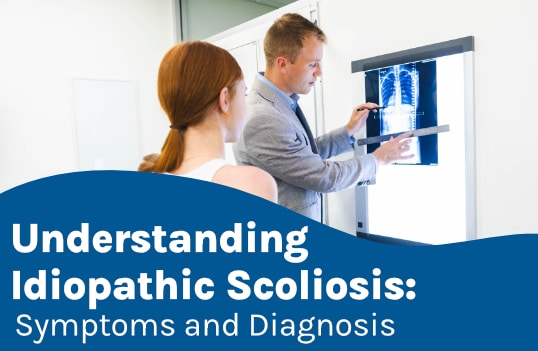
Understanding idiopathic scoliosis and the potential benefits of early diagnosis is crucial, especially for parents. We don’t know what causes the initial onset of idiopathic scoliosis, but we understand the main trigger for progressive scoliosis: growth.
Idiopathic scoliosis accounts for the majority of scoliosis cases, has no single-known cause, and is diagnosed through a physical examination and X-ray imaging. Adolescent idiopathic scoliosis is the most common type of scoliosis overall and its main symptom is asymmetrical posture.
Symptoms of idiopathic scoliosis can vary from patient to patient, ranging from subtle and mild to overt and severe.
Idiopathic Scoliosis: No Single-Known Cause
Idiopathic scoliosis is the main type of scoliosis to affect all ages.
Idiopathic means not clearly associated with a single-known cause, so while we know how to diagnose and treat idiopathic scoliosis, we don’t fully understand what triggers its initial onset (1).
There are a number of theories regarding the etiology of idiopathic scoliosis, and the general consensus is that it’s multifactorial; instead of having a single cause, its development could be shaped by a number of factors that vary from person to person (1, 2).
Potential contributing factors may include genetics, growth, hormones, nerve and muscle issues, and environmental factors (1, 2).
While it can be difficult for parents of children recently diagnosed to hear we don’t know what caused the scoliosis to develop, what’s most important to understand about idiopathic scoliosis is the importance of early detection and how a diagnosis should be responded to with treatment (3).
When it comes to early detection, this involves recognizing the early symptoms of scoliosis that, in many cases, can be subtle and difficult to recognize: awareness is key.
Early Symptoms of Childhood Scoliosis
Scoliosis causes an unnatural lateral spinal curve with rotation to develop, and because scoliosis is progressive, its nature is to increase in severity over time.
While idiopathic scoliosis affects all ages, it’s most commonly diagnosed in children, so let’s start with the main signs or symptoms of scoliosis in children.
Because spinal health is shaped by posture and vice versa (4), the earliest indicator of scoliosis in children is asymmetrical posture, but as scoliosis ranges in severity from mild scoliosis to moderate scoliosis and severe scoliosis, symptoms range from subtle to overt (5).
Spinal Alignment and Visual Effects
In many cases, it’s uneven shoulders and uneven hips that are the earliest telltale signs of scoliosis, and this is due to the uneven forces of the spine’s unnatural curve and rotation disrupting the body’s overall symmetry (5).
If the spine has developed an unnatural curve and rotates, it’s not in alignment, and this doesn’t just affect the spine, but also its surroundings, and the alignment of the entire body from the head to the feet (5).
In addition to uneven shoulders and hips, common disruptions to posture can include:
- The head not aligned with the torso
- An uneven eye line
- Development of an arch in the rib cage
- Pelvic obliquity
- Arm- and leg-length discrepancies
It’s a common scenario for parents to notice asymmetrical changes in a child’s body while they’re wearing a bathing suit and the torso and back is highly visible.
Adolescent Idiopathic Scoliosis
The most common type of scoliosis overall is adolescent idiopathic scoliosis, typically diagnosed at the onset of puberty in females and a little later in males; this age group also isn’t always known for their transparency, with some teenagers concealing asymmetrical changes to posture out of embarrassment (5).
Adolescents also aren’t exactly known for healthy posture, so changes to body posture can be seen as little more than the classic adolescent slouch; this is why awareness is so important.
And if there are certain risk factors in place, such as family history, regular screening for childhood scoliosis is recommended so the early signs or symptoms aren’t missed (6).
The more posture is affected, the more ill-fitting clothing can become, and mobility changes can also be expected, including disruptions to balance, coordination, and gait.
Now, postural changes are the earliest signs of childhood scoliosis, but what about cases of adult scoliosis?
Adult Scoliosis Symptoms
The main type of scoliosis to affect adults is idiopathic scoliosis, and many of these cases are pre-existing from adolescence (6).
As mentioned, the signs of idiopathic scoliosis in adolescents can be missed, particularly when mild, and it’s not uncommon for scoliosis pre-existing from adolescence to be diagnosed during adulthood when its signs become more noticeable (6).
As mentioned, the main trigger for progression is growth, which is why awareness of childhood scoliosis and the benefits of early detection are so crucial, and adolescents are the most at risk for rapid advancement due to the rapid and unpredictable nature of pubescent growth spurts (3).
One of the main ways scoliosis effects vary based on age is compression; scoliosis becomes compressive once skeletal maturity has been reached.
In young patients who are still growing, the constant lengthening motion of a growing spine can counteract the compressive force of the spine’s unnatural curve and rotation.
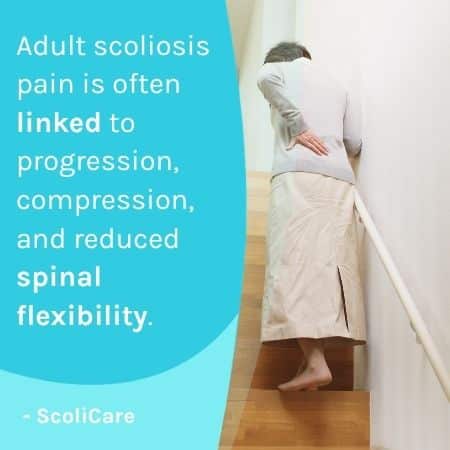
Compression isn’t the only cause of scoliosis pain, but it is a significant contributing factor, and in many cases of pre-existing scoliosis from adolescence, it’s when growth stops that scoliosis symptoms become noticeable enough to lead to assessment and diagnosis (7).
Idiopathic scoliosis in adults can be painful, and curves in the thoracic spinal section are the most prone to rapid advancement (7).
When it comes to adult scoliosis, age-related degenerative changes in the spine can also contribute to progression and pain (7).
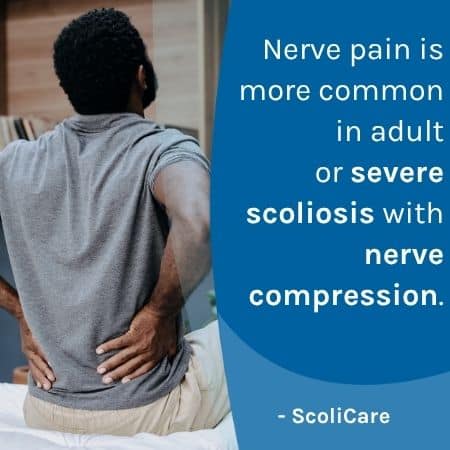
While adults can also experience postural changes and develop a prominent lean to one side, it’s more often pain in the extremities, due to nerve compression, that leads to most diagnoses (7).
As the brain and spinal cord form the body’s central nervous system, if the spinal nerves are exposed to uneven pressure, their health and function can be disrupted.
A common complication of adult lumbar scoliosis, for example, is the development of sciatic nerve pain as the sciatic nerve starts in the lower back (7).
Knowing the signs of scoliosis to watch for in childhood and adulthood can lead to early diagnosis and early intervention.
Diagnosing Idiopathic Scoliosis
Diagnosing idiopathic scoliosis early isn’t always easy. The symptoms of mild scoliosis can be subtle, particularly when growth minimizes the potential effects of compression.
Most young patients are diagnosed with idiopathic scoliosis through routine screening examinations and/or because parents and/or caregivers have awareness and successfully recognize some of the early indicators (6).
In children, it’s most often uneven shoulders and hips that alert parents to the need for assessment, and in adults, it’s most often pain felt in the arms, hands, legs, and feet due to compressed nerves that lead to diagnosis, sometimes years after the initial onset of scoliosis (5, 6, 7).
Recognizing the signs of scoliosis is the first step towards early detection, and a physical examination will include taking a patient’s medical and family history, examining the spine and trunk will in a forward-bend position, and if indicators of scoliosis are present, X-ray imaging is warranted (6).
An X-ray is needed to reach a diagnosis of scoliosis: to confirm the size of the scoliosis (minimum of 10 degrees) and the presence of rotation (6).
X-ray imaging tells us what’s happening in and around the spine, and in most cases of typical idiopathic scoliosis, curves are right-bending; if a curve is left-bending, this may be an indicator that the case is atypical and could have an underlying pathology.
Approximately 80 percent of scoliosis cases are idiopathic, and the remaining 20 percent have known causes: neuromuscular, degenerative, and congenital scoliosis (8).
Conclusion
Idiopathic scoliosis is the most common form of scoliosis to affect all ages, and although we don’t fully understand its causation, we know growth makes it progress, and we know how to respond with treatment.
While there are never treatment guarantees, particularly when it comes to childhood scoliosis, how scoliosis is managed during periods of rapid growth is key; proactive treatment works towards counteracting the condition’s progressive nature.
Here at ScoliCare, treatment plans are proactive, customized, and nonsurgical; the treatment goal is to restore the spine and body’s alignment, balance, and stability.
Although we still don’t fully understand what drives the initial onset of idiopathic scoliosis, we know it can be highly treatable, and the sooner scoliosis is diagnosed and treatment is started, the more potential there is for a successful treatment outcome.
References:
- Trobisch P, Suess O, Schwab F. Idiopathic scoliosis. Dtsch Arztebl Int. 2010 Dec;107(49):875-83; quiz 884. doi: 10.3238/arztebl.2010.0875. Epub 2010 Dec 10. PMID: 21191550; PMCID: PMC3011182
- Wise CA, Gao X, Shoemaker S, Gordon D, Herring JA. Understanding genetic factors in idiopathic scoliosis, a complex disease of childhood. Curr Genomics. 2008 Mar;9(1):51-9. doi: 10.2174/138920208783884874. PMID: 19424484; PMCID: PMC2674301
- Negrini, S., Donzelli, S., Aulisa, A. G., Czaprowski, D., Schreiber, S., de Mauroy, J. C., … & Zaina, F. (2018). 2016 SOSORT guidelines: orthopaedic and rehabilitation treatment of idiopathic scoliosis during growth. Scoliosis and spinal disorders, 13(1), 3
- Carini F, Mazzola M, Fici C, Palmeri S, Messina M, Damiani P, Tomasello G. Posture and posturology, anatomical and physiological profiles: overview and current state of art. Acta Biomed. 2017 Apr 28;88(1):11-16. doi: 10.23750/abm.v88i1.5309. PMID: 28467328; PMCID: PMC6166197
- InformedHealth.org [Internet]. Cologne, Germany: Institute for Quality and Efficiency in Health Care (IQWiG); 2006-. Overview: Scoliosis in teenagers. [Updated 2024 Mar 25]. Available from: https://www.ncbi.nlm.nih.gov/books/NBK608496/Weinstein, S. L. (2019).
- Ng SY, Bettany-Saltikov J. (2017). The natural history of adolescent idiopathic scoliosis. Journal of Pediatric Orthopaedics, 39, S44-S46.Ng SY, Bettany-Saltikov J. Imaging in the Diagnosis and Monitoring of Children with Idiopathic Scoliosis. Open Orthop J. 2017 Dec 29;11:1500-1520. doi: 10.2174/1874325001711011500. PMID: 29399226; PMCID: PMC5759132
- Zaina, F., Marchese, R., Donzelli, S., Cordani, C., Pulici, C., McAviney, J., & Negrini, S. (2023). Current knowledge on the different characteristics of back pain in adults with and without scoliosis: a systematic review. Journal of Clinical Medicine, 12(16), 518
- Asher MA, Burton DC. Adolescent idiopathic scoliosis: natural history and long term treatment effects. Scoliosis. 2006 Mar 31;1(1):2. doi: 10.1186/1748-7161-1-2. PMID: 16759428; PMCID: PMC1475645
The post Understanding Idiopathic Scoliosis: Symptoms and Diagnosis appeared first on ScoliCare.
More news
-
 12 January 2022
By Rosemary Marchese, Physiotherapist Juvenile idiopathic scoliosis (JIS) needs careful attention and it is so important that these children are not ‘missed’. With much of the attention in the literature…
-
 17 July 2024
Receiving a scoliosis diagnosis as an adult can be daunting. Many people wonder how it happened, what the future holds, and whether it can be treated. Understanding scoliosis in adults…