
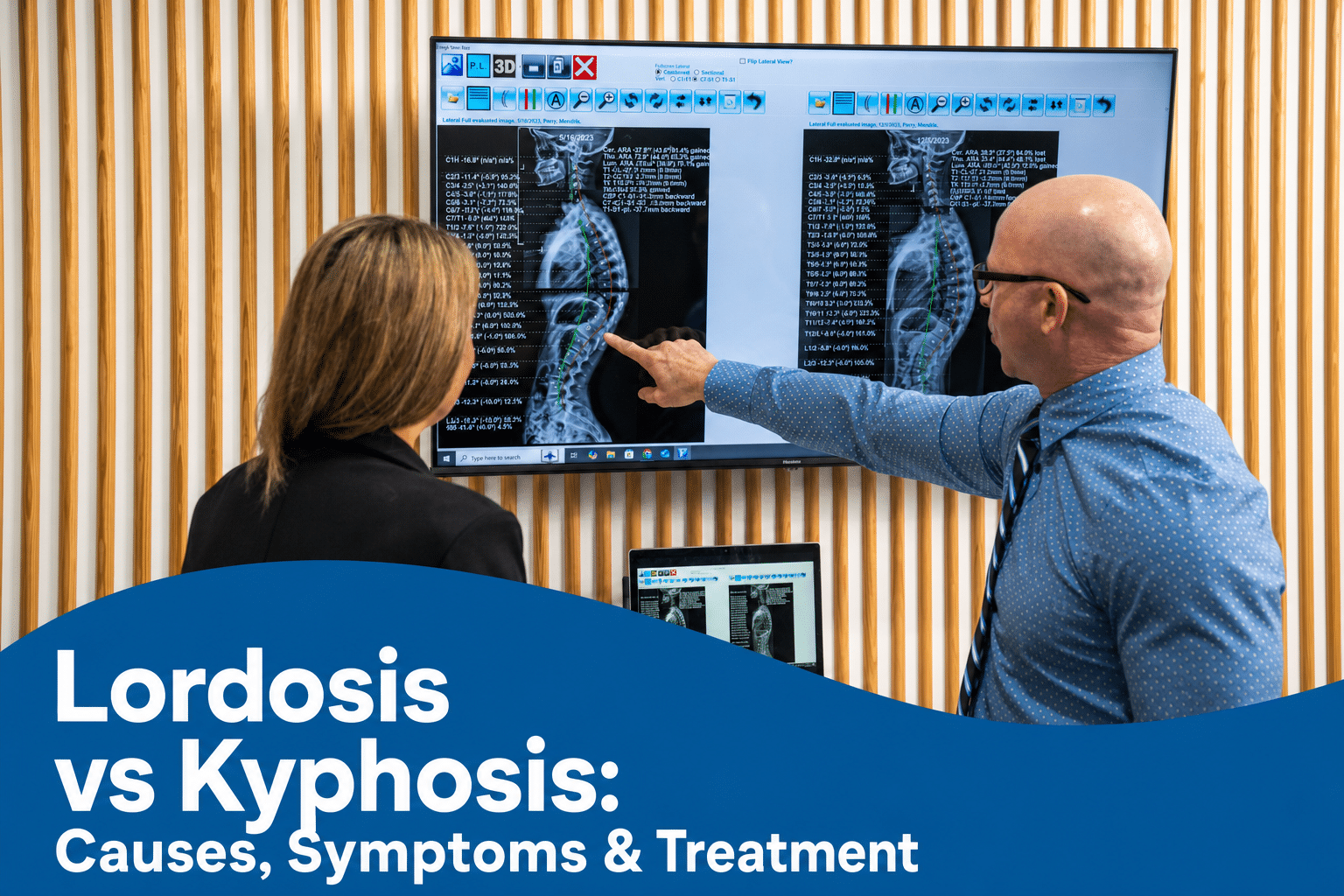
Lordosis and kyphosis are types of spinal curves, and the spine’s curves can shape overall spinal health. A spine with its natural and healthy curves in place is stronger, more flexible, and better able to handle the stress of daily activity. Lordosis makes the spine curve inward, while kyphosis refers to an outward curvature of the spine.
If a person’s degree of lordosis and/or kyphosis falls within a normal range, the curve is healthy. An increase in lordosis can make the spine excessively curved, and a decrease in lordosis can make the spine excessively straight; too much kyphosis can make the spine round forward excessively, and too little kyphosis can also make the spine excessively straight.
Both the spine’s lordosis and kyphosis are important, so let’s talk about the different roles of the spine’s main sections, and what happens when a section loses its healthy curve.
Spinal Sections
The spine is one long structure that can be divided into three main sections: the cervical spine (neck), thoracic spine (middle/upper back), and the lumbar spine (lower back).
The spinal sections work together to facilitate optimal spinal health and function, and a spine that’s functional is one that’s strong, flexible, aligned, and facilitates good posture and nerve communication.
If a healthy spinal curve is lost in any one section of the spine, it can affect more than just the one section; it can also affect the spine’s surrounding muscles, nerves, and the balance and stability of the other spinal sections.
The loss of healthy spinal curves can also make the spine more vulnerable to injury (1).
Each of the spine’s main sections has a characteristic curvature type that promotes spinal alignment, strength, and flexibility.
Lordotic curves are found in the cervical and lumbar spinal sections, and the spine’s kyphosis is found in the largest section: the thoracic spine.
The terms lordosis and kyphosis refer to normal curve types, with hyperlordosis and hyperkyphosis referring to excessive degrees or lordosis, and hypolordosis and hypokyphosis referencing a decrease in healthy lordosis and kyphosis
Lordosis
Lordosis refers to an inward spinal curvature.
Lordotic curves are found in the neck (cervical spine) and lower back (lumbar spine), and the cervical spine needs its healthy lordosis to help support the weight of the head and facilitate a wide range of motion in the neck (2).
The lower back’s lordosis enables its ability to support the weight of the trunk, the spinal sections above, and healthy movement patterns.
Cervical HyperLordosis
An increase in cervical lordosis can cause the neck to curve inward excessively and is known as cervical hyperlordosis.
A typical range of cervical lordosis falls between 30 and 40 degrees (3).
Excessive lordosis in the cervical spine can be caused by poor posture, misshapen vertebrae, neuromuscular conditions (cerebral palsy, muscular dystrophy), muscular imbalance, and spinal conditions like scoliosis.
Cervical Hypolordosis
Cervical hypolordosis can occur when there is a decrease in the neck’s lordosis and involves the neck curve straightening out and is commonly diagnosed when a person’s cervical lordosis measures under 20 degrees (3).
A straight neck is vulnerable to forward head posture as the head shifts forward in position, increasing its weight on the vertebrae of the cervical spine and limiting its range of motion (4).
The neck can lose its healthy lordosis and become excessively straight for different reasons: chronic poor posture, injury, underlying conditions like scoliosis, and or muscle imbalance.
Lumbar HyperLordosis
The lower back isn’t just weight-bearing, it also facilitates a number of complex movements like bends, twists, and lifts, and if the lower spine isn’t aligned, it can affect the position and function of the pelvis (5).
A healthy range of lumbar lordosis is commonly considered to be between 20 and 45 degrees
If a person’s lumbar lordosis increases in the 60-degree range, it’s commonly diagnosed as lumbar hyperlordosis.
If the lumbar spine’s degree of lordosis becomes excessive, the lower back can curve inward excessively, causing a swayback posture where the buttocks and abdomen protrude excessively.
Lumbar Hypolordosis
If the lumbar spine’s lordosis straightens out and flattens the curve, this is known as lumbar hypolordosis and can make the lower spine more vulnerable to injury and strain (1).
Kyphosis
Kyphosis is the opposite curve type and refers to the thoracic spine’s outward curvature.
The middle/upper back’s kyphosis helps maintain spinal strength so the upper body is supported, the spinal cord within is protected, and the ribcage is anchored, protecting the heart and lungs.
A healthy range of kyphosis in the middle/upper back is between 20 and 40 degrees, with hyperkyphosis commonly diagnosed when the thoracic spine’s kyphosis increases to 45+ degrees.
Thoracic Hyperkyphosis
There are also different types of hyperkyphosis: postural hyperkyphosis, Scheuermann’s hyperkyphosis, and age-related hyperkyphosis.
Postural hyperkyphosis develops when chronic poor posture causes the spine to round forward excessively due to strained vertebrae, muscles, and/or ligaments.
Scheuermann’s hyperkyphosis is caused by misshapen vertebrae that cause the spine to wedge forward and curve outward excessively (6).
Age-related hyperkyphosis is caused by degenerative changes in the spine, most often starting with the discs that sit between adjacent vertebrae, and affects older adults (7).
If a person’s kyphosis becomes excessive, this is diagnosed as thoracic hyperkyphosis and means the spine’s outward curvature is over-pronounced and can become problematic; conversely, if there is too little kyphosis, this can also be problematic and is diagnosed as thoracic hypokyphosis.
Thoracic Hypokyphosis
Hypokyphosis involves a decrease in the thoracic spine’s kyphosis and can cause the spine to become excessively straight.
Hypokyphosis can be caused by poor posture, muscle imbalances, or the presence of an underlying spinal condition.
Symptoms of excessive lordosis and kyphosis and decreases in lordosis and kyphosis are shaped by a number of factors including patient age, severity, and cause.
Treatment Options
Although lordosis and kyphosis are opposite spinal-curve types, if curve sizes become problematic, they can respond to a similar combination of nonsurgical treatment options; however, treatment plans need to be customized and shaped by a condition’s underlying cause, severity, and experienced symptoms.
There are no treatment guarantees, but early detection and a proactive treatment approach does increase the scope of nonsurgical treatment.
In the early stages, over- and under-pronounced degrees of lordosis and kyphosis may respond well to condition-specific exercise, and for more severe cases and/or when physical therapy alone isn’t enough, customized 3D bracing and Chiropractic BioPhysics® can also be applied (8, 9).
Condition-specific physical therapy may improve the spine’s flexibility, making it more responsive, and it can also restore the spine’s surrounding muscle strength and balance; a spine that’s surrounded by strong and balanced muscles means more support and stability for the spine’s healthy alignment (8).
Bracing is a common form of treatment for a number of unhealthy spinal curves and can help by applying pressure to the spine that improves its alignment. For young patients who are still growing, bracing can be particularly effective as the spine is more flexible and responsive.
Condition-specific chiropractic care can work towards improving the spine’s position and alignment through a number of adjustments and techniques (9).
In cases of severe increases or decreases in lordosis and/or kyphosis with significant nerve compression and pain, surgical intervention may be recommended.
Conclusion
Lordosis and kyphosis are opposite spinal-curve types.
Lordosis refers to the spine’s inward curvature, and the spine’s natural lordosis characterizes the cervical and lumbar spinal sections.
Kyphosis refers to the spine’s outward curvature that characterizes the thoracic spine.
Too much lordosis means the spine is curving inward excessively and is diagnosed as hyperlordosis, and too little lordosis means there is a flattening of the curve and is diagnosed as hypolordosis.
Too much kyphosis, or too little, can also be problematic and is diagnosed as hyperkyphosis or hypokyphosis.
The key to spinal health is balance and stability, and in order for the spine to maintain optimal strength, flexibility, and stability, its natural and healthy curves need to be in place.
A spine with curves that are over- or under-pronounced can be problematic and disrupt the spine’s biomechanics in different ways.
In addition to postural changes, unhealthy spinal curves can also disrupt healthy movement patterns and cause muscular imbalance, nerve compression, and pain.
Here at ScoliCare, treatment plans proactively work towards restoring as much of the spine’s natural strength and function as possible through improving postural and spinal alignment.
References:
- Kuo YL, Chung CH, Huang TW, Tsao CH, Chang SY, Peng CK, Cheng WE, Chien WC, Shen CH. Association between spinal curvature disorders and injury: a nationwide population-based retrospective cohort study. BMJ Open. 2019 Jan 17;9(1):e023604. doi: 10.1136/bmjopen-2018-023604. PMID: 30782710; PMCID: PMC6340633
- Kaiser JT, Reddy V, Launico MV, et al. Anatomy, Head and Neck: Cervical Vertebrae. [Updated 2023 Oct 24]. In: StatPearls [Internet]. Treasure Island (FL): StatPearls Publishing; 2025 Jan-. Available from: https://www.ncbi.nlm.nih.gov/books/NBK539734/McAviney J, Schulz D, Bock R
- McAviney J, Schulz D, Bock R, Harrison DE, Holland B. Determining the relationship between cervical lordosis and neck complaints. J Manipulative Physiol Ther. 2005 Mar-Apr;28(3):187-93. doi: 10.1016/j.jmpt.2005.02.015. PMID: 15855907.
- Oakley PA, Kallan SZ, Harrison DE. Structural rehabilitation of the cervical lordosis and forward head posture: a selective review of Chiropractic BioPhysics® case reports. J Phys Ther Sci. 2022 Nov;34(11):759-771. doi: 10.1589/jpts.34.759. Epub 2022 Nov 1. PMID: 36337218; PMCID: PMC9622351
- James W Youdas, Tom R Garrett, Kathleen S Egan, Terry M Therneau, Lumbar Lordosis and Pelvic Inclination in Adults With Chronic Low Back Pain, Physical Therapy, Volume 80, Issue 3, 1 March 2000, Pages 261–275, https://doi.org/10.1093/ptj/80.3.261
- Mansfield JT, Bennett M. Scheuermann Disease. [Updated 2023 Jul 31]. In: StatPearls [Internet]. Treasure Island (FL): StatPearls Publishing; 2025 Jan-. Available from: https://www.ncbi.nlm.nih.gov/books/NBK499966/
- Ailon T, Shaffrey CI, Lenke LG, Harrop JS, Smith JS. Progressive Spinal Kyphosis in the Aging Population. Neurosurgery. 2015 Oct;77 Suppl 4:S164-72. doi: 10.1227/NEU.0000000000000944. PMID: 26378354
- Yang S, Yi YG, Chang MC. The Effectiveness of Exercise Programs in Adolescents with Thoracic Kyphosis: A Narrative Review. Healthcare (Basel). 2024 Jul 29;12(15):1503. doi: 10.3390/healthcare12151503. PMID: 39120206; PMCID: PMC11312307
- Harrison DE, Harrison DD, Betz JJ, Janik TJ, Holland B, Colloca CJ, Haas JW. Increasing the cervical lordosis with chiropractic biophysics seated combined extension-compression and transverse load cervical traction with cervical manipulation: nonrandomized clinical control trial. J Manipulative Physiol Ther. 2003 Mar-Apr;26(3):139-51. doi: 10.1016/S0161-4754(02)54106-3. Erratum in: J Manipulative Physiol Ther. 2005 Mar-Apr;28(3):214. PMID: 12704306
The post Lordosis vs Kyphosis: Causes, Symptoms & Treatment appeared first on ScoliCare.
More news
-
 17 February 2026
The thoracic spine is the largest spinal section, and its health and function is shaped, in part, by its degree of kyphosis. If a person’s kyphosis becomes excessive, the upper…
-
 28 August 2024
While scoliosis is quite widely known, the term hyperkyphosis is less familiar. If you’re just starting to learn about hyperkyphosis and how it relates to adolescents, you may have questions…