

Scoliosis severity is determined by a measurement known as Cobb angle that’s based on curve size, but a patient’s angle of rotation (ATR) is also important because it shapes symptoms and treatment needs. High degrees of rotation are most closely associated with severe thoracic scoliosis and/or neuromuscular scoliosis.
Rotoscoliosis is severe because it involves an unnatural spinal curvature with a high degree of rotation. The excessive rotational component means the spine twists significantly so symptoms tend to be more overt and disruptive.
In order to be considered a true scoliosis, certain parameters have to be met.
Diagnosing Scoliosis
Diagnosing scoliosis involves a comprehensive initial patient assessment, followed by X-ray imaging to confirm the size of the unnatural sideways spinal curve and its rotational component (1).
Curve size is determined by a patient’s Cobb angle measurement during X-ray, and a minimum Cobb angle of 10 degrees is needed to reach a diagnosis of scoliosis (1).
Structural scoliosis involves an unnatural sideways spinal curve with rotation, making scoliosis 3-dimensional and more complex to treat as the spine’s unnatural curve and twist need to be addressed (1).
Because scoliosis is progressive and progresses with growth, a diagnosis of mild scoliosis doesn’t indicate where its symptoms will stay; proactive treatment is needed to work towards preventing progression and increasing effects (2).
When scoliosis is mild, its effects can be subtle and difficult to detect, but as scoliosis progresses, the spine’s unnatural curve and rotation is increasing, making symptoms more noticeable, including postural changes and pain (2).
Scoliosis severity indicates the level of structural deformity in the spine, including how far out of alignment the spine has shifted and how much rotation is present.
Determining the Degree of Rotation
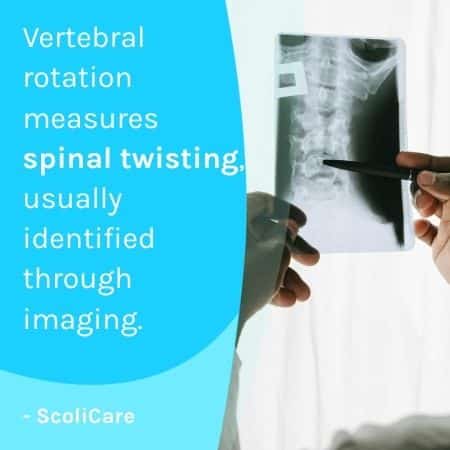
A patient’s degree of rotation is also known as vertebral rotation, and it’s mainly determined via imaging techniques that identify the level of twist in the curve’s vertebrae.
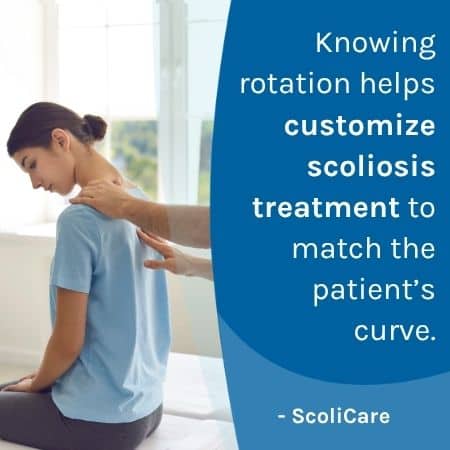
Rotation is commonly measured at the apex of the curve and/or in different adjacent vertebrae (3)
It’s also important to understand how body position can yield different measurements. For example, when measurements are determined while a patient is lying down, rotation can appear less so isn’t as accurate as standing radiographs (3).
Patient position is important. The higher accuracy of standing X-rays and radiographic imaging also applies to determining a patient’s Cobb angle measurement: the gold standard when it comes to classifying condition severity (3, 4).
Imaging techniques for measuring the axial rotation include CT scans (computed tomography) because they provide the clearest axial views (3).
MRIs (magnetic resonance imaging) can be combined with 3-dimensional reconstructions to assess rotation without exposure to radiation (3).
3-dimensional reconstructions are low-dose imaging systems capable of reconstructing the entire spine for a complete picture of what’s happening in and around the spine; these can be used to determine a patient’s Cobb angle and degree of axial rotation (3, 4).
Common X-ray methods include assessing the position of a vertebra pedicle (boney stalk that projects from the backside of a vertebral body) to estimate how much rotation is occurring (3).
Because treatment plans are shaped around a patient’s initial measurements, including Cobb angle and the degree of axial rotation, the accuracy of these measurements are essential to treatment-plan customization and success (3, 4).
Why is Measuring the Spine’s Rotation Important?
It’s important to know a scoliosis patient’s degree of rotation so treatment plans can be crafted accordingly.
Scoliosis doesn’t just cause the spine to curve unnaturally to the side; because there is a rotational component, scoliosis is a 3-dimensional spinal condition and needs to be addressed as such.
A patient’s degree of rotation indicates how much the vertebrae are misaligned horizontally, while a patient’s Cobb angle measures the spine’s angular misalignment (3, 4).
Addressing the unnatural sideways spinal curve, but not its rotation, limits potential treatment efficacy.
Rotation is also associated with certain symptoms such as a noticeable rib hump and/or asymmetrical shoulder blades.
Severe Thoracic Scoliosis
Many cases of rotoscoliosis involve thoracic scoliosis. Scoliosis can develop in any spinal section, but it’s common in the thoracic spine (middle/upper back), the largest spinal section and the only section that attaches to the rib cage (5).
When the thoracic spine is curving to the side unnaturally and rotating, a common effect is the development of an arch in the rib cage (one side protrudes more than the other) due to the unnaturally-curved vertebrae casing rotation in attached ribs (5).
Severe rotation causes the ribs on one side to rotate backward while the ribs on the other side rotate forward (5).
So thoracic scoliosis is associated with high degrees of rotation, and neuromuscular scoliosis is also associated with rotoscoliosis.
Neuromuscular Scoliosis
Neuromuscular scoliosis cases tend to be severe and include severe rotation due to a lack of muscular control; neuromuscular scoliosis develops because of a neurological or muscular condition interrupting communication between the brain and supportive muscles and ligaments that support the spine’s alignment and stability (6).
The more severe scoliosis is, and/or the more it progresses, the more complex its treatment needs are, and a key factor in treatment efficacy is impacting scoliosis on every level, including its underlying 3-dimensional structural nature.
Conclusion
Scoliosis is a 3-dimensional structural issue that affects the spine’s alignment, stability, and support, and a misaligned spine can cause effects felt throughout the body through asymmetrical posture and mobility changes.
Because scoliosis doesn’t just cause the spine to curve unnaturally to the side but also rotate, it’s a complex 3-dimensional condition that requires the customization of treatment plans, and this is partially because scoliosis can range so widely in severity.
Scoliosis is also progressive, meaning its nature is to become more severe over time, and as the spine’s unnatural curve and rotation increase, treatment needs become more complex; regardless of severity or type, the timing of when treatment is started can be a crucial factor, so early detection and intervention is always the goal.
References:
- Janicki JA, Alman B. Scoliosis: Review of diagnosis and treatment. Paediatr Child Health. 2007 Nov;12(9):771-6. doi: 10.1093/pch/12.9.771. PMID: 19030463; PMCID: PMC2532872
- Di Felice F, Zaina F, Donzelli S, Negrini S. The Natural History of Idiopathic Scoliosis During Growth: A Meta-Analysis. Am J Phys Med Rehabil. 2018 May;97(5):346-356. doi: 10.1097/PHM.0000000000000861. PMID: 29493563
- Lam GC, Hill DL, Le LH, Raso JV, Lou EH. Vertebral rotation measurement: a summary and comparison of common radiographic and CT methods. Scoliosis. 2008 Nov 2;3:16. doi: 10.1186/1748-7161-3-16. PMID: 18976498; PMCID: PMC2587463
- Lee CS, Hwang CJ, Jung HS, Lee DH, Park JW, Cho JH, Yang JJ, Park S. Association Between Vertebral Rotation Pattern and Curve Morphology in Adolescent Idiopathic Scoliosis. World Neurosurg. 2020 Nov;143:e243-e252. doi: 10.1016/j.wneu.2020.07.111. Epub 2020 Jul 23. PMID: 32712411
- Chen B, Tan Q, Chen H, Luo F, Xu M, Zhao J, Liu P, Sun X, Su N, Zhang D, Fan W, Liu M, Huang H, Wang Z, Huang J, Zhang R, Li C, Li F, Ni Z, Du X, Jin M, Yang J, Xie Y, Chen L. Imbalanced development of anterior and posterior thorax is a causative factor triggering scoliosis. J Orthop Translat. 2019 Jan 7;17:103-111. doi: 10.1016/j.jot.2018.12.001. PMID: 31194037; PMCID: PMC6551366
- Loughenbury PR, Tsirikos AI. Current concepts in the treatment of neuromuscular scoliosis: clinical assessment, treatment options, and surgical outcomes. Bone Jt Open. 2022 Jan;3(1):85-92. doi: 10.1302/2633-1462.31.BJO-2021-0178.R1. PMID: 35084206; PMCID: PMC9047085
More news
-
 14 March 2021
Kurt Cobain and his Scoliosis Part of our series of famous people who have/had a Scoliosis. Next up is Kurt Cobain! Kurt Cobain is best known as the lead…
-
 1 November 2022
It is hard to believe that the fastest man on earth has scoliosis! Olympian Usain Bolt was born with scoliosis. His right leg is half an inch shorter than his…
-
 21 February 2023
Today we know that scoliosis affects approximately 2-4% of adolescents. The treatment of scoliosis has evolved over the years, with various approaches being developed to manage the condition. One of…