Because scoliosis is progressive, treatment needs are ongoing, and how scoliosis is addressed can shape the spine’s overall health. When it comes to choosing the best scoliosis brace, treatment approach is important; a specific brace type is aligned with a particular treatment approach, and patients need to consider their treatment goals.
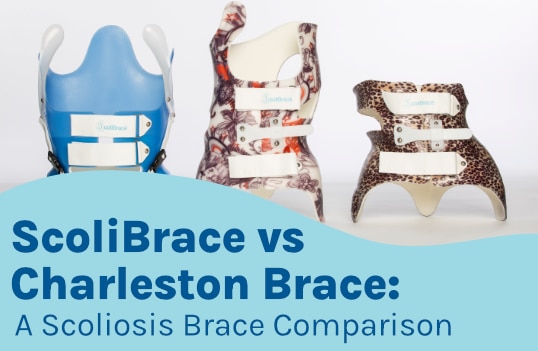
Scoliosis bracing is a primary nonsurgical scoliosis treatment option with proven results; however, there is a wide variety of scoliosis braces to choose from. The ScoliBrace® is a modern advanced ultracorrective 3D scoliosis brace commonly recommended for full-time wear, and the Charleston brace is a traditional hypercorrective scoliosis brace worn only at nighttime.
A scoliosis brace is an orthotic device worn around the torso to improve the spine’s alignment and/or stop scoliosis from progressing.
Scoliosis Treatment Approach
Scoliosis causes an unhealthy lateral spinal curve, with rotation, to develop, and how it’s responded to with treatment is crucial.
Because scoliosis is progressive, the timing of treatment is important, particularly in children because growth spurts trigger progression. While there are no treatment guarantees, there are a number of treatment benefits associated with early diagnosis and intervention, so how treatment manages progression is an outcome-shaping factor (1).
There are two main ways to treat scoliosis: with a surgical approach or a nonsurgical approach.
Scoliosis surgery is a type of spinal fusion that has the goal of stopping progression through immobilizing the spline’s most unnaturally-tilted vertebrae by fusing them together and attaching metal rods to maintain the spine’s straight alignment and prevent further progression (2).
There is a place in scoliosis treatment for spinal fusion surgery, but there are some serious potential risks and complications involved, and nonsurgical scoliosis treatment is less invasive and can preserve more of the spine’s long-term strength and function for a better quality of life (2).
With early detection and intervention, bracing may prevent curve progression from reaching the surgical threshold.
It’s also important to understand that stopping progression isn’t the same as correcting scoliosis; corrective treatment works towards addressing the underlying structural nature of scoliosis while increasing the spine’s support and stability through improving the spine’s surrounding muscle balance and strength, and the timing of diagnosis and bracing is key (3).
So while some braces are designed around the primary goal of stopping progression, a modern corrective brace has the goal of correcting the scoliosis.
Let’s explore the main differences between the ScoliBrace® and the Charleston bending brace in terms of wearing recommendations, design, customization, and efficacy.


Brace Wear
No two scoliosis cases are the same, so brace-wear recommendations can vary based on a number of factors: brace type, curve location, severity, and rate of progression.
Regardless of the type of brace, all braces need to be worn exactly as prescribed for effectiveness; in fact, compliance is a significant challenge to brace efficacy.
Particularly in cases of adolescent idiopathic scoliosis, full-time brace-wear recommendations can be problematic if teens are self-conscious about wearing the brace to school and in front of friends, but when worn as prescribed, and combined with other types of treatment, the ScoliBrace® may help prevent progression and correct the curve (4).
The ScoliBrace® is most often recommended for full-time wear (up to 23 hours a day), which is why the brace is designed with comfort in mind; they are flexible and easily concealable under clothes so they can be worn during daily activity.
In contrast, the Charleston bending brace is worn at nighttime only. The brace is worn during sleep, which can increase compliance rates, but it can’t be used in conjunction with exercise-based treatment.
Design
As a 3D corrective brace, the ScoliBrace® essentially unwinds the spine in all three dimensions: the spine’s side-to-side lateral curve and the front-to-back rotational component (3, 5).
The ScoliBrace works towards overcorrecting a scoliotic spine so it settles into a straighter alignment and posture (3).
Because the Charleston bending brace is only worn at night, it bends the spine in the curve’s opposite direction (into the convex side) to counteract its unnatural position; because of the side-bending approach, the brace can’t be worn while in an upright position or during movement (5).
Customization
The ScoliBrace® is fully customized to address the specifics of a patient’s scoliosis, body posture, and body type.
The ScoliBrace® uses modern 3D scanning technology so braces can be fully customized to also address the spine’s rotational component, and the customized design helps with compliance rates; the brace is also available in a wide range of colors and patterns for future personalization, and opens and closely easily at the front (3, 5).
Because the ScoliBrace® uses BraceScan and digital CAM/CAD (computer-aided design and manufacture) technology, every brace is customized to address a patient’s specific curve type (3, 5).
The Charleston brace is a rigid brace designed from a custom cast taken of the patient’s torso while in a recumbent position. Through the mold’s creation of a mirror image of the curve, force is applied to bend the spine in the opposite direction of the curve (6).
Efficacy
The ScoliBrace® is an evidence-based and customized scoliosis brace that’s used to address a variety of curve sizes in juveniles, adolescents, and adults ranging from mild to severe (3, 4, 5).
While ScoliBrace® can be used as early intervention in cases of early-onset juvenile scoliosis, in most cases of adolescent idiopathic scoliosis, the potential efficacy of the ScoliBrace® increases when it’s paired with a scoliosis-specific rehabilitative exercise plan (4).
The ScoliBrave was designed to be worn during daily activity so it can maintain muscle strength and endurance, and because it’s a 3-dimensional brace, it works towards correcting the spine’s unnatural curve and rotation (4).
The Charleston bending brace is most effective in cases of mild to moderate scoliosis with a focus on single lumbar and thoracolumbar curves (6).
The Charleston bending brace is most often recommended for young children as early intervention and/or treatment of adolescent idiopathic scoliosis in the early stages (6).
Because the Charleston isn’t designed with movement in mind, it can’t be combined with a scoliosis-specific exercise based program and isn’t as effective in severe cases requiring a multifaceted 3-dimensional treatment approach (6).
Conclusion
As a progressive condition, scoliosis isn’t curable in the traditional sense, but it can be highly treatable and scoliosis symptoms can be minimized through a proactive treatment plan.
Treatment success can never be guaranteed, but brace therapy holds a firm place in scoliosis treatment for its ability to improve the spine and body’s alignment and posture; however, scoliosis braces differ in design, potential, and treatment goals.
The ScoliBrace® is an ultracorrective 3D scoliosis brace that’s highly customized and effective because it’s part of a comprehensive and integrative approach to addressing scoliosis on all levels.
The Charleston bending brace is a hypercorrective nighttime brace that bends the spine in the opposite direction of the curve to straighten it and maintain its position. Because the Charleston bending brace holds the spine in a hypercorrective position, it can’t be used in conjunction with scoliosis-specific rehabilitative exercise.
Scoliosis-specific rehabilitative exercise and corrective bracing work complement each other as they work towards a common goal of improving the spine’s position and body posture for long-term sustainable treatment results.
Find Your Nearest Clinic
ScoliCare Clinics, affiliates and product providers are in over 200 locations around the world. Find your nearest ScoliCare location here.

References:
- Negrini, S., Donzelli, S., Aulisa, A. G., Czaprowski, D., Schreiber, S., de Mauroy, J. C., … & Zaina, F. (2018). 2016 SOSORT guidelines: orthopaedic and rehabilitation treatment of idiopathic scoliosis during growth. Scoliosis and spinal disorders, 13(1), 3
- Fan H, Wang Q, Huang Z, Sui W, Yang J, Deng Y, Yang J. Comparison of Functional Outcome and Quality of Life in Patients With Idiopathic Scoliosis Treated by Spinal Fusion. Medicine (Baltimore). 2016 May;95(19):e3289. doi: 10.1097/MD.0000000000003289. PMID: 27175629; PMCID: PMC4902471
- Benes G, Roye BD, Stikeleather L, Hresko MT, Sucato DJ, Welborn MC, McClellan C, Sponseller PD. Scoliosis Bracing: Details Make the Difference. J Pediatr Soc North Am. 2024 Feb 5;5(4):776. doi: 10.55275/JPOSNA-2023-776. PMID: 40432941; PMCID: PMC12088085
- Marchese R, Du Plessis J, Pooke T, McAviney J. The Improvement of Trunk Muscle Endurance in Adolescents with Idiopathic Scoliosis Treated with ScoliBrace® and the ScoliBalance® Exercise Approach. J Clin Med. 2024 Jan 23;13(3):653. doi: 10.3390/jcm13030653. PMID: 38337346; PMCID: PMC10856658
- Lim KBL, Mak HKW, Abdul Rahaman SH, Ong LL, Ooi SYJ, Lee NKL. A pilot study on the “ScoliBrace®” in the treatment of adolescent idiopathic scoliosis. Eur J Orthop Surg Traumatol. 2024 May;34(4):1803-1809. doi: 10.1007/s00590-024-03845-6. Epub 2024 Feb 28. PMID: 38416233.
- Price CT, Scott DS, Reed FR Jr, Sproul JT, Riddick MF. Nighttime bracing for adolescent idiopathic scoliosis with the Charleston Bending Brace: long-term follow-up. J Pediatr Orthop. 1997 Nov-Dec;17(6):703-7. PMID: 9591969
More news
-
 29 August 2025
Understanding brace options is key—while the Milwaukee brace aims to immobilize, the modern ScoliBrace® uses 3D correction to actively reshape posture and the spine.
-
 6 November 2026
Compare the ScoliBrace and Providence brace for scoliosis, including how each is designed and worn, to help find the right treatment approach.
-
 2 September 2025
Bracing has evolved—unlike the 2D Boston Brace, the ScoliBrace® targets scoliosis in 3D, aiming to improve posture and spinal alignment more effectively.