
Scoliosis is most commonly diagnosed in adolescents but can affect all ages, including older adults. In fact, the actual rate of scoliosis increases among the aging population due to the prevalence of degenerative scoliosis: caused by age-related degenerative changes in the spine. Seniors recently diagnosed need to understand that progression is likely and degenerative instability increases the need for fall prevention.
Adults over the age of 60 are most commonly diagnosed with degenerative de novo scoliosis; because the scoliosis is caused by degenerative instability, most cases are progressive and painful. Customized treatment plans focus on increasing the spine’s balance and stability for fall prevention, pain relief, and general improvements to quality of life.
Disruptions to balance and stability can be dangerous for older adults, so a diagnosis of adult scoliosis needs to be taken seriously and treated proactively.
Understanding Adult Scoliosis
Children are more frequently diagnosed with scoliosis, but adults are also affected. The two main types of adult scoliosis are pre-existing adolescent scoliosis in adults (ASA) and degenerative de novo scoliosis (DDS) (1).
The most prevalent type of scoliosis overall is adolescent idiopathic scoliosis (AIS) diagnosed at the onset of puberty in females and a little later in males (2), and adolescent scoliosis in adults is the most common type of adult scoliosis (3).
Because scoliosis is progressive, treatment needs are ongoing, and while we don’t know why most cases of scoliosis develop initially, we understand that growth is the main trigger for progression, and degenerative changes in the spine also cause increased curve progression.
Adult and childhood scoliosis differ for a number of reasons, a primary one being growth has stopped, and once skeletal maturity has been reached, scoliosis becomes compressive.
Compression is uneven and/or excessive pressure, and while growth is occurring, the spine is undergoing a constant lengthening motion, counteracting the compressive force of the spine’s unnatural curve and twist.
A primary cause of scoliosis pain is compression, and although children can also experience scoliosis back and muscle pain, back and nerve pain is more closely associated with adult scoliosis (4); it’s pain that leads to most diagnoses of adult scoliosis, while postural changes are the most-noticeable symptoms of childhood scoliosis (2).
The two main types of adult scoliosis are adolescent scoliosis in adults (ASA) and degenerative de novo scoliosis; the former involves pre-existing cases from adolescence, while the latter is diagnosed later in life and affects older adults (1).
Degenerative Scoliosis
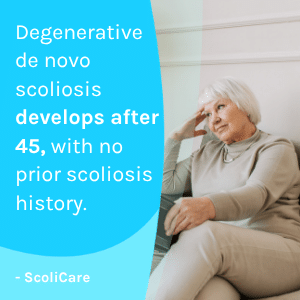
Degenerative de novo scoliosis develops later in life, with no prior history, and is most common in adults over the age of 45 (5).
The first step to customizing an adult’s scoliosis treatment plan is determining if the scoliosis is pre-existing or a new scoliosis.
Degenerative scoliosis is more common in females than males partially due to changes in bone density and hormone levels associated with menopause (5).
Degenerative scoliosis is caused by spinal degeneration, and while cases of adolescent scoliosis in adults can be progressive or stable (3), most cases of degenerative scoliosis are progressive and painful (5).
Spinal degeneration is to be expected with age, and while much of it is natural and age-related, the cumulative effect of certain lifestyle factors can either accelerate or decelerate the process: obesity, low activity levels, chronic poor posture, improper repeated lifting of heavy objects, smoking and excessive alcohol consumption.
Most degenerative changes within the spine start with the intervertebral discs. An intervertebral disc sits between adjacent vertebral bodies (bones of the spine), and disc health shapes overall spinal health in a number of ways (6).
Disc Degeneration
Disc degeneration is the cause of many spinal conditions and issues, and it mainly involves fluid loss and changes to disc shape and function (6).
The discs consist of a soft inner nucleus and a tough, but flexible, outer annulus, and together, the discs work to preserve water and nutrients and maintain their central position between adjacent vertebrae (6).
The discs work together to facilitate the spine’s shock absorption, flexibility, structure, and prevent vertebrae from rubbing up against one another, causing friction and more wear and tear on the spine during movement (6).
Over time, the discs naturally lose fluid, and excessive fluid loss is known as desiccation and commonly causes the outer annulus to become brittle and less flexible, compromising its shock absorption capability and causing the disc’s shape to change, becoming thinner (6).
When disc shape and health are impacted, the position of adjacent vertebrae that attach to the disc in between can also be disrupted, causing the spine to become misaligned and off-balance (5). A spine that’s not balanced is unstable and one that’s more vulnerable to developing an unnatural spinal curve: scoliosis.
Degenerative Scoliosis Symptoms
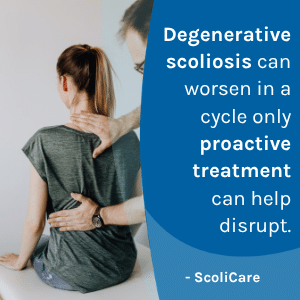
Because degenerative scoliosis is caused by degenerative instability, it’s virtually guaranteed to get worse as increasing instability causes curve progression, and curve progression causes increasing instability: a cycle of degenerative changes that only proactive treatment can break (5, 6).
The main symptom of degenerative scoliosis is generally lower back and leg pain, also likely to get worse as progression occurs (5).
Seniors should know that although curve size is an important factor that informs the customization of treatment plans, studies show pain level isn’t determined solely by curve severity, but also curve location, and most cases of degenerative scoliosis develop in the lumbar spine (4, 5).
The spine’s balance is another key factor when it comes to scoliosis pain. Adults whose posture has shifted noticeably forward are more likely to experience pain than adults whose posture shifts backward (4, 5).
In addition to lower back pain, postural changes such as a prominent forward hunch or lean to one side are common in seniors with scoliosis (5).
A loss of height is also common as degenerative scoliosis develops and progresses, and the more severe the scoliosis, the more healthy movements may be disrupted, causing further uneven wear and tear on the spine and its surroundings (5).
Additional clinical factors capable of compounding the scoliosis include menopause, former spinal surgery, a family history of scoliosis, and bone disease that weakens the spine (osteoporosis/osteopenia).
Degenerative Scoliosis Treatment
Once diagnosed, the most important choice to make is how to address the scoliosis with treatment for a better quality of life.
Because degenerative scoliosis affects older adults, involves the spine’s increasing instability, and causes pain capable of disrupting quality of life, fall prevention and pain management are focuses of treatment (4, 5).
When it comes to fall prevention, restoring the spine’s balance and stability is crucial. While significant curve reductions and corrections are a goal of childhood scoliosis treatment, an adult’s spine is different because growth is no longer occurring (5).
An adult’s spine is going to be less flexible, limiting corrective potential, but even small improvements to the spine’s balance can make a big difference when it comes to stability and pain (4, 5).
ScoliBalance®
ScoliBalance® combines the best of what scoliosis-specific chiropractic care and evidence-based scoliosis-specific exercise programs (the Schroth Method and the Scientific Exercise Approach to Scoliosis and Lyon Method ) has to offer (7).
In some cases, intense scoliosis-specific rehabilitative exercise can improve core strength for more spinal support; ScoliBalance® is a customized scoliosis-specific exercise rehabilitative program that is shaped by a patient’s posture, ability, curve type, symptoms, and treatment goals (7).
If an older adult’s curve is still flexible, ScoliBalance® has the potential to achieve fall prevention, improve pain, the spine’s balance, stability, posture, and appearance.
In cases that are progressing rapidly and further compromising the spine’s stability, a customized 3-dimensional scoliosis brace may be helpful.
ScoliBrace®
Because the ScoliBrace® is modern and corrective in its design, it works in conjunction with movement, making it complementary to ScoliBalance® programs.
Customized 3-dimensional bracing can help re-align the spine, improve and maintain a straight and uptight posture, reduce pain by preventing too much movement within the spine, and improve overall spinal health and quality of life (8).
The ScoliBrace® works by pushing the spine into a straighter alignment and supporting a straight and neutral upright posture (8).
Older adults with degenerative scoliosis are also vulnerable to the development of a lateral listhesis where one vertebral body slips to the side and is misaligned in relation to the lower vertebra. A lateral listhesis can cause severe pain and instability.
With a lateral listhesis, a brace can help stabilize the spine and provide short-term pain relief.
Conclusion
Degenerative scoliosis is the main type to affect adults over the age of 60, and in these cases, natural age-related spinal degeneration is occurring, and the sooner treatment is started, the more potential there is to preserve function and slow the degenerative process.
Lower back and leg pain is common for older adults with scoliosis, and while pain medications can help with short-term relief, for sustainable long-term pain-management solutions, a proactive treatment plan is needed.
A focus of treatment for seniors with scoliosis is on improving the spine’s balance and stability for better posture and fall prevention.
It’s never too late to work towards improving quality of life for a senior affected by scoliosis, and while no treatment outcome can be guaranteed, when degenerative scoliosis is diagnosed early in the degenerative process, there is more potential for treatment success.
References:
- Schwab FJ, Smith VA, Biserni M, Gamez L, Farcy JP, Pagala M. Adult scoliosis: a quantitative radiographic and clinical analysis. Spine (Phila Pa 1976). 2002 Feb 15;27(4):387-92. doi: 10.1097/00007632-200202150-00012. PMID: 11840105
- Weinstein SL. The Natural History of Adolescent Idiopathic Scoliosis. J Pediatr Orthop. 2019 Jul;39(Issue 6, Supplement 1 Suppl 1):S44-S46. doi: 10.1097/BPO.0000000000001350. PMID: 31169647
- Ansari K, Singh M, McDermott JR, Gregorczyk JA, Balmaceno-Criss M, Daher M, McDonald CL, Diebo BG, Daniels AH. Adolescent idiopathic scoliosis in adulthood. EFORT Open Rev. 2024 Jul 1;9(7):676-684. doi: 10.1530/EOR-23-0162. PMID: 38949156; PMCID: PMC11297403
- Zaina F, Marchese R, Donzelli S, Cordani C, Pulici C, McAviney J, Negrini S. Current Knowledge on the Different Characteristics of Back Pain in Adults with and without Scoliosis: A Systematic Review. J Clin Med. 2023 Aug 9;12(16):5182. doi: 10.3390/jcm12165182. PMID: 37629224; PMCID: PMC10455254
- York PJ, Kim HJ. Degenerative Scoliosis. Curr Rev Musculoskelet Med. 2017 Dec;10(4):547-558. doi: 10.1007/s12178-017-9445-0. PMID: 28980155; PMCID: PMC5685967
- Scarcia L, Pileggi M, Camilli A, Romi A, Bartolo A, Giubbolini F, Valente I, Garignano G, D’Argento F, Pedicelli A, Alexandre AM. Degenerative Disc Disease of the Spine: From Anatomy to Pathophysiology and Radiological Appearance, with Morphological and Functional Considerations. J Pers Med. 2022 Nov 1;12(11):1810. doi: 10.3390/jpm12111810. PMID: 36579533; PMCID: PMC9698646
- Palazzo, C., Montigny, J. P., Barbot, F., Bussel, B., Vaugier, I., Fort, D., … & Marty-Poumarat, C. (2017). Effects of bracing in adult with scoliosis: a retrospective study. Archives of Physical Medicine and Rehabilitation, 98(1), 187-190.Oakley PA, Harrison DD, Harrison DE, Haas JW. Evidence-based protocol for structural rehabilitation of the spine and posture: review of clinical biomechanics of posture (CBP) publications. J Can Chiropr Assoc. 2005
- Bayram F, Karatekin BD, Erhan B, Pasin O, Yumusakhuylu Y. Conservative Treatment in Adult Degenerative Scoliosis: a Prospective Cohort Study. Maedica (Bucur). 2024 Mar;19(1):23-29. doi: 10.26574/maedica.2024.19.1.23. PMID: 38736938; PMCID: PMC11079735
More news
-
 25 October 2023
Back pain in patients with scoliosis is quite prevalent. It is also possible that patients with scoliosis present with specific features of low back or leg pain. ScoliCare Head of…
-
 21 September 2022
By Ella Bourne - Chiropractor Background Idiopathic Scoliosis is the most common spinal deformity in adolescents, with established prevalence 2-3% in adolescents (1). The estimated prevalence of lower back pain…
-
 1 November 2020
Is Scoliosis a Cause of Pain? It might seem obvious that a bent or twisted spine would be painful, right! However doctors and other health professionals are taught that scoliosis…