
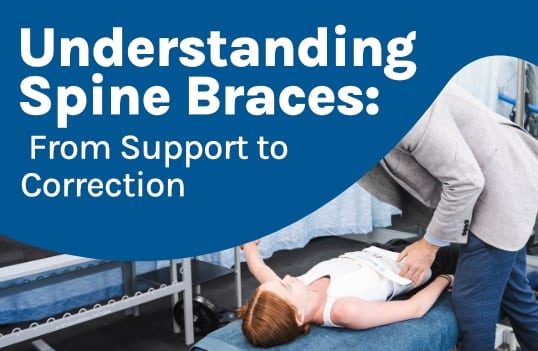
There are different approaches to treating scoliosis. Patients need to be informed about the benefits of different brace types and the treatment approach they’re part of. From supporting healthy posture and the spine’s optimal alignment to corrective potential, scoliosis bracing can be used as early intervention, for support, and/or as part of an integrative treatment plan.
Spinal braces for scoliosis can offer support, stability, pain relief, and correction. Treatment plans for scoliosis need to be fully customized including brace type. Understanding spine braces and the different scoliosis treatment options available is important.
Spinal braces can feature different designs and purposes.
Spinal Bracing as Scoliosis Treatment
Scoliosis bracing has been used as a nonsurgical treatment option for many years, but their design and purpose has evolved over the years (1).
A scoliosis brace is an orthotic device that’s worn tightly around the torso to improve the upper body and spine’s posture and alignment; it plays a central role in addressing scoliosis in children and adults.
Scoliosis bracing can be recommended for full-time or part-time wear, and some braces are designed to be worn only during sleep as a nighttime brace.
Research supports the potential efficacy of scoliosis bracing as a nonsurgical scoliosis treatment option and correlates full-time brace wear with successful treatment outcomes (2).
When it comes to the difference in bracing for childhood scoliosis and adult scoliosis, because children are still growing, their spines are more flexible and responsive to bracing; with adults, because flexibility of the curve is a determining factor in treatment, bracing is more about support, stability, and pain relief than correcting the scoliosis (3).
There is a significant difference between traditional scoliosis braces and modern corrective braces, so let’s talk about how they differ in design and function.
Traditional Scoliosis Bracing
Most traditional braces are types of TLSO braces (thoraco-lumbar sacral orthosis), and they are commonly made from rigid thermoplastic material and are hospital-designed (4).
There are many different types of TLSO braces, and their approach is to immobilize the spine using a 3-point pressure system that applies intense pressure at strategic points of the spine’s unnatural curve (4).
The Boston brace is the most widely used traditional brace that’s shown some success at stopping curve progression, but this isn’t the same as correcting scoliosis (5).
As a progressive condition, the nature of scoliosis is to get worse, and how a treatment approach manages progression is key.
Traditional scoliosis treatment has the primary goal of stopping progression, while modern corrective treatment has the primary goal of correcting the scoliosis.
In addition, the methodology of traditional scoliosis bracing can have some negative effects. Due to the intense squeezing nature of traditional bracing, the spine can be weakened over time, particularly in cases where bracing is recommended for full-time wear, and some patients develop breathing difficulties (6).
As traditional bracing uses spinal immobilization, it’s not designed to work with movement, so muscle strength and endurance can also suffer (6).
Traditional TLSO braces show positive results in slowing/stopping curve progression (5), and modern corrective bracing takes brace potential a step further to include correction.
Modern Corrective Scoliosis Bracing
After years of observation and research, the full potential of scoliosis bracing was understood and led to the design and manufacture of 3-dimensional scoliosis braces with corrective potential.
Stopping progression is a key part of managing scoliosis, but correcting scoliosis has the goal of addressing progression by improving the underlying structural nature of the scoliosis itself.
Corrective treatment doesn’t solely want to slow or stop progression; it wants to correct the spine’s position and alignment, and improve the spine’s surrounding muscle strength and balance so there is more support and stability for the spine.
When the spine’s structural alignment and position is improved, and its surrounding muscles are strengthened and balanced, progression is counteracted by the improvements to overall spinal health and function.
At the pinnacle of modern corrective bracing is the ScoliBrace®: a custom-made ultracorrective brace that has the potential to impact scoliosis in all 3 dimensions: addressing the spine’s unnatural lateral bending curve and its rotation (7).
The ScoliBrace® also has the goal of 3-dimensional postureal restoration; spinal health shapes postural health, and postural health shapes spinal health.
Improving how the body is held and positioned during daily activity can reduce tension on the spine, its supportive structures, and surrounding muscles, and improvements to the spine’s position makes it easier to maintain a straight and upright body posture (7).
So how exactly does the ScoliBrace® have the potential to improve the spine’s position and body posture?
ScoliBrace® Design and Function
The ScoliBrace® is part of a proactive nonsurgical treatment approach, so while the ScoliBrace® has a lot to offer in terms of its potential, the approach it’s aligned with increases its potential through integration with additional scoliosis-specific treatments (7, 8).
The ScoliBrace® is designed around the principle of Mirror Image® exercise rehabilitation so is 3D designed and manufactured to improve the body and spine’s 3D alignment (7).
Using CAM and CAD (computer-aided manufacture and design), 3D scans, digital X-rays, photos of a patient’s spine and body are captured to create a brace that’s fully customized around the specifics of a patient’s curve type and body posture.
The advanced customization techniques make braces more comfortable and appropriate for full-time wear. A scoliosis brace can only be effective if it’s worn exactly as it’s prescribed, but compliance can be a barrier to brace success when braces are uncomfortable and/or bulky and can’t easily be concealed under clothes.
The ScoliBrace® utilizes spinal coupling to hold the spine in an overcorrective position that counteracts the spine’s unnatural curve and rotation, rather than using 3-point pressure, to reshape the body’s 3D posture while inside the brace.
While the brace is worn, often for full-time wear, the connection between the brain and the new body position is being strengthened to maintain the position when not wearing the brace.
Together, the brain, spine, muscles, ligaments, joints, and supportive structures are being retained to maintain the body and spine’s healthier position.
And the potential of corrective bracing increases when paired with a scoliosis-specific rehabilitative exercise plan (8).
ScoliBrace® and ScoliBalance®
In some cases of mild flexible curves, bracing alone, as early intervention, may be enough to correct a curve and prevent progression, but in progressive, moderate, and severe curves, additional treatments are needed (8)
Because ScoliBrace® doesn’t immobilize the spine and is designed to work with movement, it can be combined with the corrective potential of ScoliBalance®: a customized scoliosis-specific rehabilitative exercise plan (8).
Designed by chiropractor, Dr. Jeb McAviney, and physical therapist Rose Mirenzi, ScoliBalance® combines the best of what scoliosis-specific chiropractic care and established scoliosis-specific exercise-based treatment programs like the Schroth Method and the Scientific Exercise Approach to Scoliosis (SEAS) has to offer (8, 9).
Chiropractic BioPhysics® is helpful as an adjunctive treatment, but the true corrective potential is in the combined power of modern 3D bracing and scoliosis-specific exercise working towards a common goal: improving the spine and body’s alignment, balance, and stability (9).
So it’s not just about what a chosen brace type has to offer, but the treatment approach it’s part of.
Conclusion
It’s important for patients to be educated on the different scoliosis treatment options available to them. Scoliosis treatment can shape the spine’s long-term health and function so informed treatment choices need to be made.
Just as no two cases of scoliosis are the same, treatment plans should be fully customized for specific results.
Patients need to understand the pros and cons of the different treatment approaches and options, and when it comes to scoliosis bracing, there are a number of options from a supportive brace with the main goal of stopping progression, to a corrective brace with the goal of improving the spine and body’s 3D alignment.
References:
- Heary RF, Bono CM, Kumar S. Bracing for scoliosis. Neurosurgery. 2008 Sep;63(3 Suppl):125-30. doi: 10.1227/01.NEU.0000320387.93907.97. PMID: 18812914
- Thompson, G. H. (2007). A Comparison of the Thoracolumbosacral Orthoses and Providence Orthosis in the Treatment of Adolescent Idiopathic Scoliosis. J Pediatr Orthop, 27, 369Y374.
*Weinstein, S. L., Dolan, L. A., Wright, J. G., & Dobbs, M. B. (2013). Design of the bracing in adolescent idiopathic scoliosis trial (BrAIST). Spine, 38(21), 1832 - McAviney J, Mee J, Fazalbhoy A, Du Plessis J, Brown BT. A systematic literature review of spinal brace/orthosis treatment for adults with scoliosis between 1967 and 2018: clinical outcomes and harms data. BMC Musculoskelet Disord. 2020 Feb 8;21(1):87. doi: 10.1186/s12891-020-3095-x. PMID: 32035480; PMCID: PMC7007692
- Sha L, Zhang T, Sui W, Fan Q, Yang J, Deng Y, Huang Z, Yang J. Comparison of the efficacy of thoracolumbosacral and lumbosacral orthosis for adolescent idiopathic scoliosis in patients with major thoracolumbar or lumbar curves: a prospective controlled study. Front Pediatr. 2024 Apr 2;12:1368201. doi: 10.3389/fped.2024.1368201. PMID: 38628358; PMCID: PMC11018990
- Karimi MT, Rabczuk T. Evaluation of the efficiency of Boston brace on scoliotic curve control: A review of literature. J Spinal Cord Med. 2020 Nov;43(6):824-831. doi: 10.1080/10790268.2019.1578104. Epub 2019 Feb 27. PMID: 30811316; PMCID: PMC7808318.
- İşçi H, Özdemir Görgü S. Understanding bracing outcomes in adolescents with idiopathic scoliosis: a mixed-methods approach. Front Rehabil Sci. 2025 Jul 23;6:1625736. doi: 10.3389/fresc.2025.1625736. PMID: 40772267; PMCID: PMC12325295
- Lim KBL, Mak HKW, Abdul Rahaman SH, Ong LL, Ooi SYJ, Lee NKL. A pilot study on the “ScoliBrace®” in the treatment of adolescent idiopathic scoliosis. Eur J Orthop Surg Traumatol. 2024 May;34(4):1803-1809. doi: 10.1007/s00590-024-03845-6. Epub 2024 Feb 28. PMID: 38416233
- Improvement of trunk muscle endurance in Adolescent Idiopathic Scoliosis (AIS) patients undergoing ScoliBrace® and Scientific Exercise Approach to Scoliosis (SEAS) treatment, SOSORT Book of Abstracts, SOSORT Lyon 2017.
- Haggard, J. S., Haggard, J. B., Oakley, P. A., & Harrison, D. E. (2017). Reduction of progressive thoracolumbar adolescent idiopathic scoliosis by Chiropractic BioPhysics®(CBP®) Mirror Image® methods following failed traditional chiropractic treatment: a case report. Journal of Physical Therapy Science, 29(11), 2062-206
The post Understanding Spine Braces: From Support to Correction appeared first on ScoliCare.
More news
-
 1 November 2022
It is hard to believe that the fastest man on earth has scoliosis! Olympian Usain Bolt was born with scoliosis. His right leg is half an inch shorter than his…
-
 17 July 2024
Receiving a scoliosis diagnosis as an adult can be daunting. Many people wonder how it happened, what the future holds, and whether it can be treated. Understanding scoliosis in adults…