
Part of the focus of childhood scoliosis treatment is counteracting progression. Growth is the main trigger for progression, so how scoliosis is managed during periods of rapid growth is key. Adolescents are the most at risk for rapid curve progression due to the rapid and unpredictable nature of pubescent growth spurts.
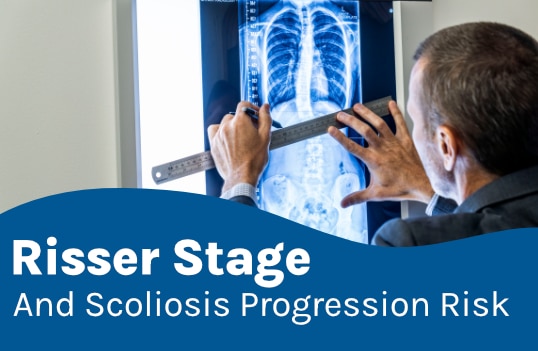
The Risser stage is a method for estimating potential scoliosis progression in children based on how much growth remains prior to reaching skeletal maturity; stages (0-5) are assigned to levels of iliac crest ossification with lower stages indicating more growth and potential progression, and higher stages indicating less growth and potential progression.
Scoliosis treatment plans need to be customized, and determining how much growth remains for a young patient can help craft a strategy for counteracting progression.
Scoliosis Progression
Scoliosis is progressive, so its nature is to become more severe over time, and there are a number of factors that shape a patient’s potential rate of progression (1).
Because scoliosis is progressive, the timing of treatment can be a key factor in its outcome (1, 2).
Scoliosis causes the spine to develop an unhealthy lateral curve with rotation, and progression means the size of the unnatural spinal curve, and its effects, are increasing.
As scoliosis progresses, it’s becoming more severe, the spine is becoming increasingly rigid, and less responsive to treatment.
In children, growth is the main trigger for progression, and in adults who are no longer growing, age-related spinal degeneration can trigger the onset of degenerative scoliosis and/or curve progression (1, 2, 3).
Children are the most at risk for rapid progression, particularly during periods of rapid growth, and the most prevalent type of scoliosis overall is adolescent idiopathic scoliosis (AIS) (1, 2).
Adolescent scoliosis is diagnosed around the onset of puberty in females and a little later in males, and the rapid and unpredictable nature of growth spurts during puberty can cause mild cases to quickly become moderate or severe (1, 2).
There are never treatment guarantees, but in many cases of scoliosis, if scoliosis is diagnosed in the early stages and treated proactively, the likelihood of a positive treatment-outcome increases (2).
Patient and scoliosis variables that help treatment providers determine a patient’s growth potential help craft treatment plants accordingly.
What is Risser Staging?
How scoliosis is managed during periods of rapid growth in children is crucial (2).
Growth spurts trigger progression, so the more growth spurts a patient goes through, the more potential progression there is in the future, and when it comes to customizing a treatment plan accordingly, this means working towards counteracting progression (2).
Children grow at different rates. There are always average heights and growth rates, but when it comes to scoliosis, an average doesn’t help; the more specific the treatment plan, the more individualized its results can be.
No two cases of childhood scoliosis are the same. Two adolescents can be diagnosed at the same age and with the same severity level, but if one adolescent grows faster with more significant growth spurts, they may progress significantly more, or faster, than the other patient (4).
In addition, the type of treatment approach is key. Traditional treatment often recommends watching and waiting in mild cases of scoliosis, but merely observing scoliosis, particularly during rapid periods of growth, may equate to allowing curve size to increase unimpeded (2).
Risser staging is a method for predicting progression based on a patient’s level of bone growth; the Risser stage is a scale from 0-5 that rates a patient’s level of iliac crest ossification and fusion (4)
The iliac crest is the curved and thick upper edge of the hip bone. The iliac crest forms the top sides of the pelvis and is an anchor for abdominal, back, and hip muscles; it also helps support the weight of the spine and stabilizes the pelvis (4)
The iliac crest aligns with the L4 vertebrae (4th vertebra of the lumbar spine) and can also be referred to as the hip bone or top of the pelvis.
Iliac Crest Ossification and Fusion
Iliac crest ossification is the process by which cartilage on the iliac (top edges of the hip bone) becomes bone; this signals adolescent skeletal maturity (4).
Ossification occurs across the iliac crest and moves towards the back.
In stages 1-3, ossification progresses across the crest with an estimated 25- to 75-percent coverage; at stage 4, almost-complete ossification has occurred, and at stage 5, growth has stopped and complete fusion between the apophasis (central cartilage growth plate) and ilium (upper hip bone) has occurred (4, 5)
At stage 5, skeletal maturity has been reached and the risk of progression decreases.
The average age of complete ossification is around 14 in females and 16 in males, but in some cases, full fusion can occur up to the age of 25 (4, 5).
Simply put, risser staging helps determine a patient’s bone age, so the amount of potential growth can be factored into the customization of treatment plans for a more specific and accurate prognosis.
Growth, Progression, and Treatment Methods
It’s important to determine a young patient’s growth potential because a key focus of childhood scoliosis treatment is effectively counteracting the progressive nature of scoliosis while the constant trigger of growth is occurring (1, 5).
A primary goal of treating scoliosis in children is to significantly reduce the size of the scoliosis and hold the reduction throughout growth; the faster a patient is progressing, the more challenging it is to counteract the condition’s progressive nature (1, 5).
So accurately assessing skeletal maturity means knowing how much potential progression a patient may face and directing treatment decisions accordingly.
Progression makes the spine increasingly rigid and less responsive to treatment; it also makes scoliosis symptoms more overt and disruptive, and the need for scoliosis surgery (spinal fusion).
A proactive treatment approach aims to prevent curve progression, increasing effects, and the need for invasive future surgical treatment.
The best way to preserve as much of the spine’s natural strength and function as possible is through nonsurgical treatment that’s integrative, customized, and evidence-based.
In patients with high growth potential (Risser stage of 0-2), this is a crucial window for treatment such as bracing that guides the spine’s growth in a straight and aligned position. Bracing efficacy is higher during periods of rapid growth and has the goal of preventing progression (4, 5).
Scoliosis-specific rehabilitative exercise plans (ScoliBalance®) also more effective during certain growth stages and because corrective scoliosis bracing (ScoliBrace®) is designed to work with movement, the treatment modalities complement one another as they are working towards the same goal: improving the spine’s position and balance (6).
Bracing and scoliosis-specific rehabilitative exercise also improve posture through holding the torso in a straight and upright position while teaching postural awareness through the use of Mirror Image exercise (6).
Accurately assessing bone maturity in children can lead to better results when it comes to managing progression, and the best way to minimize the potential effects and complications of scoliosis is through proactive treatment plans (4, 5).
Conclusion
Scoliosis affects all ages but is most often diagnosed in adolescence, and because no two scoliosis cases are the same, treatment plans need to be customized accordingly.
The more accurate and individualized a patient’s treatment plan is, the more specific the prognosis can be, and while there are no treatment guarantees, with early diagnosis and intervention, there are fewer limitations to what nonsurgical treatment can achieve.
Risser staging, also known as the risser system, is a method used in childhood scoliosis treatment that assigns stages (0-5) to the level of bone maturity based on iliac crest ossification and fusion.
A patient’s risser sign helps predict how much progression needs to be counteracted and informs treatment decisions.
A lower grade on the scale means more growth potential and progression, while higher grades indicate more skeletal maturity with less potential progression; when an integrative plan addresses this factor by apportioning scoliosis-specific rehabilitative exercise and corrective bracing at the ideal stage of skeletal maturity, potential treatment efficacy increases.
Regardless of patient age or scoliosis severity, there are always improvements that can be worked towards through a comprehensive, customized, and complete care plan: ScoliCare can help.
References:
- Weinstein SL. The Natural History of Adolescent Idiopathic Scoliosis. J Pediatr Orthop. 2019 Jul;39(Issue 6, Supplement 1 Suppl 1):S44-S46. doi: 10.1097/BPO.0000000000001350. PMID: 31169647
- Negrini, S., Donzelli, S., Aulisa, A. G., Czaprowski, D., Schreiber, S., de Mauroy, J. C., … & Zaina, F. (2018). 2016 SOSORT guidelines: orthopaedic and rehabilitation treatment of idiopathic scoliosis during growth. Scoliosis and spinal disorders, 13(1), 3
- York PJ, Kim HJ. Degenerative Scoliosis. Curr Rev Musculoskelet Med. 2017 Dec;10(4):547-558. doi: 10.1007/s12178-017-9445-0. PMID: 28980155; PMCID: PMC5685967
- Hacquebord JH, Leopold SS. In brief: The Risser classification: a classic tool for the clinician treating adolescent idiopathic scoliosis. Clin Orthop Relat Res. 2012 Aug;470(8):2335-8. doi: 10.1007/s11999-012-2371-y. PMID: 22538960; PMCID: PMC3392381.
- Dimeglio A, Canavese F. Progression or not progression? How to deal with adolescent idiopathic scoliosis during puberty. J Child Orthop. 2013 Feb;7(1):43-9. doi: 10.1007/s11832-012-0463-6. Epub 2012 Dec 11. PMID: 24432058; PMCID: PMC3566248
- Marchese R, Du Plessis J, Pooke T, McAviney J. The Improvement of Trunk Muscle Endurance in Adolescents with Idiopathic Scoliosis Treated with ScoliBrace® and the ScoliBalance® Exercise Approach. J Clin Med. 2024 Jan 23;13(3):653. doi: 10.3390/jcm13030653. PMID: 38337346; PMCID: PMC10856658
The post Risser Stage and Scoliosis Progression Risk appeared first on ScoliCare.
More news
-
 6 September 2021
What is the progression risk for very young children with scoliosis? A child that has Juvenile idiopathic scoliosis (JIS) is characterised by a high risk of progression. The growth spurts…
-
 15 July 2024
In recent years, patient-centered care has revolutionized the approach to scoliosis treatment by focusing on the unique needs, preferences and values of each patient. This approach places patients at the…