
The connection between scoliosis and genetics isn’t fully clear; the cause does depend on the type in question, and the majority of cases involve idiopathic scoliosis. When the cause is known, it shapes the design of treatment plans.
Scoliosis is a progressive unhealthy lateral curvature of the spine. The spine’s healthy curves are important for its strength, flexibility, and ability to handle stress incurred during daily activity. While scoliosis can run in families, it’s considered more familial than genetic.
Although we don’t always know what causes scoliosis to develop, observation and study have taught us that a proactive treatment response is best.
What Does a Scoliosis Diagnosis Mean?
A scoliosis diagnosis means an unnatural sideways spinal curvature has developed that also rotates, and there are different severity levels and types.
In addition, its progressive nature means that most cases of scoliosis will get worse over time, so a scoliosis diagnosis means that treatment is needed.
Scoliosis can be diagnosed as mild scoliosis, moderate scoliosis, or severe scoliosis, can affect all ages, and different types include idiopathic scoliosis, neuromuscular scoliosis, and degenerative scoliosis.
Most cases of scoliosis are idiopathic, meaning no known cause, although there appear to be genetic factors, and adolescents are the most commonly diagnosed (1, 2).
In cases of neuromuscular scoliosis, the scoliosis develops due to a neuromuscular condition like cerebral palsy, spina bifida, or muscular dystrophy; these cases can be severe, and treatment needs to focus on the larger neuromuscular condition (3).
A significant number of neuromuscular conditions have genetic causes. Not all neuromuscular conditions cause scoliosis, but it is a common complication, so in cases of neuromuscular scoliosis, genetics can play more of a role in the larger neuromuscular condition than the scoliosis itself (3).
After idiopathic scoliosis,degenerative scoliosis is the next most common type to affect adults, is most prevalent in adults over 45, and because it’s caused by degenerative instability, it is almost always progressive and painful (4).
For the current topic of scoliosis and genetics, let’s focus on the most common type overall: adolescent idiopathic scoliosis.
Adolescent Idiopathic Scoliosis
Adolescent idiopathic scoliosis is the most prevalent type of scoliosis and is most often diagnosed during rapid periods of growth between 10 and 18 years of age (2).
As growth is what makes scoliosis progress, children going through growth spurts have the most to gain from early detection and treatment (5).
Idiopathic means not clearly linked to a single known cause, but that doesn’t mean idiopathic scoliosis can’t have multiple causes, or be caused by a combination of variables.
Considering the prevalence of childhood scoliosis, at the time of diagnosis, treatment providers are frequently asked what caused the child’s scoliosis and/or if it was preventable.
When it comes to idiopathic scoliosis, it’s considered more multifactorial and familial than genetic. 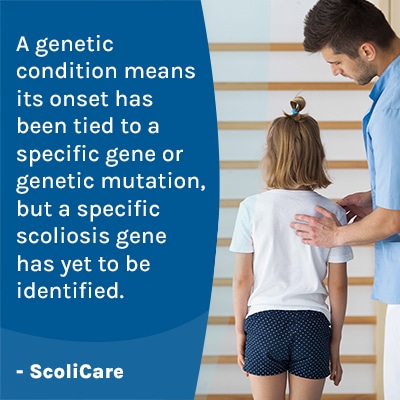 A genetic condition means its onset has been tied to a specific gene or genetic mutation, but a specific scoliosis gene has yet to be identified (1).
What idiopathic scoliosis does have are known risk factors, one of which is family history. In addition, females are more likely to be diagnosed and progress, and children approaching puberty are also more at risk, as progression is triggered by growth, and this is when scoliosis is most commonly diagnosed (6).
There are significant benefits to diagnosing childhood scoliosis prior to the first significant growth spurts of puberty, but what really needs to be understood is that the potential benefits of early detection are only available to those whose treatment approach is proactive and values starting treatment early (5).
When a patient is first assessed, it’s not just their spine, posture, and movement that are observed; a patient’s medical and family history are also considered.
Genetic vs Familial
In addition to gender and age, having another family member diagnosed with scoliosis is considered a risk factor, but this can be due to a number of factors (6).
After all, families don’t just share genes; they can share body types, diet, lifestyle, mental health, geography, socioeconomic factors, sleep habits, and more.
So the higher risk of being diagnosed with scoliosis if another member has been diagnosed isn’t linked solely to genetics, but can also be tied to a number of familial factors (6).
Parents of children recently diagnosed need to understand that other than regular screening to help with early detection and education, there isn’t much a parent can do to prevent a child from being diagnosed (5).
Understanding scoliosis risk factors and the benefits of early detection can mean diagnosing scoliosis while it’s still mild and most likely to respond well to treatment (5).
So let’s talk about the early indicators of scoliosis that parents and caregivers should watch for, particularly when risk factors are present.
Signs of Scoliosis in Children
Scoliosis is most often diagnosed in children, and while no two cases are the same, postural changes are often the earliest visual indicators that scoliosis is present (7).
As scoliosis is causing the spine to bend and rotate unnaturally, this is disrupting its alignment and balance, and also disrupting posture (7).
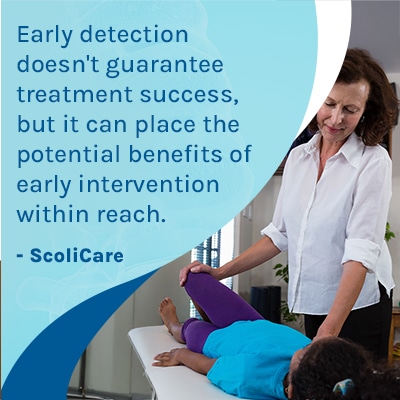
Early detection doesn’t guarantee treatment success, but it does place the potential benefits of early intervention within reach (5).
When scoliosis is diagnosed while mild, the curve size is smaller and may be easier to correct; it also means a significant amount of progression hasn’t yet occurred (5).
The more progression a child goes through, the more challenging it can be to reverse its effects, including postural changes (7).
Early signs of scoliosis include uneven shoulders, shoulder blades, and hips, and as progression occurs, particularly when driven by unpredictable growth spurts, these changes can occur quickly, and the longer scoliosis is left untreated, the more established the effects can become (7).
Additional changes to watch for include the development of a rib cage asymmetry where one side protrudes more, and the more posture is affected, the more healthy movement patterns can be disrupted including balance, coordination, and gait (7).
Scoliosis that’s left untreated can cause increasing uneven wear and tear on the spine and body, and regardless of the cause, what matters most is how a diagnosis is responded to with treatment.
Conclusion
So is scoliosis genetic? While many sources cite genetic factors as a potential cause of idiopathic scoliosis, one specific scoliosis gene that accounts for its development hasn’t been identified.
As family history is considered a risk factor, the general consensus is that idiopathic scoliosis is more familial: caused by a combination of variables that family members commonly share.
Here at ScoliCare, we don’t just treat scoliosis; we want to help more patients experience the potential benefits of early detection through education and awareness.
While there is still a lot we don’t fully understand about scoliosis causation and genetic factors, we know the sooner treatment is started, the better, and we know that when approached proactively, nonsurgical treatment has more potential for correction.
Here at ScoliCare, an experienced team of Clinicians can diagnose, assess, and treat scoliosis with nonsurgical treatment options that are evidence-based, less invasive than surgical options, and work towards restoring the spine and body’s symmetry and balance.
References:
- Wise CA , Gao X, Shoemaker S, Gordon D, Herring JA. Understanding genetic factors in idiopathic scoliosis, a complex disease of childhood. Curr Genomics. 2008 Mar;9(1):51-9. doi: 10.2174/138920208783884874. PMID: 19424484; PMCID: PMC2674301
- Weinstein SL. The Natural History of Adolescent Idiopathic Scoliosis. J Pediatr Orthop. 2019 Jul;39(Issue 6, Supplement 1 Suppl 1):S44-S46. doi: 10.1097/BPO.0000000000001350. PMID: 31169647
- Wishart BD, Kivlehan E. Neuromuscular Scoliosis: When, Who, Why and Outcomes. Phys Med Rehabil Clin N Am. 2021 Aug;32(3):547-556. doi: 10.1016/j.pmr.2021.02.007. Epub 2021 May 12. PMID: 34175013.
- Marty-Poumarat, Catherine MD*; Scattin, Luciana MD†; Marpeau, Michèle MD*; Garreau de Loubresse, Christian MD‡; Aegerter, Philippe MD, PhD§. Natural History of Progressive Adult Scoliosis. Spine 32(11):p 1227-1234, May 15, 2007. | DOI: 10.1097/01.brs.0000263328.89135.a6
- Dunn J, Henrikson NB, Morrison CC, et al. Screening for Adolescent Idiopathic Scoliosis: A Systematic Evidence Review for the U.S. Preventive Services Task Force [Internet]. Rockville (MD): Agency for Healthcare Research and Quality (US); 2018 Jan. (Evidence Synthesis, No. 156.) Chapter 1, Introduction. Available from: https://www.ncbi.nlm.nih.gov/books/NBK493369/
- Scaturro D, Costantino C, Terrana P, Vitagliani F, Falco V, Cuntrera D, Sannasardo CE, Vitale F, Letizia Mauro G. Risk Factors, Lifestyle and Prevention among Adolescents with Idiopathic Juvenile Scoliosis: A Cross Sectional Study in Eleven First-Grade Secondary Schools of Palermo Province, Italy. Int J Environ Res Public Health. 2021 Nov 24;18(23):12335. doi: 10.3390/ijerph182312335. PMID: 34886069; PMCID: PMC8656498
- Hong KS, Van Minh P, Nguyen HT, Phan MH, Nguyen HN, Pham TP. Re-evaluation of Incorrect Posture as a Diagnostic Criterion for Scoliosis in School Screenings: A Cross-Sectional Study in Vietnam. Cureus. 2025 Mar 31;17(3):e81535. doi: 10.7759/cureus.81535. PMID: 40314041; PMCID: PMC12043434.
The post Scoliosis and Genetics: Exploring the Connection appeared first on ScoliCare.
More news
-
 11 April 2022
Rosemary Marchese, Physiotherapist As a clinician working with patients with scoliosis, it was not uncommon to hear particular questions from parents of adolescents with idiopathic scoliosis. One of those questions…
-
 14 March 2021
Kurt Cobain and his Scoliosis Part of our series of famous people who have/had a Scoliosis. Next up is Kurt Cobain! Kurt Cobain is best known as the lead singer…