
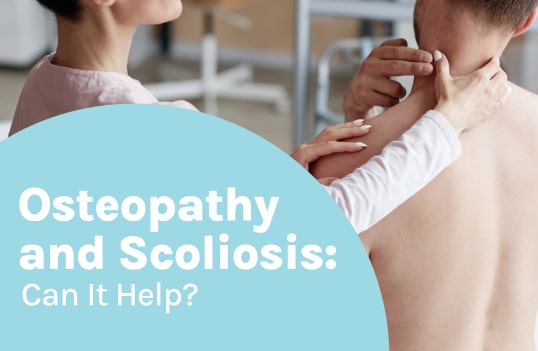
While a variety of physical therapy approaches work towards a similar goal of pain relief and improving mobility, the principles, practices, and techniques can vary. Osteopathy, for example, uses a hands-on approach to whole-body improvement through manual manipulation, while physical therapy for scoliosis is specialized, exercise-based, and corrective. Osteopathy can be used as a complementary treatment that offers therapeutic benefits and symptom relief, but isn’t a corrective scoliosis treatment option.
Osteopathy may help some people with scoliosis manage pain, muscle tension, and mobility, but it does not correct the spinal curve. For scoliosis treatment, care usually needs to be scoliosis-specific and may include scoliosis-specific exercise and 3D corrective bracing.
Non-surgical scoliosis management should be prioritized in the form of 3D corrective bracing and scoliosis-specific exercise programs, as per international guidelines and research.
Can Osteopathy Help Scoliosis?
Osteopathy may help locate and assess issues related to scoliosis such as changes to posture, movement, muscle strength and balance, and joint mobility.
Osteopathy can provide more information regarding particular areas of the body that may be showing signs of scoliosis, need further assessment, and/or aren’t functioning properly due to the spine’s unnatural curve, so it can be helpful in terms of identifying scoliosis symptoms and working towards symptom relief.
Scoliosis-treatment plans need to be personalized, and the more information that’s available about a patient’s overall health and how scoliosis is affecting the body, the more specific a treatment plan can be for widespread improvement.
Osteopathy is a type of manual healthcare that focuses on how the musculoskeletal system shapes overall health (1).
Through the use of massage, stretches, and hands-on manipulation, circulation, tension, and the body’s alignment may be improved. Osteopathic philosophy is built on the understanding that if the body’s not aligned and balanced, it can’t function properly (1).
Manual techniques such as palpation involve an osteopath using their fingers and hands to feel around the body for areas of tenderness, swelling, abnormalities, assessing pulse, heart rate, temperature, muscle tone and joint stability (1).
When movement, muscle tension, and joint mobility improve, some people may feel more comfortable and move more easily.
Osteopaths may assess posture, movement, muscle tension, and joint mobility, but scoliosis diagnosis and treatment planning usually require scoliosis-specific assessment and, when appropriate, imaging (1).
Scoliosis and Osteopathy
What you should know about osteopathy and scoliosis is that the benefits are more therapeutic, in terms of symptom relief, but osteopathy is not a treatment option.
Scoliosis affects the spine’s structure and alignment by causing it to curve unnaturally to the side and rotate, and this doesn’t just affect the spine and its individual structures, but also muscles surrounding the spine, spinal nerves, and the entire body (2).
Because the spine is the body’s main structural support, it stabilizes the body, and because scoliosis disrupts the spine’s straight, neutral, and aligned position, it means the body is also off-balance and less stable (2).
Scoliosis can cause poor posture, muscular imbalance, muscle pain and tension, nerve pain, and a loss of mobility and coordination (2).
Scoliosis patients can benefit from a number of different types of treatment, and while osteopathy can be integrated into a scoliosis physical therapy program as an adjunctive treatment, it cannot replace primary nonsurgical scoliosis treatment options (3).
What osteopathy can do for scoliosis is help identify areas of muscle tension, imbalance, and joint immobility, and offer short-term pain relief and functional improvement.
Osteopathy for Symptom Relief
Osteopathy can be used to help relieve some symptoms of scoliosis, but what patients should know is that symptom relief is not the same as addressing the cause of the symptoms, and improvement to the spine’s structural alignment is not within the scope of osteopathy (3).
With the onset and progression of scoliosis, back and muscle pain is common, and an osteopath can help with pain management through soft tissue massage that releases tension from strained and sore muscles (1).
Osteopaths can also recommend stretches to relax strained and overused muscles in the back, chest, and hip, and because of the whole-body approach, they can assess and improve body posture through manual techniques to address muscular imbalance and joint immobility: important factors for spinal health (1).
Improvements in movement, posture, and comfort can often support better function.
An effect of scoliosis progression is the spine getting more rigid, and this can cause a reduced range of motion and pain, and osteopaths work towards increasing overall flexibility, and the flexibility of its surrounding muscles, for pain relief and better body mechanics (1).
In some cases, manual therapy may help with rib mobility and breathing comfort, but breathing concerns in scoliosis should be assessed by an appropriately-trained clinician (1).
Osteopathic treatment can complement the primary scoliosis management protocols of scoliosis-specific physical therapy, targeted exercise, and 3D corrective bracing (4).
Scoliosis-Specific Exercise
Physical therapy focuses on pain relief, mobility, and functional improvement, largely through the power of exercise and mindful movement.
What patients should know about physical therapy for scoliosis is that it needs to involve scoliosis-specific exercise, be designed by a scoliosis specialist, and personalized around a patient’s curve, symptoms, and treatment goals.
As discussed above, osteopathy is best understood as supportive care rather than curve-corrective treatment.
Because scoliosis can progress, especially during growth, treatment decisions should be based on the individual curve, symptoms, age, and risk of change.
ScoliBalance®
Designed by chiropractor, Dr. Jeb McAviney, and physical therapist Rose Mirenzi, ScoliBalance® combines the best of what scoliosis-specific chiropractic care and established scoliosis-specific exercise-based treatment programs like the Schroth Method and the Scientific Exercise Approach to Scoliosis (SEAS) has to offer (4).
ScoliBalance® is an evidence-based customized scoliosis-specific rehabilitative exercise program used to treat scoliosis in patients of all ages.
ScoliBalance® personalizes treatment plans around a patient’s age, progressive rate, curve location, type, severity, symptoms, and treatment goals.
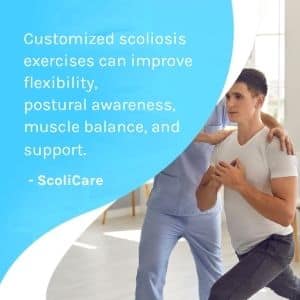
When customized and scoliosis-specific, exercise can offer a number of benefits including making the spine more flexible for treatment responsiveness, teaching postural awareness through the use of Mirror Image® exercise, and improving the spine’s surrounding muscle strength and balance for more support (4).
Patients are taught postural awareness and restoration for 3D correction as they learn how to position the body and spine during movement; the more these corrections are integrated into daily life, the more established the spine’s healthier position becomes (4).
ScoliBalance® begins educating patients in-clinic, and when patients are capable, the rehabilitative exercises can be performed from home.
Particularly when ScoliBalance® is used as part of a complete care approach, it can offer the following benefits:
- Slowing/stopping curve progression
- Increasing spinal flexibility
- Increasing the spine’s surrounding muscle strength/balance
- Improving body appearance
- Improving posture
- Teaching postural awareness
- Restoring healthy movement patterns
- Pain relief
- Curve reduction
- Fall prevention in older adults
Scoliosis can range from mild to very severe, and for smaller flexible curves, ScoliBalance® may successfully stop curve progression while improving posture and body appearance, but for larger more-complex curves, bracing is also necessary (4).
Because the modern ScoliBrace® uses the same corrective approach as ScoliBalance®, the treatments complement one another by working towards the same goal of improving the spine’s position and preventing progression (4).
Studies show that when ScoliBalance® is combined with ScoliBrace®, muscle health can be improved and preserved (4).
Conclusion
Scoliosis patients need to know the difference between managing symptoms of scoliosis and treating the scoliosis. General medical care and physical therapy can address symptoms of scoliosis, but treating scoliosis effectively means addressing its structural nature and increasing the spine’s support and stability for long-term symptom relief.
While osteopaths can use palpation, stretches, and massage to release tension, balance/strengthen muscles, increase flexibility, and mobilize joints, these are general approaches with general benefits that can help as an adjunctive treatment, but the main nonsurgical scoliosis treatment options are ScoliBalance® and ScoliBrace®.
If you or your child has scoliosis and you are considering osteopathy, it can be helpful to understand where it fits. Osteopathy may support comfort and mobility, but scoliosis-specific assessment is important to understand the curve, risk of progression, and whether exercise-based care, bracing, or monitoring may be appropriate.
References:
- Roberts A, Harris K, Outen B, Bukvic A, Smith B, Schultz A, Bergman S, Mondal D. Osteopathic Manipulative Medicine: A Brief Review of the Hands-On Treatment Approaches and Their Therapeutic Uses. Medicines (Basel). 2022 Apr 27;9(5):33. doi: 10.3390/medicines9050033. PMID: 35622072; PMCID: PMC9143587
- Janicki JA, Alman B. Scoliosis: Review of diagnosis and treatment. Paediatr Child Health. 2007 Nov;12(9):771-6. doi: 10.1093/pch/12.9.771. PMID: 19030463; PMCID: PMC2532872
- Hasler C, Schmid C, Enggist A, Neuhaus C, Erb T. No effect of osteopathic treatment on trunk morphology and spine flexibility in young women with adolescent idiopathic scoliosis. J Child Orthop. 2010 Jun;4(3):219-26. doi: 10.1007/s11832-010-0258-6. Epub 2010 Apr 18. PMID: 21629373; PMCID: PMC2866846
- Marchese R, Du Plessis J, Pooke T, McAviney J. The Improvement of Trunk Muscle Endurance in Adolescents with Idiopathic Scoliosis Treated with ScoliBrace® and the ScoliBalance® Exercise Approach. J Clin Med. 2024 Jan 23;13(3):653. doi: 10.3390/jcm13030653. PMID: 38337346; PMCID: PMC10856658
The post Osteopathy and Scoliosis: Can It Help? appeared first on ScoliCare.
More news
-
 24 February 2023
The short answer is yes, people with scoliosis can live normally. However, it is important to understand the condition and its impact on the individual's life. Scoliosis is a complex…
-
 15 July 2024
In recent years, patient-centered care has revolutionized the approach to scoliosis treatment by focusing on the unique needs, preferences and values of each patient. This approach places patients at the…