

Scoliosis is a sideways curvature of the spine measuring over 10 degrees combined with rotation. Studies show that approximately 2-3% of adolescents will develop Scoliosis with 10% progressing past 20 degrees and requiring some form of treatment (1). Parents are frequently told by health care providers that Scoliosis of 20 degrees is, “nothing to worry about”, or, “they will grow out of it”, or even worse, “ lets watch it and see if it gets worse”. ‘Wait and see’ is not a treatment option and risks the child missing a perfect window of opportunity to seek treatment.
Scoliosis Can Progress
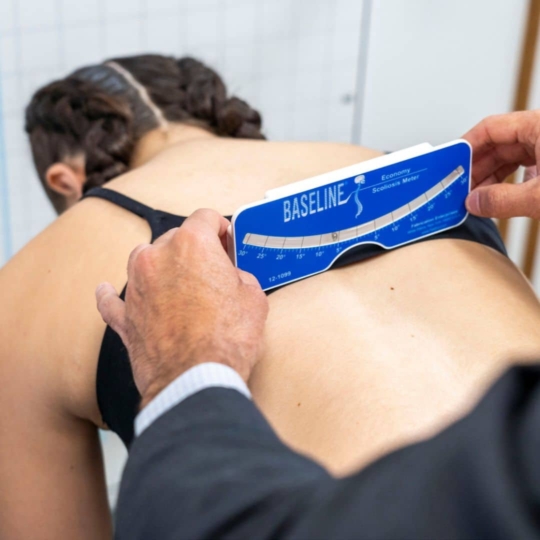
Scoliosis curves that reach 20 degrees are more likely to continue to worsen in a growing child (1, 2). At 20 degrees some form of Physiotherapeutic Scoliosis Specific Exercise (PSSE) program should begin at a minimum and part time bracing could be considered as well in some cases where the patient is very young or the curve seems to be progressing very fast (2). . PSSE programs are scoliosis exercise programs specific to treating scoliosis and are very different to other more general exercise programs (2, 3). ScoliBalance is a comprehensive PSSE program and combines the best of research and clinical experience to provide a custom made program to the patient that is specific to their curve type and presentation (2). This program is combined with ScoliBrace for larger curves (3), which has been shown to improve the Cobb angle in many patients and reduce progression in almost all patients who wear their brace as prescribed (3).
ScoliBrace For Curves Greater Than 25 Degrees
If PSSE isn’t enough to stabilize the scoliosis curve, or the curve has already reached 25 degrees then full time scoliosis bracing should begin (2). Results are best when full time corrective bracing is started early, ideally before the curve reaches 30 degrees (2, 3). When combined with PSSE the patient has a greater chance of getting better results (2) that go even beyond just reducing the Cobb angle but can also include making sure trunk muscle endurance is not only maintained, but improved (3). Once the curve has reached more than 30 degrees the risk of progression is higher and more deformity of the spine and discs has taken place. At this point full time bracing and PSSE offers the best chance of stabilizing or reducing the curve (2, 3). Treatment is also aimed at prevention of postural collapse, reduction or prevention of pain and reducing the need for excessive treatment or surgery during adult life (4).
When choosing a brace it is important to note that not all braces are built the same. ScoliBrace is a mirror image, over corrective brace that uses modern design features like CAD/CAM and finite element modeling. Analysis of the patient ‘s scoliosis using this system involves the use of 3D laser scanning and not outdated casting methods and hand crafting.
ScoliBrace and ScoliBalance in One Location
Embarking on a scoliosis treatment journey is an important decision. To make life easier and less arduous for the patient it is important to seek expert care all in the one location. ScoliCare East Phoenix offers ScoliBalance, a PSSE program and ScoliBrace all in their scoliosis specific clinic. This means that the patient can be assessed and have their scoliosis treated and managed all in one location. This includes an in- office, X-ray facility, private ScoliBalance suites to provide one-on-one hour long scoliosis exercise sessions. The patient can have their brace scans done on site and the brace delivered to the clinic for fitting and management.
If you or your child are suffering from Scoliosis anywhere in Arizona we are the place to come for treatment. Call us today at 480-892-0022 to set up a consultation time or contact us on our website at ScoliCare.com/East-Phoenix-Arizona.
References:
- Weinstein, Stuart L. MD. The Natural History of Adolescent Idiopathic Scoliosis. Journal of Pediatric Orthopaedics 39():p S44-S46, July 2019. | DOI: 10.1097/BPO.0000000000001350
- Negrini, S., Donzelli, S., & McAviney, J. (2023). Current Knowledge on the Different Characteristics of Back Pain in Adults with and without Scoliosis: A Systematic Review. Journal of Clinical Medicine. Retrieved from MDPI.
- Marchese, R., Du Plessis, J., Pooke, T., & McAviney, J. (2024). The Improvement of Trunk Muscle Endurance in Adolescents with Idiopathic Scoliosis Treated with ScoliBrace® and the ScoliBalance® Exercise Approach. Journal of Clinical Medicine, 13(3), 653.
- Boon Leong Lim, K., Mak, H.K.W., Abdul Rahaman, S.H., Ong, L.L., Ooi, S.Y.J., & Lee, N.K.L. (2024). A pilot study on the “ScoliBrace” in the treatment of adolescent idiopathic scoliosis. European Journal of Orthopaedic Surgery & Traumatology. Retrieved from PubMed.
More news
-
 19 October 2021
This month we take you behind the scenes of the treatment story of a 14 year old girl with adolescent idiopathic scoliosis who opted for a ScoliBrace. Let’s call her…
-
 15 July 2024
In recent years, patient-centered care has revolutionized the approach to scoliosis treatment by focusing on the unique needs, preferences and values of each patient. This approach places patients at the…