
The spine’s healthy curves are important; they make the spine stronger and less vulnerable to injury, more flexible with a wider range of motion, and better able to handle daily stress. The loss of a healthy spinal curvature can affect the spine and body in a number of ways.
Lordosis is an inward curve of the spine found in the neck and lower back. Too much lordosis is known as hyperlordosis, and too little lordosis is diagnosed as hypolordosis. There is a natural variance in curve size from person to person, but if lordosis becomes over- or under-pronounced, the lordosis is considered atypical and may be problematic.
As one long structure with three main sections, the health of each spinal section is connected.
What is Lordosis?
There are healthy and unhealthy spinal curves.
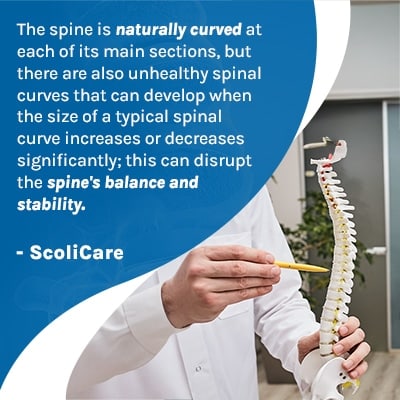
The spine is naturally curved at each of its main sections, but there are also unhealthy spinal curves that can develop when the size of a typical spinal curve increases or decreases significantly; this can disrupt the spine’s balance and stability (1).
The three main spinal sections include the cervical spine (neck), thoracic spine (middle/upper back), and the lumbar spine, and each section has specific roles to play in maintaining overall spinal health function (1).
Lordosis refers to a spinal curvature type that curves inwards, so when viewed from either side, a lordotic curve will be C-shaped.
Lordosis naturally occurs in the cervical and lumbar spinal sections.
If the spine’s vertebrae (bones) are aligned, its healthy curves are in place, but if one or more vertebral bodies shift out of alignment with the rest of the spine, the development of an unhealthy spinal curve can increase the risk of injury and become problematic (2).
 The vertebrae of the cervical spine connect the brain to the rest of the spine and body, they support the weight of the head, and facilitate a wide range of motion in the neck, but if the neck can’t maintain its healthy curve (lordosis), its ability to function can be disrupted (3).
The thoracic spine is the largest spinal section, and as the only section attached to the rib cage, it provides structural support, protects important organs, and facilitates the torso’s range of motion.
The thoracic spine has a curve that bends outwards, known as kyphosis: the opposite curve type to lordosis (4).
The vertebrae of the lumbar spine work the hardest. The lower back has to support the weight of the thoracic and cervical spinal sections above and the upper body; it facilitates the spine’s alignment with the pelvis for healthy lower body movement, and it feels the effects of strenuous movement/lifting heavy objects (5, 6).
If the lower back loses its lordosis, pain and functional deficits may develop (5, 6).
Now that we’ve talked generally about lordosis, and the lordotic sections of the spine, let’s talk about the difference between an increase or decrease in lordosis.
Too Much Lordosis: Hyperlordosis
The spine’s natural curves and alignment are key to overall spinal health, and as the balance and stability of the spine shapes the balance and stability of the entire body, the development of an unhealthy spinal curve can be disruptive in a number of ways.
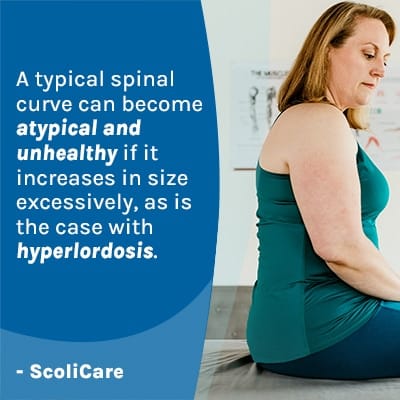
A typical spinal curve can become atypical and unhealthy if it increases in size excessively, as is the case with hyperlordosis.
The spine is the body’s main support structure; it allows us to stand upright, practice good posture, engage in a wide range of motion, and supports healthy movement patterns.
And as the spinal cord consists of 31 pairs of spinal nerves that work with the brain and form the central nervous system, a healthy spine is needed for clear brain-body communication (1).
Hyperlordosis is diagnosed when a patient’s lordosis becomes excessive, meaning the spine bends inward too far, disrupting spinal balance and alignment.
Cervical Hyperlordosis
If a person’s cervical lordosis becomes excessive, cervical hyperlordosis can cause forward head posture to develop; the head shifts forward in response to the neck’s excessive inward curve, increasing the weight of the head on the neck (3, 7).
Common symptoms of cervical hyperlordosis can include:
- Poor posture (head and neck are pushed forward)
- Stiffness in the neck
- Neck pain
- Headaches
- A loss of motion in the neck
- Dizziness
- Numbness and tingling sensations due to nerve compression
- Weakness in the neck
The neck’s healthy curve is important, and while a person’s degree of lordosis can vary within a healthy range, if the neck curves too far inward, the curve is excessive and considered atypical (3).
A healthy range of cervical lordosis would fall within 20 to 40 degrees, with cervical hyperlodosis commonly diagnosed at 45+ degrees (3).
Lumbar Hyperlordosis
 A diagnosis of lumbar hyperlordosis means the lower back curves inward excessively, and this can disrupt the lumbar spine’s load-bearing ability (5).
If the lower back has too much lordosis, it can disrupt the even distribution of upper body weight over the pelvis and lower body as the hips can tilt forward excessively, and this can cause the development of unhealthy posture and movement patterns (5, 6).
The main symptom of lumbar hyperlordosis is a swayback appearance involving the buttocks and abdomen protruding excessively, and additional symptoms can include:
- Lower back pain that worsens with movement
- Reduced mobility in the lower back and body
- Posture changes (head shifting forward and hips tilting forward)
- Inability to lay flat on a surface
- Tight lower back muscles
- Muscle spasms
- Radiating pain in the legs due to nerve compression
- Bowel- and bladder-control issues (more common in severe cases)
The health of the lumbar spine is important, particularly as it affects lower body movement (6).
While estimates can vary, a healthy degree of lumbar lordosis is generally considered to fall within a range of 40 to 60 degrees, with lumbar hyperlordosis diagnosed at 60+ degrees (3, 8).
Too Little Lordosis: Hypolordosis
We’ve talked about what happens when a person’s degree of lordosis increases to the point of being excessive and problematic, but what happens if there is a decrease of lordosis?
While hyperlordosis is more common than hypolordosis, particularly in the lower back, a diagnosis of hypolordosis means a decrease in lordosis has caused the affected spinal section to flatten out, becoming excessively straight.
Cervical Hypolordosis
If the cervical spine flattens out excessively, the curve’s C-shape is lost and causes the neck to appear excessively straight (3, 7).
Cervical hyporlordosis can also cause the development of forward head posture, and additional common symptoms can include:
- Neck pain
- Reduced range of motion in the neck
- Headaches
- Numbness and/or tingling in the neck, shoulders, and arms due to compressed nerves
- Muscle weakness
- Dizziness
- Difficulty swallowing (severe cases)
- Disruptions to bladder function (severe cases)
Lumbar Hypolordosis
Lumbar hypolordosis causes the lumbar spine to straighten out excessively, commonly causing a stooped-forward posture (5, 6).
In addition to postural changes, common symptoms of lumbar hypolordosis can include:
- Lower back pain
- Stiffness in the lower back
- Limited mobility in the lower back
- Numbness and/or tingling in the lower back and legs due to nerve compression
- Muscle weakness
- Bowel or bladder issues (severe cases)
An excessive loss of lordosis in the lower back may not just affect the lumbar spine, but also has the potential to affect the sections above and the lower body, particularly when it comes to mobility.
Conclusion
Overall spinal health is shaped by a number of factors, one of which is the health of each spinal section’s curve and alignment with the rest of the spine.
There are two main types of spinal curves: lordosis and kyphosis.
Lordosis refers to an inward spinal curvature, while kyphosis is the opposite curve type that curves outwards in a reverse C-shape (when viewed from the side).
Lordosis naturally occurs in the cervical and lumbar spinal sections, and a healthy degree of lordosis means the spine doesn’t curve too far inward, nor is it excessively straight.
If the spine develops too much lordosis, this is diagnosed as hyperlordosis, and if the spine’s natural lordosis flattens out and causes the section to become excessively straight, this is diagnosed as hypolordosis.
Too much or too little lordosis can cause postural and mobility changes, pain and discomfort, and disruptions to nerve health/function.
There are a number of potential causes for hyper and hypolordosis including chronic poor posture, low activity levels, too much time spent looking down at devices (tech neck), obesity, injury, spinal degeneration, injury, and the presence of underlying spinal conditions like scoliosis.
The first step to addressing a loss of healthy lordosis is determining its underlying cause so a treatment plan can be customized accordingly.
References:
- Purves D, Augustine GJ, Fitzpatrick D, et al., editors. Neuroscience. 2nd edition. Sunderland (MA): Sinauer Associates; 2001. The External Anatomy of the Spinal Cord. Available from: https://www.ncbi.nlm.nih.gov/books/NBK11160/
- Kuo YL, Chung CH, Huang TW, Tsao CH, Chang SY, Peng CK, Cheng WE, Chien WC, Shen CH. Association between spinal curvature disorders and injury: a nationwide population-based retrospective cohort study. BMJ Open. 2019 Jan 17;9(1):e023604. doi: 10.1136/bmjopen-2018-023604. PMID: 30782710; PMCID: PMC6340633
- Lippa L, Cacciola F. Loss of cervical lordosis: What is the prognosis? J Craniovertebr Junction Spine. 2017 Jan-Mar;8(1):9-14. doi: 10.4103/0974-8237.199877. PMID: 28250631; PMCID: PMC5324370.Been E, Kalichman L. Lumbar lordosis. Spine J. 2014 Jan;14(1):87-97. doi: 10.1016/j.spinee.2013.07.464. Epub 2013 Oct 2. PMID: 24095099
- Lam JC, Mukhdomi T. Kyphosis. [Updated 2023 Aug 8]. In: StatPearls [Internet]. Treasure Island (FL): StatPearls Publishing; 2025 Jan-. Available from: https://www.ncbi.nlm.nih.gov/books/NBK558945/
- Chun SW, Lim CY, Kim K, Hwang J, Chung SG. The relationships between low back pain and lumbar lordosis: a systematic review and meta-analysis. Spine J. 2017 Aug;17(8):1180-1191. doi: 10.1016/j.spinee.2017.04.034. Epub 2017 May 2. PMID: 28476690
- Levine D, Whittle MW. The effects of pelvic movement on lumbar lordosis in the standing position. J Orthop Sports Phys Ther. 1996 Sep;24(3):130-5. doi: 10.2519/jospt.1996.24.3.130. PMID: 8866271
- Mahmoud NF, Hassan KA, Abdelmajeed SF, Moustafa IM, Silva AG. The Relationship Between Forward Head Posture and Neck Pain: a Systematic Review and Meta-Analysis. Curr Rev Musculoskelet Med. 2019 Dec;12(4):562-577. doi: 10.1007/s12178-019-09594-y. PMID: 31773477; PMCID: PMC6942109
- Been E, Kalichman L. Lumbar lordosis. Spine J. 2014 Jan;14(1):87-97. doi: 10.1016/j.spinee.2013.07.464. Epub 2013 Oct 2. PMID: 24095099
The post Lordosis Explained: Normal vs. Abnormal Spinal Curves appeared first on ScoliCare.
More news
-
 5 August 2025
The spine’s healthy curves are key to its overall health and function, and the spine has three main sections including the cervical spine, thoracic spine, and the lumbar spine. The…
-
 24 February 2023
The short answer is yes, people with scoliosis can live normally. However, it is important to understand the condition and its impact on the individual's life. Scoliosis is a complex…
-
 27 August 2024
ScoliCare Denver Colorado's Head Scoliosis Clinician, Dr. Chris Gubbels, recently had the pleasure of participating in the Difference Makers Podcast, hosted by Dr. Hoven. During the podcast, Dr. Gubbels delved…