Not all cases of scoliosis require surgery; many are responsive to nonsurgical treatment, and while there are never treatment guarantees, there is a direct link between early diagnosis, proactive treatment, and treatment success.
A traditional scoliosis treatment approach tends to funnel patients towards surgical treatment because little is done to prevent progression; watching and waiting is the common approach for mild cases, and for severe scoliosis, spinal fusion surgery is often recommended.
Scoliosis degrees refers to the size of the unnatural spinal curve, as measured on X-ray, which can range from mild to severe; however, at all times, even mild cases can progress.
Understanding Scoliosis Severity
To diagnose scoliosis, a comprehensive initial assessment has to take place that involves determining the severity of a patient’s scoliosis in a number of areas.
Scoliosis causes a lateral curvature of the spine to develop, and as the spine also rotates, it’s a 3-dimensional condition and needs treatment to address it as such.
As a progressive condition, it’s likely to get worse over time and with growth; growth spurts trigger progression which is why children should be regularly screened for early indicators of scoliosis (1, 2).
While severity is a key condition factor treatment plans need to be shaped around, there are a number of other important factors to consider, particularly when it comes to curve progression.
Scoliosis needs to be classified as mild scoliosis, moderate scoliosis, or severe scoliosis, and this is determined by a patient’s Cobb angle measurement on X-ray(3).
Cobb Angle Measurement
Scoliosis severity is determined by a patient’s Cobb angle, and this involves a standing X-ray being performed while taking a series of measurements (3).
The greater the Cobb angle, the more severe the condition, and a scoliosis X-ray can also reveal the curve type, direction, and location, and in children, a scoliosis X-ray can also indicate how much bone growth remains (4).
Determining a patient’s remaining bone growth is key because as growth triggers progression, this indicates a patient’s likely rate of progression and can be factored into treatment plans for the most customized and specific results possible (4).
Adolescent idiopathic scoliosis is the most common type of scoliosis, and adolescents are the most at risk for rapid advancement due to the rapid and unpredictable growth spurts that occur during puberty (1, 2, 4).
While severity is important, in terms of progression, quality of life, and treatment needs, there are other key factors to consider.
Progression
A patient’s rate of curve progression, along with the amount of rotation, the type of curve, and curvature location are additional key factors to consider
Regardless of curve size at the time of diagnosis, rapid advancement is possible, particularly in children going through puberty, and watching and waiting can amount to wasting valuable treatment time (1, 2, 4).
Because of its progressive nature, scoliosis isn’t a static condition, so even patients diagnosed with mild scoliosis can progress to become moderate scoliosis and/or severe scoliosis.
The most important thing to understand about a scoliosis diagnosis is that mild doesn’t indicate a lack of urgency or mean there is more time to simply observe while deciding what to do next (1, 2, 4).
Patients diagnosed while mild are fortunate because they can experience the potential benefits of early detection, but these benefits are only available to patients whose treatment is proactive, and traditional treatment is more reactive than proactive.
Traditional Treatment: Scoliosis Surgery
For patients committing to a traditional treatment approach, it can lead to scoliosis surgery because although scoliosis can be highly responsive to non-surgical treatment, particularly while mild, traditional treatment providers will often recommend merely observing mild cases; this places the child at risk of curve progression.
Spinal fusion surgery is most often recommended for severe scoliosis that’s continuing to progress and/or atypical types of scoliosis.
When severe, patients have a Cobb angle measurement of over 45-50 degrees, and other than traditional bracing, no additional treatment disciplines are applied prior to recommending scoliosis surgery.
Surgical intervention for scoliosis is a type of spinal fusion surgery that fuses the spine with the goal of stopping curve progression.
The process can involve removing the discs that sit between adjacent vertebral bodies to be fused, fusing the vertebrae into one solid bone, and attaching metal rods to the spine to hold its alignment.
Risks associated with the procedure itself can include infection, nerve damage, and excessive blood loss, but when it comes to quality of life, the long-term effects of living with a fused spine should also be considered (5). Scoliosis fusion surgery also means the spine loses its ability to move as freely as it does when it is an unfused structure.
Long-Term Effects of Scoliosis Surgery
Spinal fusion surgery is invasive with some patients experiencing a noticeable loss in spinal flexibility that can impact quality of life, along with the knowledge that a fused spine is weaker and more vulnerable to injury (5).
A healthy spine is a flexible one; the spine’s natural design is movement-based so fusing a portion of the spine and eliminating movement in that area can come at a cost (5).
Some patients are unable to participate in certain sports and activities due to spinal rigidity, and pain around the fusion site is also common.
While there are different types of spinal fusion, such as vertebral body tethering that’s considered to be less invasive but is still somewhat in its early stages of implementation, a fused spine is fused for life, there is no reversal, and if the hardware fails at any point and/or any other issues arise, the only recourse is a revision surgery (6).
When considering spinal fusion surgery, it’s important to understand that the younger a patient is at the time of the procedure, the longer the hardware used has to perform optimally, and the risks associated with spinal surgery increase with each procedure (6).
The reality is that many cases of scoliosis, particularly those that are diagnosed early, can respond well to a combination of nonsurgical scoliosis-specific treatment disciplines.
Nonsurgical Scoliosis Treatment Alternative
Nonsurgical scoliosis treatment is proactive and integrative; it prioritizes starting treatment immediately following a diagnosis because as a progressive condition, waiting is wasting valuable treatment time.
The milder scoliosis is when treatment is started, the easier it is to correct.
While traditional treatment will often recommend spinal fusion surgery with large curves of 45+ degrees that are continuing to progress, a lot can be done beforehand to work towards prevention: preventing further curve progression, increasing symptom severity, and the need for future surgical treatment (2).
Nonsurgical treatment also values the power of combining multiple scoliosis-specific treatment disciplines: scoliosis-specific exercise and 3-dimensional corrective bracing (7).
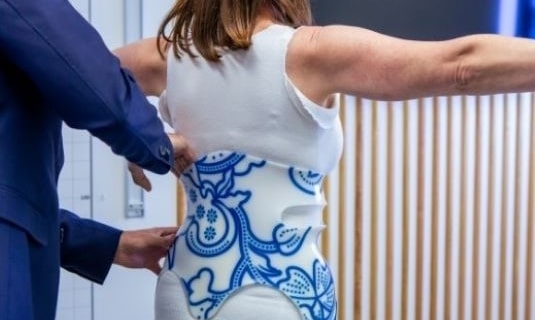
ScoliCare Clinics around the world have been treating scoliosis in patients of all ages with scoliosis-specific chiropractic adjustments/techniques, the ScoliBalance® program, and the advanced 3D custom-made scoliosis brace: the ScoliBrace® (7).
Together, these disciplines complement one another and work towards significantly improving the spine’s alignment, the body’s 3-dimensional posture, and the spine’s surrounding muscle strength and balance.
The spine needs to be supported and stabilized by strong surrounding muscles, so improving core strength can mean taking pressure off the spine and its surroundings.
Nonsurgical scoliosis treatment focuses on the spine’s long-term health, so its approach to correcting the abnormal curvature prioritizes preserving the spine’s natural strength and function.
Conclusion
Scoliosis severity is determined by the size of the unnatural spinal curvature, and when it comes to the degree of scoliosis that requires surgery, it’s important to understand that there are two main scoliosis treatment approaches, one of which doesn’t involve surgery.
Curve size is measured in degrees, and for scoliosis to be considered severe, the Cobb angle is over 45-50 degrees and is continuing to progress. Scoliosis ranges from mild to moderate and severe scoliosis.
Spinal fusion surgery fuses the curve’s most-tilted vertebrae into one solid bone and stabilizes the spine’s position with metal rods attached to the spine with pedicle screws.
While spinal fusion holds a place in scoliosis treatment, in many cases, the risk and potential complications of spinal surgery can be avoided with a proactive nonsurgical treatment plan.
Scoliosis diagnosed early means the potential benefits of early detection are within reach, but only for patients whose treatment provider values a proactive response and customized nonsurgical treatment plan.
Here at ScoliCare, the scope of customized nonsurgical treatment that’s patient-centered and evidence-based may include significantly improving the spine and body’s alignment, posture, and stability.
References:
- Weinstein SL. The Natural History of Adolescent Idiopathic Scoliosis. J Pediatr Orthop. 2019 Jul;39(Issue 6, Supplement 1 Suppl 1):S44-S46. doi: 10.1097/BPO.0000000000001350. PMID: 31169647Dunn J, Henrikson NB, Morrison CC, et al
- Screening for Adolescent Idiopathic Scoliosis: A Systematic Evidence Review for the U.S. Preventive Services Task Force [Internet]. Rockville (MD): Agency for Healthcare Research and Quality (US); 2018 Jan. (Evidence Synthesis, No. 156.) Chapter 1, Introduction. Available from: https://www.ncbi.nlm.nih.gov/books/NBK493369/
- Wang, J., Zhang, J., Xu, R. et al. Measurement of scoliosis Cobb angle by end vertebra tilt angle method. J Orthop Surg Res 13, 223 (2018). https://doi.org/10.1186/s13018-018-0928-5
- Negrini S, Donzelli S, Aulisa AG, Czaprowski D, Schreiber S, de Mauroy JC, Diers H, Grivas TB, Knott P, Kotwicki T, Lebel A, Marti C, Maruyama T, O’Brien J, Price N, Parent E, Rigo M, Romano M, Stikeleather L, Wynne J, Zaina F. 2016 SOSORT guidelines: orthopaedic and rehabilitation treatment of idiopathic scoliosis during growth. Scoliosis Spinal Disord. 2018 Jan 10;13:3. doi: 10.1186/s13013-017-0145-8. PMID: 29435499; PMCID: PMC5795289
- Fan H, Wang Q, Huang Z, Sui W, Yang J, Deng Y, Yang J. Comparison of Functional Outcome and Quality of Life in Patients With Idiopathic Scoliosis Treated by Spinal Fusion. Medicine (Baltimore). 2016 May;95(19):e3289. doi: 10.1097/MD.0000000000003289. PMID: 27175629; PMCID: PMC4902471
- Cook CE, Garcia AN, Park C, Gottfried O. True Differences in Poor Outcome Risks Between Revision and Primary Lumbar Spine Surgeries. HSS J. 2021 Jul;17(2):192-199. doi: 10.1177/1556331621995136. Epub 2021 Mar 4. PMID: 34421430; PMCID: PMC8361594
- Marchese R, Du Plessis J, Pooke T, McAviney J. The Improvement of Trunk Muscle Endurance in Adolescents with Idiopathic Scoliosis Treated with ScoliBrace® and the ScoliBalance® Exercise Approach. J Clin Med. 2024 Jan 23;13(3):653. doi: 10.3390/jcm13030653. PMID: 38337346; PMCID: PMC10856658
The post What Degree of Scoliosis Requires Surgery? Explained appeared first on ScoliCare.