
Childhood scoliosis affects children of all ages, and adolescent idiopathic scoliosis is the most common type. Adult scoliosis is diagnosed once skeletal maturity is reached. The value of regular scoliosis screening examinations cannot be underestimated, particularly when risk factors, such as family history are present.
What parents need to know about childhood scoliosis is that it can be highly treatable, but early detection is key. As a leading spinal condition diagnosed in school-aged children, awareness of the early signs of scoliosis is crucial because it can lead to early detection and intervention.
Diagnosing scoliosis early means while it’s still mild and may be highly responsive; it means the opportunity to be proactive with treatment is within reach.
Early Detection
Early detection doesn’t guarantee successful treatment, but it does increase the scope of nonsurgical treatment.
An early diagnosis means diagnosing scoliosis early in its progressive line, while still mild.
What parents need to understand is that as a progressive condition, the nature of scoliosis is to become more severe, so even scoliosis diagnosed as mild doesn’t mean there is less need for treatment, or that it can unfold at a slower pace (1).
In fact, while scoliosis is mild is the best time to start treatment.
Scoliosis ranges from mild scoliosis to moderate and severe scoliosis, and when it comes to childhood scoliosis, the focus is on progression.
Progression is triggered by growth, and depending on the stage of growth a child is in at the time of diagnosis, this can help predict a patient’s potential rate of progression, and the more information, the better when it comes to crafting customized treatment plans (2).
Mild curves are simpler to treat, and as significant progression hasn’t yet occurred, there are less effects to improve and/or reverse, and as progression makes the spine more rigid, starting treatment early can mean when the spine is still flexible and likely to be the most responsive (2).
When it comes to children, knowing how to manage the scoliosis through growth is key, and with early detection, the opportunity to start treatment while scoliosis is mild and simplest to treat is there (2, 3).
 With early intervention, progression is more manageable, particularly in children for whom growth is constantly occurring; with early detection, it’s easier to stay ahead of progression (3).
Mild curves rarely stay mild, not without the help of proactive treatment.
A child’s initial assessment will be comprehensive, and if scoliosis is present, the degree of curve and the likelihood of progression is predicted.
Risk Factors
Scoliosis risk factors are variables that increase the likelihood of developing scoliosis, so if there are risk factors in place, this means a child is more likely to be diagnosed with scoliosis, so regular screening is recommended, particularly as periods of intense growth are approaching (2, 4).
A significant scoliosis risk factor is family history (4). One of the first questions I’m asked, after diagnosing a child, is what could have been done to prevent it, and if the parents passed the scoliosis down to the child.
What’s interesting about family history is that having another family member diagnosed does increase the likelihood of another diagnosis, but a clear genetic causative link has yet to be identified (4).
Considering the prevalence of childhood scoliosis, a lot of research has been done on the subject of idiopathic scoliosis etiology, but a specific gene, or genetic mutation, that causes the initial development of scoliosis hasn’t been found.
So why does scoliosis appear to run in families? Scoliosis is considered to be more familial than genetic.
Because scoliosis occurs more frequently within a family, it’s considered to be familial, and remember, families don’t just share genes; they share body type, appearance, posture, diet, lifestyle, sleep habits, socioeconomic factors, geographical factors, and more.
So it’s more accurate to say idiopathic scoliosis has multiple causes, rather than one single clear-known cause, and idiopathic scoliosis accounts for the majority of scoliosis cases.
If one child in the family has already received a scoliosis diagnosis, this is an indication that other children should be regularly screened for scoliosis during routine physical check ups; what this also means is that parents and/or caregivers need to be aware of the subtle early signs of scoliosis so they can be recognized and assessed (2, 4).
Additional risk factors include curve size, curve location and the type of curve (4) gender and age. Scoliosis is more commonly seen in girls and boys, and females are more likely to continue progressing and require more treatment, and as most scoliosis is diagnosed at the onset of puberty, children approaching the age of 10 with known risk factors should be regularly assessed (1)
So females approaching puberty with another family member diagnosed are the most at risk.
And what is the most common type of scoliosis to affect children?
Adolescent Idiopathic Scoliosis
Scoliosis can affect children of all ages, but the most prevalent form of scoliosis overall is adolescent scoliosis diagnosed (AIS) between the ages of 10 and 18 (1).
AIS is most often noticed around 11 or 12 years of age in females, and later in boys, and it’s estimated that up to 5 percent of adolescents will develop adolescent idiopathic scoliosis (1).
Adolescents are the age group most at risk for rapid advancement of the curve due to the rapid stage of growth they are in.
Adolescents have the best chance of correcting their scoliosis with treatment when it is applied early, when they are being treated as they grow, and this makes regular screening particularly important (2, 3).
So as scoliosis makes the spine bend and twist unnaturally, what are its early signs for parents to watch out for?
Early Signs of Childhood Scoliosis
Children have the most to gain from early detection, but they can be the most difficult to diagnose, and this is partially due to the sometimes subtle signs of mild scoliosis, and the lack of pain in some children.
Scoliosis in adolescents develops differently to scoliosis that develops later in life in older adults. Older adults living with a new onset of scoliosis often experience pain whereas adolescents don’t always experience pain (5, 6).
In children, pain can occur but it’s less common. This can make the scoliosis easy to miss (1, 6).
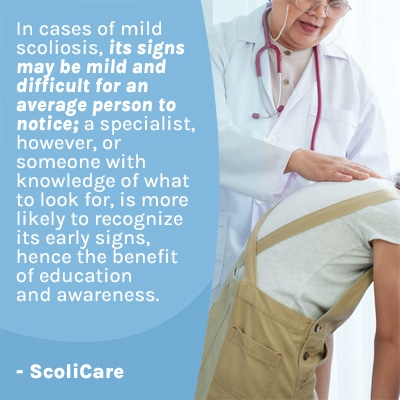 In cases of mild scoliosis, its signs may be mild and difficult for the patient, parent or caregiver to notice; a specialist, however, or someone with knowledge of what to look for, is more likely to recognize its early signs, hence the benefit of education and awareness.
In adolescents, the earliest signs of scoliosis are postural changes that disrupt the body’s overall symmetry:
- A head that’s uncentered over the torso
- An uneven eye line
- Uneven shoulders
- One shoulder blade protruding more on one side than the other
- A rib cage arch (one side protrudes more)
- Uneven hips
- Unequal arm and leg length
- A prominent rib cage on one side when the person bends over (2).
As progression occurs, these types of postural changes become more overt, which is why many cases of scoliosis aren’t diagnosed while mild, they’re diagnosed after they have progressed to moderate and/or severe and become more noticeable (2).
Changes to movement are also common including disruptions to how a child walks, stands (a prominent lean to one side), balances, and coordinates movement (2).
But after a significant amount of progression has already occurred, valuable time has been missed: the opportunity to start treatment while curves are mild and more responsive.
So does a single postural asymmetry guarantee a diagnosis of childhood scoliosis: not necessarily. But if there are postural changes occurring and there are known risk factors in place, this can warrant the need for regular screening and makes a diagnosis more likely.
Scoliosis Screening
Scoliosis screening involves a physical examination that looks for indicators that scoliosis is occurring (2).
Regular screening should be started early, prior to puberty, as management through growth is key, and considering the potential benefits of an early diagnosis, this is time well spent (2).f
A screening exam can be performed by a general practitioner or at a ScoliCare Clinic around the world.
A thorough examination involves taking a patient’s family history, medical history, performing a movement/postural assessment, and physical examination including an Adam’s forward bend test.
We can tell a lot about a patient’s spine by how they hold their bodies and move, and when patients are in a forward bend position, their spines and any related trunk asymmetries are highly visible.
When combined with the use of a scoliometer, a patient’s angle of trunk rotation (ATR) can also be assessed, and if scoliosis indicators are present, the need for further testing can be warranted, in the form of a scoliosis X-ray.
If an X-ray comes back confirming the presence of childhood scoliosis, the most important decision to be made is when to start treatment and the type of treatment to commit to.
Conclusion
When it comes to childhood scoliosis, what’s most important for parents to understand is the importance of screening and early detection.
While we don’t fully understand why most cases of childhood scoliosis develop initially, we know it’s growth that makes them progress, and we know how to respond with treatment.
There are never treatment guarantees, but particularly in cases of childhood scoliosis, early detection and intervention can mean starting treatment while scoliosis is still mild, curves are still minor and flexible, and are the most likely to respond well.
Even for children diagnosed as mild, because they are still experiencing growth, the scoliosis is unlikely to stay mild and can progress quickly, particularly once the rapid and unpredictable growth spurts of puberty start, and the more progression occurs, the harder it is to manage.
Many children with scoliosis respond well to a combination of scoliosis-specific exercise-based treatment, (ScoliBalance®) and corrective bracing (ScoliBrace®), but the earlier these treatment options are applied, the more effective they are likely to be – a watch and wait approach is not a treatment approach (2).
Mild childhood scoliosis is unlikely to stay mild, but it can be highly treatable, therefore early treatment leads to a higher rate of success (2).
The ScoliCare team prioritises education and awareness. We want more people to understand the benefits of early detection, intervention, and the steps it takes to get there.
References:
- Weinstein S. L. (2019). The Natural History of Adolescent Idiopathic Scoliosis. Journal of pediatric orthopedics, 39(Issue 6, Supplement 1 Suppl 1), S44–S46. https://doi.org/10.1097/BPO.0000000000001350
- Negrini S, Donzelli S, Aulisa AG, Czaprowski D, Schreiber S, de Mauroy JC, Diers H, Grivas TB, Knott P, Kotwicki T, Lebel A, Marti C, Maruyama T, O’Brien J, Price N, Parent E, Rigo M, Romano M, Stikeleather L, Wynne J, Zaina F. 2016 SOSORT guidelines: orthopaedic and rehabilitation treatment of idiopathic scoliosis during growth. Scoliosis Spinal Disord. 2018 Jan 10;13:3. doi: 10.1186/s13013-017-0145-8. PMID: 29435499; PMCID: PMC5795289
- Negrini, S., Grivas, T. B., Kotwicki, T., Maruyama, T., Rigo, M., Weiss, H. R., & members of the Scientific society On Scoliosis Orthopaedic and Rehabilitation Treatment (SOSORT) stefano. negrini@ isico. it. (2006). Why do we treat adolescent idiopathic scoliosis? What we want to obtain and to avoid for our patients. SOSORT 2005 Consensus paper. Scoliosis, 1(1), 4.
- Théroux, J., Stomski, N., Hodgetts, C.J. et al. Prevalence of low back pain in adolescents with idiopathic scoliosis: a systematic review. Chiropr Man Therap 25, 10 (2017). https://doi.org/10.1186/s12998-017-0143-1
- Lenz, M., Oikonomidis, S., Harland, A. et al. Scoliosis and Prognosis—a systematic review regarding patient-specific and radiological predictive factors for curve progression. Eur Spine J 30, 1813–1822 (2021). https://doi.org/10.1007/s00586-021-06817-0
- Zaina, F., Marchese, R., Donzelli, S., Cordani, C., Pulici, C., McAviney, J., & Negrini, S. (2023). Current Knowledge on the Different Characteristics of Back Pain in Adults with and without Scoliosis: A Systematic Review. Journal of Clinical Medicine, 12(16), 5182. https://doi.org/10.3390/jcm12165182
- Menger RP, Sin AH. Adolescent Idiopathic Scoliosis. [Updated 2023 Apr 3]. In: StatPearls [Internet]. Treasure Island (FL): StatPearls Publishing; 2025 Jan-. Available from: https://www.ncbi.nlm.nih.gov/books/NBK499908/
- Dunn J, Henrikson NB, Morrison CC, et al. Screening for Adolescent Idiopathic Scoliosis: A Systematic Evidence Review for the U.S. Preventive Services Task Force [Internet]. Rockville (MD): Agency for Healthcare Research and Quality (US); 2018 Jan. (Evidence Synthesis, No. 156.) Available from: https://www.ncbi.nlm.nih.gov/books/NBK493367/Konieczny MR, Senyurt H, Krauspe R. Epidemiology of adolescent idiopathic scoliosis. Journal of Children’s Orthopaedics. 2013;7(1):3-9
- Negrini S, Donzelli S, Aulisa AG, Czaprowski D, Schreiber S, de Mauroy JC, Diers H, Grivas TB, Knott P, Kotwicki T, Lebel A, Marti C, Maruyama T, O’Brien J, Price N, Parent E, Rigo M, Romano M, Stikeleather L, Wynne J, Zaina F. 2016 SOSORT guidelines: orthopaedic and rehabilitation treatment of idiopathic scoliosis during growth. Scoliosis Spinal Disord. 2018 Jan 10;13:3. doi: 10.1186/s13013-017-0145-8. PMID: 29435499; PMCID: PMC5795289
- Konieczny MR, Senyurt H, Krauspe R. Epidemiology of adolescent idiopathic scoliosis. Journal of Children’s Orthopaedics. 2013;7(1):3-9
- Marty-Poumarat, Catherine MD*; Scattin, Luciana MD†; Marpeau, Michèle MD*; Garreau de Loubresse, Christian MD‡; Aegerter, Philippe MD, PhD§. Natural History of Progressive Adult Scoliosis. Spine 32(11):p 1227-1234, May 15, 2007. | DOI: 10.1097/01.brs.0000263328.89135.a6
- Hong KS, Van Minh P, Nguyen HT, Phan MH, Nguyen HN, Pham TP. Re-evaluation of Incorrect Posture as a Diagnostic Criterion for Scoliosis in School Screenings: A Cross-Sectional Study in Vietnam. Cureus. 2025 Mar 31;17(3):e81535. doi: 10.7759/cureus.81535. PMID: 40314041; PMCID: PMC12043434